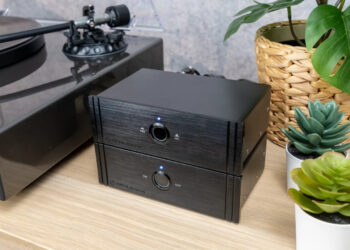


EAT is expanding its balanced phono stage lineup with two new models, the EAT E-Glo SB and EAT E-Glo CB, bringing the fully balanced architecture of the flagship E-Glo FB to a broader segment of the high-end analog market. Distributed in North America by VANA Ltd., the EAT E-Glo SB and CB combine balanced XLR connectivity, discrete circuitry and dual-mono construction in EAT’s familiar full-width chassis.
A Shared Balanced Platform
Positioned between the compact Petit B and the reference E-Glo FB, the EAT E-Glo SB and CB share a three-gain-stage topology. The first stage uses three discrete semiconductor operational amplifiers, one each for the positive and negative phase and a third that sums both outputs, cancelling common-mode noise and applying high-frequency RIAA equalization. The final output stage converts the unbalanced signal to a balanced one through a dual discrete operational amplifier, with dedicated DC servo circuits keeping output offset low. Both models support balanced XLR connectivity for MM and MC cartridges, cartridge-loading adjustments, gain from 40dB to 70dB, and simultaneous RCA and XLR outputs.
Two Different Second Stages
Where the EAT E-Glo SB and CB diverge is in the second gain stage. The E-Glo SB moves closest to the flagship’s design, with a fully balanced tube-based second stage built around two ECC83S and two E88CC triodes. The E-Glo CB instead uses a hybrid single-ended tube-transistor stage, pairing two ECC83S triodes with one transistor, and adds the low-frequency RIAA boost together with a switchable subsonic filter.

“Balanced phono stages still aren’t common, especially tube-based ones,” said Roy Feldstein, Chief Technology Officer at VANA Ltd. “What I like about the CB and SB models is that EAT didn’t simply strip features out of a flagship model. These are two truly thoughtful designs that derive from the same philosophy behind the reference model.”
Built in Prague and Vienna
Like the rest of the EAT range, the E-Glo SB and E-Glo CB are designed and manufactured in Prague and Vienna, with each model treated as its own creation rather than a scaled-down flagship. For owners exploring balanced phono amplification for the first time, the pairing offers two distinct entry points into the same design philosophy that underpins the reference E-Glo FB — the kind of careful cartridge-matching that also mattered in our recent coverage of the Audio-Technica AT-MCD1 moving-coil cartridge.

The launch lands amid renewed enthusiast interest in dedicated phono amplification, as more vinyl listeners look to move beyond the basic phono input built into an integrated amplifier. By offering the EAT E-Glo SB and CB as two distinct, fully balanced designs rather than a single stripped-down flagship variant, EAT gives dealers a way to match the amplification stage to a customer’s cartridge, tonearm and budget without sacrificing the balanced signal path that defines the E-Glo family.
Pricing and availability
The EAT E-Glo CB carries a U.S. SRP of $4,599, while the EAT E-Glo SB is priced at $6,250. Both are available now through VANA Ltd.’s North American dealer network. Further information on the full range is available at europeanaudioteam.com.

Key specifications
- Topology: three gain stages, fully balanced XLR in/out
- EAT E-Glo SB second stage: fully balanced tube-based, two ECC83S + two E88CC triodes
- EAT E-Glo CB second stage: hybrid tube-transistor, two ECC83S triodes + one transistor, switchable subsonic filter
- Cartridge support: MM and MC, extensive loading adjustments
- Gain range: 40dB – 70dB
- Construction: dual-mono, simultaneous RCA and XLR outputs
- Pricing: EAT E-Glo CB $4,599 · EAT E-Glo SB $6,250
For dealers and enthusiasts choosing between the two, the EAT E-Glo SB and CB share the same chassis and connectivity options but target different budgets and sonic priorities: the tube-based SB leans into the flagship E-Glo FB’s fully valve-driven character, while the hybrid CB offers a more affordable, transistor-assisted entry into EAT’s balanced phono stage line