

The verdict
The Atoll Electronique IN400 Evolution is an integrated amplifier that scores 9.3/10 in our testing — it drives demanding speakers with real authority and headroom to spare. Best for listeners who value dynamic punch over convenience features; check remote compatibility before buying, since Atoll doesn't include a dedicated one.
- Effortless macro-dynamics
- No purpose-built remote
Welcome to our Atoll Electronique IN400 Evolution review. The modern integrated amplifier category has become increasingly crowded with products that attempt to be everything at once. The result is that streaming platforms, DACs, HDMI boards, colour displays, meters, room correction, apps, are often all crammed into a single chassis. While this approach can appeal to listeners looking for convenience, it frequently comes at the expense of signal purity, engineering focus, and ultimately musical engagement. Fortunately, Atoll Electronique’s new IN400 Evolution (EVO) integrated amplifier, a true dual-mono design, takes a very different approach.
This is a pure two-channel integrated amplifier, unapologetically focused on sound quality above all else. There is no built-in streamer, no DAC as standard, and no visual gimmickry. Instead, Atoll has invested its resources where they matter most: circuit design, power supply architecture, mechanical rigidity, and current delivery. It’s an amplifier that reminds you what exceptional design can achieve when the focus is on sonic performance and not features.
After several weeks of critical listening in my reference system and extensive direct comparison with my long-standing reference integrated amplifier, the Kinki Studios EX-M1+, the conclusion was clear. The Atoll IN400 Evolution delivers the most convincing dynamics I have heard from an integrated amplifier anywhere near its price, and it does so while remaining musically engaging, refined, and emotionally communicative.

In fact, its performance left such an impression that it ultimately replaced the Kinki EX-M1+ as my reference integrated amplifier.
Atoll Electronique: A French Company Built Around Music
Atoll Electronique was founded in 1997 in France by brothers Stéphane and Emmanuel Dubreuil, both lifelong music lovers who felt that the high-end market had lost sight of a core principle: musical truth delivered at a rational price. Stéphane’s earlier experience working at Triangle, a French manufacturer that has been developing, designing and assembling high-fidelity speakers for over 40 years, proved formative, giving him firsthand insight into loudspeaker and electronics design and, more importantly, into how engineering choices directly influence musical perception.
The name Atoll itself offers insight into the company’s philosophy. The founders chose it out of a deep appreciation for Atoll islands, natural formations known for their beauty, balance, and clarity. Just as significantly, the surrounding ocean symbolizes free-flowing current, a concept that aligns directly with Atoll’s engineering priorities and its emphasis on unrestricted energy delivery through amplifier circuits.

From the beginning, Atoll set out to build equipment that was fundamentally musical rather than flashy. The company committed to assembling all products in France, sourcing the majority of components from European, American, and Japanese suppliers, and keeping signal paths as short and symmetrical as possible. Manual assembly, inspection, extended warm-up, and final listening tests are part of the process for every unit that leaves the factory.
All Atoll components are assembled at a single facility in Brécey, Normandy, a small town surrounded by forests and open pastureland. The setting may seem idyllic, but it also reflects Atoll’s mindset: create an environment where engineers and technicians can focus on building equipment meant to serve music, not marketing trends. The facility includes a dedicated listening room treated with Vicoustic acoustic panels, reinforcing the belief that measurements and listening must go hand in hand.
The IN400 Evolution: Engineering with Intent
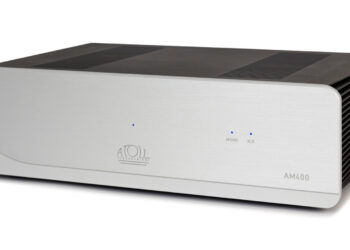
The IN400 Evolution integrated amplifier delivers 160W/8Ω or 300W/4Ω and sells for $5,400 euros or $6999 (U.S.). Weighing 19.5 kg it represents a significant step forward from the earlier IN400 Signature. Rather than tweaking the existing platform, Atoll approached the EVO as an opportunity to refine stability, improve dynamic performance, and further reduce noise or interference that could obscure musical detail.
One of the key changes lies in a revised circuit architecture designed to be less sensitive to voltage variations, contributing to greater consistency and stability under real-world conditions. Link capacitors are now more thoroughly shielded to prevent electromagnetic interference from contaminating the audio signal, and the internal layout has been optimized to keep sensitive signal paths isolated from high-current sections of the amplifier.

Atoll also redesigned the control circuitry, adding a dedicated power supply for the control logic and allowing users to choose between low-consumption standby and a preheating mode that keeps the amplifier thermally stable for immediate listening. Practical refinements such as an additional balanced XLR input and the ability to rename inputs reflect Atoll’s desire to improve usability without compromising sonic integrity.
Circuit Topology and Technical Foundations
At its core, the IN400 Evolution employs fully discrete, symmetrical circuits with very low global feedback. Rather than relying on heavy feedback to achieve linearity, Atoll stabilizes the amplifier using local feedback, high current polarization, and precise current generators. This approach preserves speed and dynamics while maintaining tonal coherence.
A new four-layer printed circuit board with nickel-gold finishing plays a critical role here. The additional layers allow Atoll to better isolate strategic signal paths, improve grounding, and enlarge PCB traces in the audio path. The audible result is lower intermodulation distortion, greater thermal stability, and improved dynamic headroom.
The output stage uses eight rigorously matched MOSFETs per channel. Matching is crucial, as it ensures that current is distributed evenly across the output devices. When this balance is achieved, the amplifier not only feels more powerful and dynamically convincing, but it also operates more reliably and consistently over time.
The amplifier’s extremely fast 2 µs rise time is a direct consequence of its wide bandwidth, circuit architecture, and relatively high bias current. This speed translates into exceptional transient response, clarity, and a sense of immediacy that becomes particularly apparent on complex or rhythmically demanding material.
Build Quality and Mechanical Damping
Physically, the IN400 Evolution is a serious piece of hardware. The chassis is constructed from 2 mm steel, while the front panel is a substantial 10 mm slab of brushed, micro-blasted, anodized aluminum. The side-mounted heatsinks are machined from solid aluminum blocks, serving both thermal and mechanical purposes.

Mechanical damping plays a meaningful role in the amplifier’s sonic performance. The rigidity of the chassis and the vibration-damping treatments applied to the heatsinks and top cover help eliminate micro-resonances that can subtly blur fine detail. The end result is a lower noise floor and improved microdynamic resolution, qualities that are readily audible during quiet passages and low-level listening.
Reference System and Evaluation Context
All listening was conducted using my reference system, which consists of the PS Audio AirLens streamer feeding the PS Audio StellarGold DAC, paired with Revival Audio’s Atalante 3 loudspeakers. This system is revealing, dynamically capable, and well suited to exposing differences between high-performance amplifiers.
The IN400 Evolution was compared directly against my long-term reference integrated amplifier, the Kinki Studios EX-M1+, using matched levels and identical cabling.
Overall Sonic Character: Power with Poise
The defining characteristic of the Atoll IN400 Evolution is its sense of effortless authority. This is an amplifier that never sounds strained, even when driving demanding material at high listening levels. Dynamics, both macro and micro, are reproduced with a natural ease that makes music feel alive rather than merely reproduced.
Compared to the Kinki EX-M1+, the Atoll consistently sounded more dynamically expressive, more controlled in the bass, and more revealing of low-level detail. Just as importantly, it maintained these strengths at lower listening levels, where many amplifiers begin to lose their coherence and emotional impact.
Track-by-Track Listening Evaluation
Dire Straits – “Telegraph Road”
Qobuz | 24-bit / 192 kHz
“Telegraph Road” is a long-form dynamic workout that exposes an amplifier’s ability to scale energy, texture, and emotional momentum over time. Through the IN400 Evolution, the opening atmospheric cues emerged from a deep, quiet background, with spatial information rendered clearly and naturally. The sense of dimensionality in the early passages was immediately apparent, as low-level details floated freely within a convincingly layered soundstage.
As the track built toward its climactic moments, the Atoll expanded the soundstage in all directions, maintaining separation and control even as the music grew dense and powerful. Mark Knopfler’s guitar retained bite and articulation without ever sounding etched, while the rhythmic foundation remained locked in and unwavering. The sense of dynamic release at the peak of the song was thrilling and emotionally satisfying, delivered with an ease that suggested substantial power reserves still in hand.
Switching to the Kinki EX-M1+ revealed a slightly more constrained presentation by comparison. While still engaging, the Kinki did not deliver the same sense of dynamic freedom or scale, particularly during the most demanding crescendos, where the Atoll sounded both more expansive and more relaxed.
Patricia Barber – “Company”
Tidal | 24-bit / 96 kHz
This track highlights an amplifier’s ability to reproduce subtle dynamic shifts, vocal nuance, and harmonic shading. The IN400 Evolution rendered Barber’s voice with exceptional intimacy, capturing breath, phrasing, and tonal inflections without exaggeration or artificial warmth. Her voice occupied a clearly defined space between the speakers, with piano and bass arranged naturally around her.

What stood out most was the amplifier’s performance at low listening levels. Even late at night, with the volume dialed well back, the emotional core of the performance remained intact. Microdynamic shifts were preserved, and the decay of notes lingered convincingly in the acoustic space. The Kinki EX-M1+ sounded smooth and musical, but it did not convey the same degree of inner detail, low-level resolution, or three-dimensionality in direct comparison.
Hans Zimmer – “Why So Serious?”
Qobuz | 24-bit / 96 kHz
Low-frequency control is a defining strength of the IN400 Evolution, and this track made that immediately clear. Deep bass notes were delivered with authority and precision, energizing the room without ever becoming bloated, loose, or diffuse. The amplifier maintained iron-fisted control over the woofers, even as sustained low-frequency passages challenged both the speakers and the room.
Equally impressive was how well the Atoll preserved upper-register detail and spatial cues during these moments of extreme bass energy. Percussion and auxiliary effects emerged cleanly, with each sound occupying a distinct spatial position. Compared to the EX-M1+, the Atoll demonstrated superior composure, maintaining clarity and texture while projecting a larger, more immersive soundfield.
Keith Jarrett – “The Köln Concert, Part I”
Tidal | 16-bit / 44.1 kHz
Solo piano places enormous demands on tonal accuracy, harmonic integrity, and dynamic shading. The IN400 Evolution captured the full body of the instrument, from the initial transient attack to the lingering decay of notes within the hall. There was a natural sense of weight to the lower registers and an airy openness to the upper octaves that made the performance feel unforced and organic.
In comparison, the Kinki EX-M1+ sounded slightly less harmonically complete, with a marginally flatter sense of resonance and spatial bloom. The Atoll conveyed a more believable impression of a real piano occupying a real acoustic environment, allowing subtle interactions between overtones to be heard clearly.
Tool – “Chocolate Chip Trip”
Qobuz | 24-bit / 48 kHz
This track showcased the IN400 Evolution’s speed, imaging precision, and transient accuracy. Percussive attacks were reproduced with startling immediacy, and complex rhythmic layers were easy to follow within a stable, well-defined soundstage. Individual effects moved through space with pinpoint localization, never collapsing into congestion.

The Atoll’s fast rise time and exceptional current delivery gave the music a sense of propulsion and rhythmic certainty that surpassed the EX-M1+, particularly during the most complex passages. Instruments and effects maintained clarity even during dense sections, making this amplifier feel effortlessly responsive and alive.
Soundstage, Imaging, and Tonal Balance
The IN400 Evolution consistently produced a wide, deep, and stable soundstage. Imaging was precise without sounding etched, and tonal balance was neutral yet musically satisfying. Bass was deep and tightly controlled, the midrange rich and textured, and the treble extended without edge or glare.
Perhaps the most impressive aspect of the IN400 Evolution is how engaging it remains at low volumes. Many powerful amplifiers only come alive when pushed; the Atoll delivers emotional impact and dynamic contrast even when played quietly. This makes it ideal for everyday use, even when you need to keep the volume in check for neighbours or housemate. I found the absence of built-in streaming, DACs, or displays a deliberate and welcome choice. Atoll has clearly prioritized sound quality over feature lists, while still offering optional DAC and phono modules for those who want them. You are not forced to pay for functionality you do not need.
Specifications
- Power: 2×160 Wrms / 8Ω – 2×300 Wrms / 4Ω
- Total of capacitors: 96 680 µF
- Bandwidth (-3 dB): 5 Hz – 100 kHz
- Rise time: 2 µs
- Input impedance: 357 kΩ
- Sensitivity: 450 mV
- Signal-to-noise ratio: 100 dB
- Distortion rate at 1 kHz: 0,05 %
- Standby consumption (low consumption): < 0,5 W
- Dimensions: 440×370×130 mm
- Weight: 19.5 Kg
Pricing
The price of the Atoll IN400 Evolution integrated amplifier is 5.400 EUR at the time of the review.

Tracklist
- Dire Straits – “Telegraph Road” – Qobuz | 24-bit / 192 kHz
- Patricia Barber – “Company” – Tidal | 24-bit / 96 kHz
- Hans Zimmer – “Why So Serious?”- Qobuz | 24-bit / 96 kHz
- Keith Jarrett – “The Köln Concert, Part I” – Tidal | 16-bit / 44.1 kHz
- Tool – “Chocolate Chip Trip” – Qobuz | 24-bit / 48 kHz
Hardware checklist
- Kinki Studios EX-M1+ integrated amp
- Atoll IN400 Evolution integrated amp
- Revival Audio Atalante 3 speakers
- PS Audio AirLens streamer
- PS Audio StellarGold DAC
- Supra sword Excalibur speaker cables
- PS Audio PowerPlant 12
- GAIA I Neo isolation feet
- Synergistic Foundation SX 12 power cable
- Synergistic Foundation SX 10 power cable
If you’re also considering the Vitus Audio SIA-025, see our full review.
Frequently asked questions
How much does the Atoll IN400 Evolution cost?
5.400 EUR at the time of review.
Does the IN400 Evolution include a built-in DAC or streamer?
No — it’s a pure two-channel integrated amplifier with no built-in streamer and no DAC as standard, though optional DAC and phono modules are available.
How much power does it deliver?
2×160W into 8Ω, or 2×300W into 4Ω, from a true dual-mono design.
Where is the Atoll IN400 Evolution made?
It’s assembled by hand at Atoll’s own facility in Brécey, Normandy, France, with manual assembly, inspection, extended warm-up and final listening tests for every unit.
How does it compare to the reviewer’s previous reference amplifier?
In direct comparison with the Kinki Studios EX-M1+, the Atoll delivered more dynamically expressive sound, better bass control, and more low-level detail — enough that it replaced the Kinki as the reviewer’s new reference integrated amplifier.
Atoll IN400 Evolution integrated amplifier
5.400 EURThe Atoll IN400 Evolution is a compelling reminder of what is possible when engineering focus and musical priorities align. It delivers exceptional dynamics, superb low-level resolution, authoritative bass, and a level of musical engagement that kept me listening long into the night. In direct comparison, it outperformed my Kinki Studios EX-M1+ in every meaningful way and has earned its place as my new reference integrated amplifier. For listeners who value music over menus and performance over features, the Atoll IN400 Evolution deserves the strongest possible recommendation.

Pros
- Effortless macro-dynamics
- Superb dynamic nuance
- Deep, authoritative and tight bass
- Drives demanding speakers with ease
- Never sounds strained or compressed
- Neutral yet organic tonal balance
- Harmonic richness, spatial, emotional impact across genres
- Optional DAC and phono modules
- Competes with more expensive integrated amps
Cons
- No purpose-built remote
- Lack of tone controls


The Atoll Electronique IN400 Evolution is an integrated amplifier that scores 9.3/10 in our testing — it drives demanding speakers with real authority and headroom to spare. Best for listeners who value dynamic punch over convenience features; check remote compatibility before buying, since Atoll doesn't include a dedicated one.
What we loved
- +Effortless macro-dynamics
- +Superb dynamic nuance
- +Deep, authoritative and tight bass
- +Drives demanding speakers with ease
- +Never sounds strained or compressed
- +Neutral yet organic tonal balance
- +Harmonic richness, spatial, emotional impact across genres
- +Optional DAC and phono modules
- +Competes with more expensive integrated amps
Worth considering
- –No purpose-built remote
- –Lack of tone controls
Compare more
Other amplifiers we've tested
 9.5/10AmplifiersStormAudio Core 16+ reviewPerformance93Features100Build90Value100Reference sound performanceSeamless Dirac integrationOnly available in blackRead the review
 9.0/10AmplifiersGold Note HP-10 Deluxe headphone amplifier reviewPerformance90Features100Build80Value80Immersive sound experienceCustom adjustable sound profilesDistinct difference between analog, Bluetooth and USB-CRead the review
 9.7/10AmplifiersLyngdorf MXA-8400 8-channel Power Amplifier reviewPerformance97Features95Build100Value100PowerhouseFantastic controlOnly XLR (analog) inputsRead the review