

The verdict
The Bowers & Wilkins 803 D5 is a three-way floorstanding loudspeaker that scores 9.1/10 in our testing — an iconic, superbly built speaker with tight, full-bodied bass, a vivid midrange and a velvety treble, earning the Best of High End Award. Best for music lovers with a medium-sized living room who are prepared to partner it with powerful, high-quality amplification and cabling.
- Iconic design
- Prefers powerful amplification
Some brands sell you a product. A few change the course of your life. For me, Bowers & Wilkins belongs firmly in the second group. My love for hi-fi and high-end audio began with this British company, and with a loudspeaker that carried the same three digits as the one in this Bowers & Wilkins 803 D5 review.
Where it all began
It happened at a small audio show in a hotel in Hasselt, where a handful of local dealers were giving demonstrations in various meeting rooms. Wandering the corridors, I was drawn in by a sound I couldn’t ignore: dance music, played with a scale and impact I had never heard before. It came from the room of Radioskoop, a Bowers & Wilkins dealer from Maasmechelen, which was demonstrating the 803 Matrix. I was hooked on the spot.
When I moved to Hasselt to study, the spark became a fire. At Teba Hifi, the local Bowers & Wilkins dealer, I bought my first real loudspeakers: Vision floorstanders, designed by Bowers & Wilkins and built in the Far East. The dealer felt the 601 bookshelf sounded better, and he was right, but I was happy to trade a little midrange clarity for deep bass and the full spectrum.
From there, the brand stayed with me at every step: Vision bookshelves and 600 Series centres for a first home theatre, then the 803 Matrix and 801 Matrix, and eventually a fully treated attic cinema with no fewer than seven 800 Diamonds, the flagship of the time, and three DB1 subwoofers.
Drifting apart
In recent years, though, my interest cooled. Bowers & Wilkins passed through a succession of owners, and successive 800 Series updates felt to me more like cosmetic polish than fundamental progress. Meanwhile, our current listening room moved to Purifi driver technology, in Lyngdorf CUE-100 and Radiant Acoustics loudspeakers among others. Their dramatically lower distortion lets you see far deeper into the music; you literally have to revisit every reference track, because there is suddenly so much more to hear.
Back on the radar
That changed when Bowers & Wilkins found a new home at Harman, part of Samsung, and budgets were freed up for real development. The result is the 800 Series Diamond D5, the fifth Diamond generation, launched in the brand’s 60th anniversary year. An invitation to visit Bowers & Wilkins in England, with a direct comparison between D4 and D5, made it clear that real steps had been taken. Read our report from the listening sessions and our interview with Andy Kerr.
Still, with ears tuned to Purifi-level transparency, I was curious and a little sceptical. What can my first love deliver in 2026, in sound quality, performance and musical engagement?
Why the 803 D5
Of the whole range, the 803 D5 made the strongest impression on me in England. It is the most compact model to wear the Turbine Head, which lifts the midrange out of the main cabinet, something earlier 803 generations never had. The 804 D5 gives its midrange its own chamber inside the cabinet, but the Turbine Head is a serious step up: the midrange breaks free and the whole speaker sounds more open. Add the iconic looks, and for the average living room I believe it is simply the golden choice. So the brand crossed my path once again. Time to find out whether the old flame still burns.
About Bowers & Wilkins
Few loudspeaker brands carry as much history as Bowers & Wilkins. The company was founded in 1966 in Worthing, on England’s south coast, by John Bowers, a passionate lover of classical music who had been running an electronics shop in the town with Roy Wilkins. Legend has it that a £10,000 legacy from a satisfied customer gave him the means to start building loudspeakers of his own. The first model, the P1, followed soon after.
From the start, Bowers & Wilkins set itself apart through research rather than fashion. In 1970 the DM70 combined an electrostatic mid and treble section with a conventional bass unit. In the mid-1970s the company pioneered woven Kevlar cones, which became a B&W signature for decades. In 1979 the original 800 Series arrived, and Abbey Road Studios adopted Bowers & Wilkins monitors, a relationship that continues today.
The 1993 Nautilus, with its spiralling tapered tube, turned the company’s ideas about cabinet resonance and rear-wave absorption into sculpture, and much of that thinking still runs through the 800 Series. The tweeter-on-top, the tapering tube behind it and the Turbine Head all trace back to that research.
In 2005 Bowers & Wilkins introduced its diamond dome tweeter, and with every generation since, the 800 Series has been the place where the company shows what it can do. The D5 is the fifth generation to use the diamond dome. The 800 Series is still built in the brand’s own factory in England.
The past decade was turbulent. After the Atkins era, the company changed hands several times: EVA Automation in 2016, Sound United in 2020 and Masimo in 2022. In September 2025, Harman, a subsidiary of Samsung Electronics, completed its acquisition of Sound United, bringing Bowers & Wilkins together with Denon, Marantz and others under a group with deep roots in audio. The 800 Series Diamond D5, launched in the brand’s 60th anniversary year, is the first flagship range to appear under the new ownership.
The philosophy behind the 803 D5
Bowers & Wilkins sums up its aim in two words: True Sound. The idea is that a loudspeaker should add nothing and take nothing away, reproducing a recording exactly as the artist and the engineer heard it in the studio. A principle often credited to John Bowers puts it well: the best loudspeaker isn’t the one that gives the most; it’s the one that loses the least.
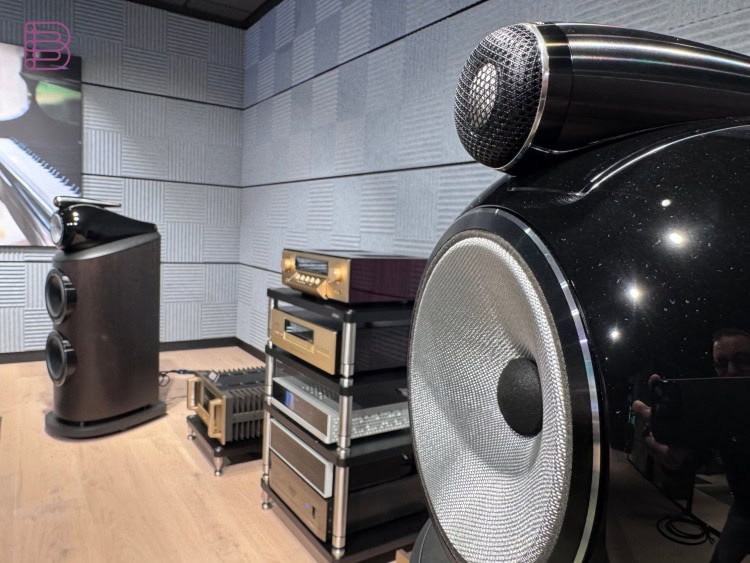
In practice that means fighting everything that colours the sound: resonating cabinets, breaking-up driver cones, diffraction around edges and interference between drivers. Every visible feature of the 803 D5 serves that goal. The curved cabinet is shaped to minimise internal standing waves and external reflections. The midrange sits in its own Turbine Head, decoupled from the bass cabinet. The diamond tweeter sits on top, free of the baffle, in a solid aluminium housing. And for the D5 generation, Bowers & Wilkins went further inside the cabinet, with aluminium Space Frame Bracing, a new aluminium top plate and motor systems borrowed from the Signature models.
Even the crossover gets the same treatment: it is mounted on the back of the cabinet, behind the aluminium spine, where its sensitive capacitors are isolated from the air pressure and vibration inside the enclosure. All of it serves the same purpose: lower distortion and less of the loudspeaker in the sound.
A day at Audiomix
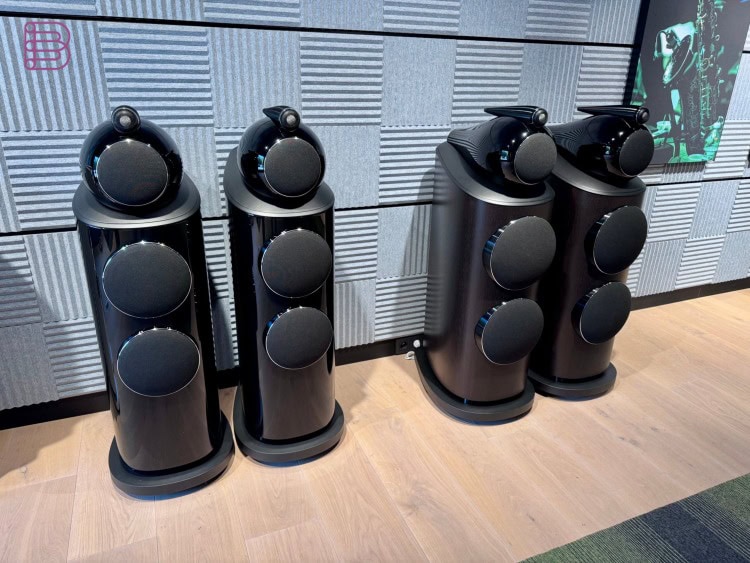
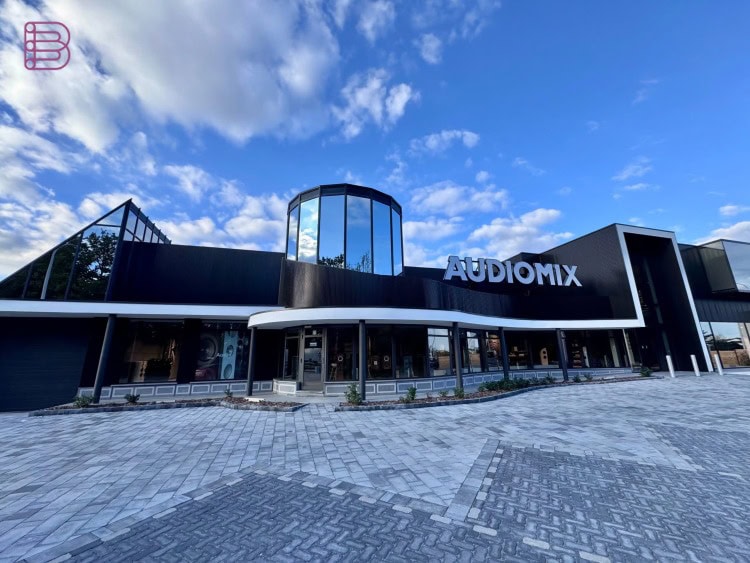
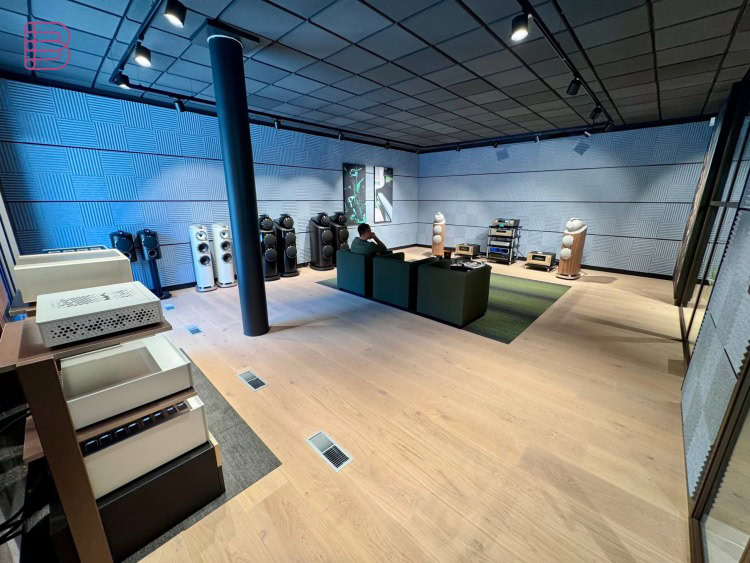
Ideally, we would have heard the 803 D5 in our own reference room at HQ, but with show season in full swing that wasn’t practical. The Eindhoven-based EU Bowers & Wilkins team suggested Audiomix in Begijnendijk instead, and it turned out to be an excellent call. The store has just been rebuilt, and its new master listening room houses every single model in the 800 Series Diamond D5 range. We were treated like royalty. I brought along my friend Rob Henckens, a fellow audiophile and Bowers & Wilkins enthusiast, because listening is always more rewarding with two.
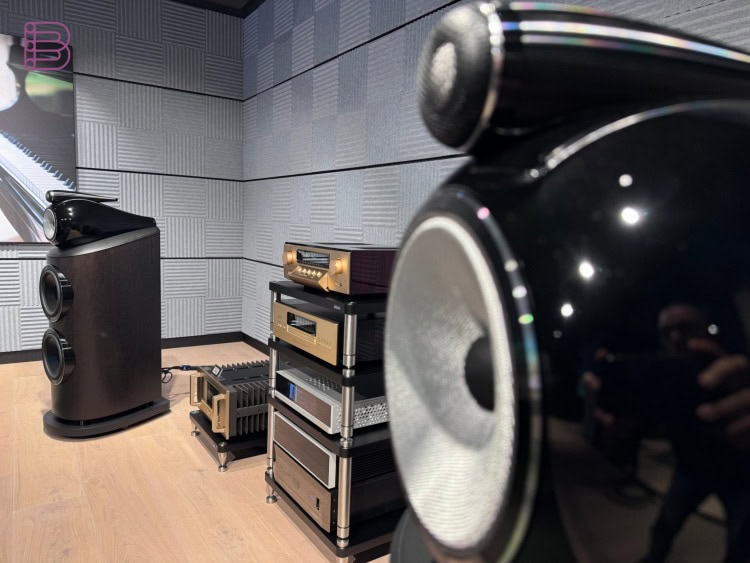
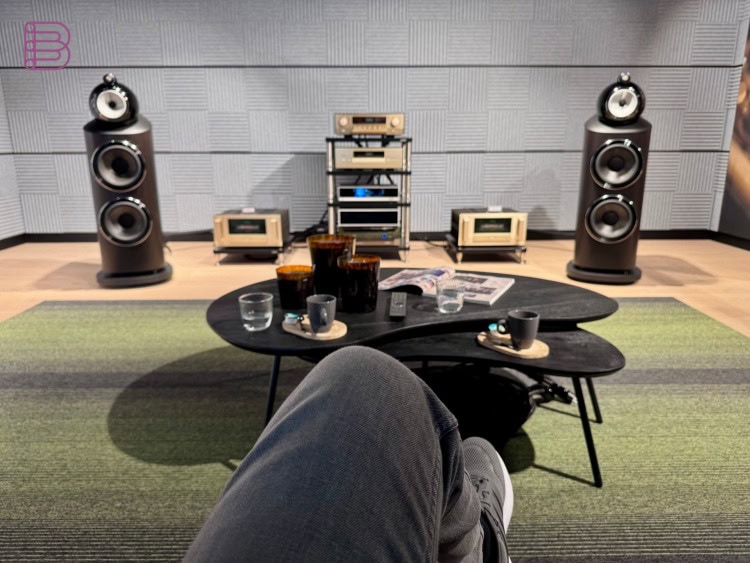
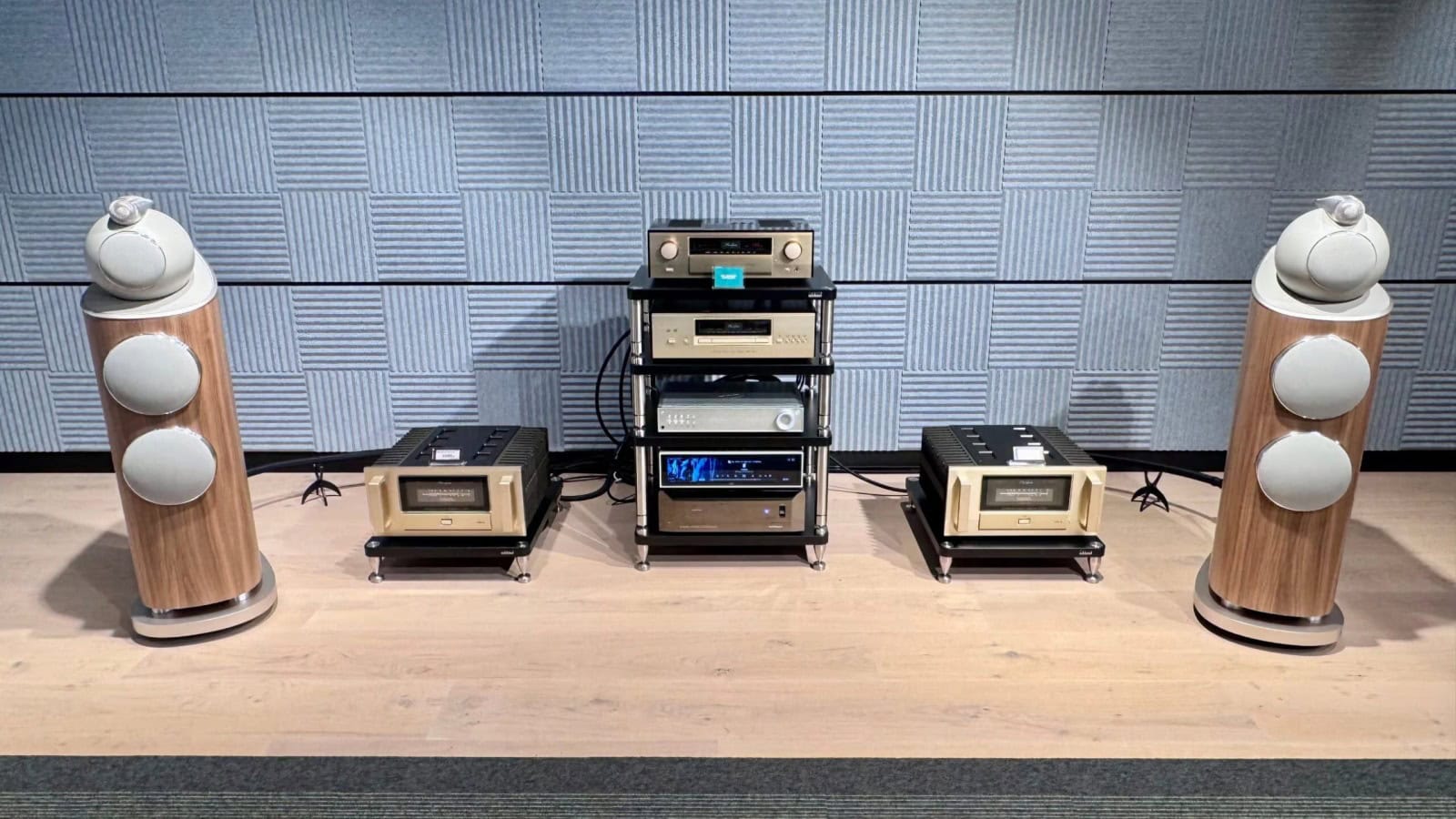
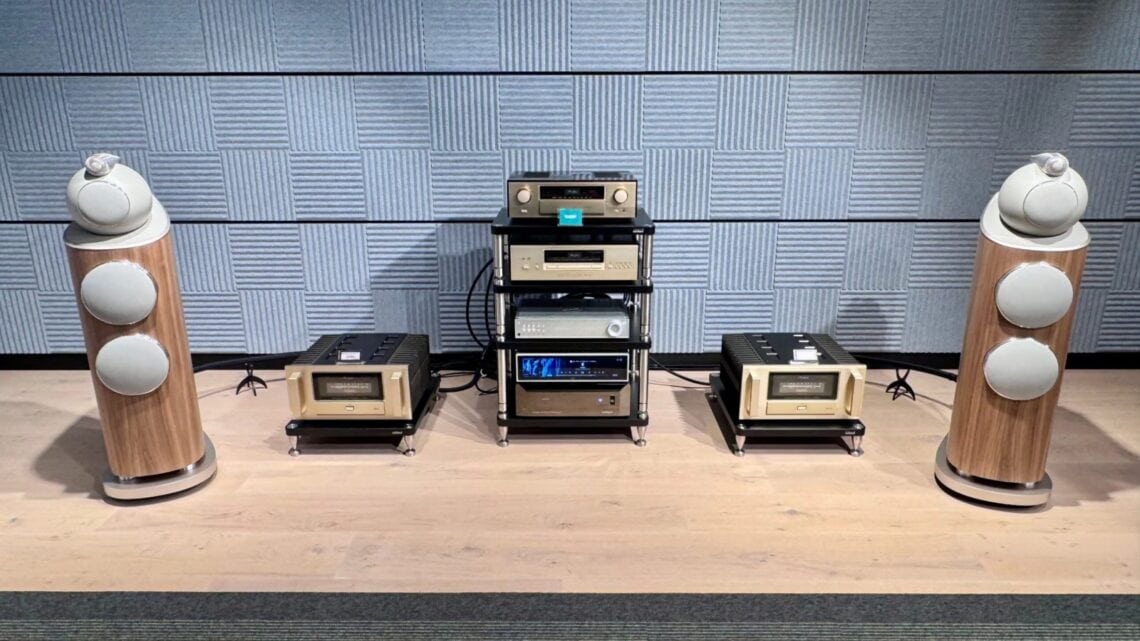
Jan Nelissen, HiFi & High End Advisor at Audiomix, let me choose four complete systems from the store’s high-end brands. Set one was ready when we arrived; the other three waited on mobile racks that were rolled into place one by one, with the speakers moved forward each time. Placement, AudioQuest cabling from near the top of the range and every connection were handled meticulously and double-checked. Jan was at our disposal whenever we had a question, and otherwise left us alone to work through our tracklist in peace. It felt like our own listening room, in a top location.
The acoustically treated room barely joined in below truly high levels, so we could judge the speakers on their own merits. And with systems ranging from sensibly priced to dream setups costing many times the price of the speakers, we could find out what the 803 D5 is truly capable of.
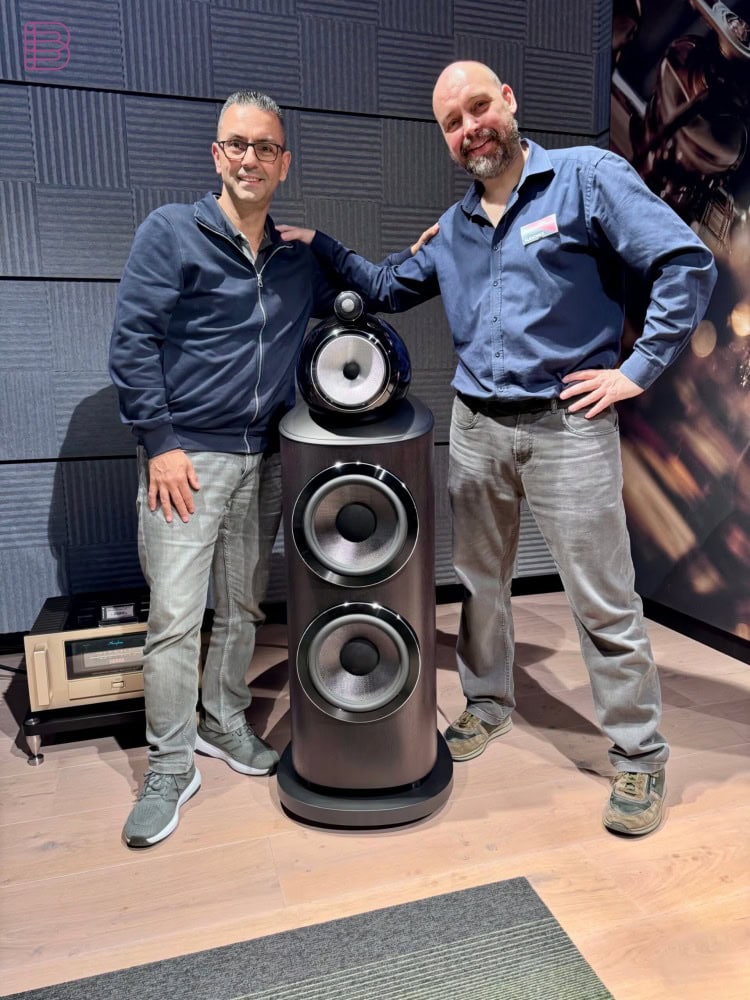
Many thanks to Audiomix for the outstanding support, and congratulations on the rebuild: a large, open, light-filled store with departments for TV, pro audio, home appliances, hi-fi and high-end, and even a bar inside. One of the top addresses in Belgium for high-end audio.
Introducing the 803 D5
The Bowers & Wilkins 803 D5 is a three-way, bass-reflex floorstanding loudspeaker and the third model in the five-strong stereo line-up of the 800 Series Diamond D5. At €30,000 per pair it sits below the 802 D5 (€37,000) and the flagship 801 D5 (€50,000), and above the 804 D5 (€18,000) and the 805 D5 standmount (€12,000).
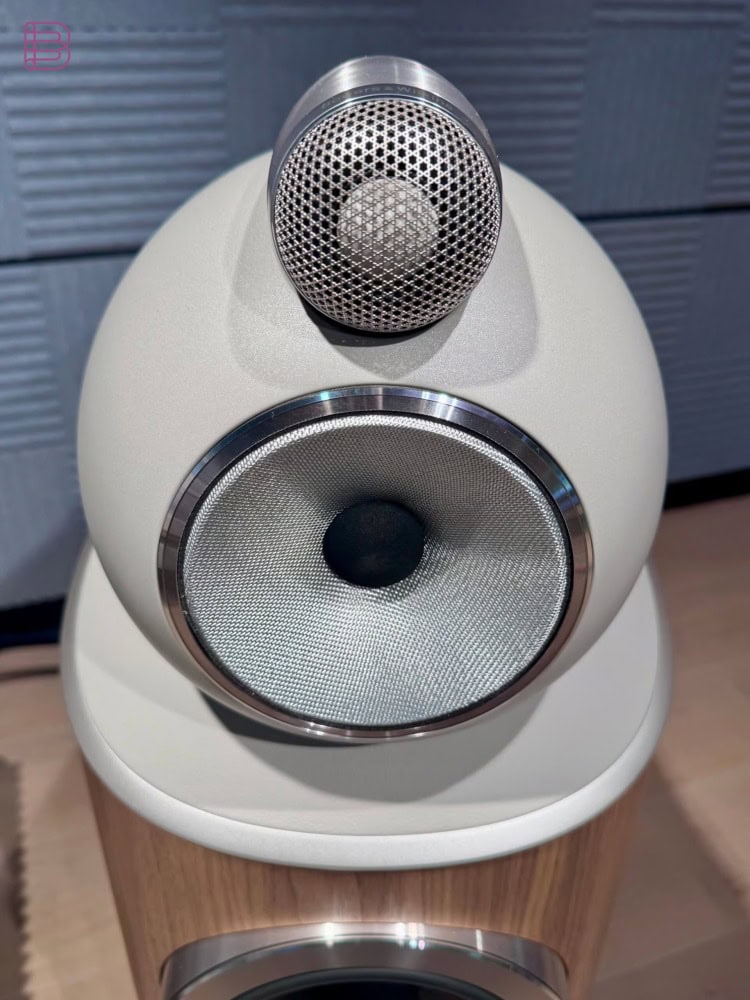
It is the smallest and most affordable model to wear the Turbine Head, which makes it, in many ways, the entry point to “real” 800 Series territory. In the wider market it competes in the €25,000–35,000 class of high-end floorstanders, alongside the likes of the KEF Blade Two Meta (€29,000), the Dynaudio Confidence 50 (€29,500), the Sonus faber Serafino G2 (€30,000), the Wilson Audio SabrinaX (from €31,990) and the Magico A5 (from €33,300). It is a segment in which buyers expect not just performance, but craftsmanship and a design statement, and each of these rivals brings its own answer: KEF’s Uni-Q point-source driver, Dynaudio’s Directivity Control, Sonus faber’s Italian craftsmanship, Wilson’s X-material cabinets and Magico’s sealed aluminium enclosures.
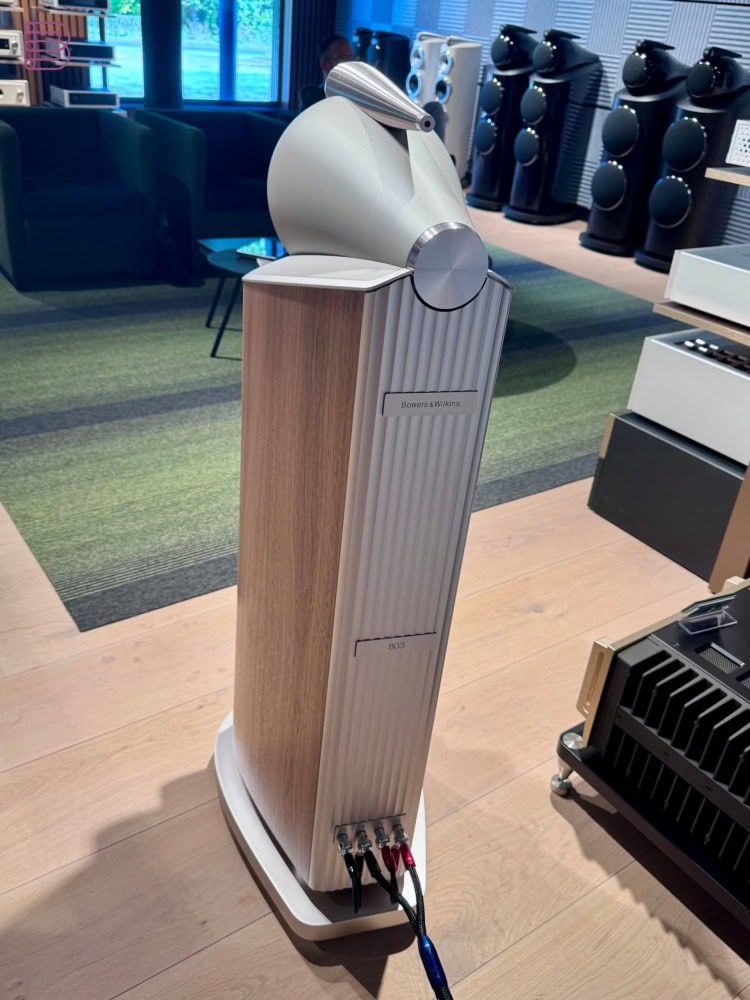
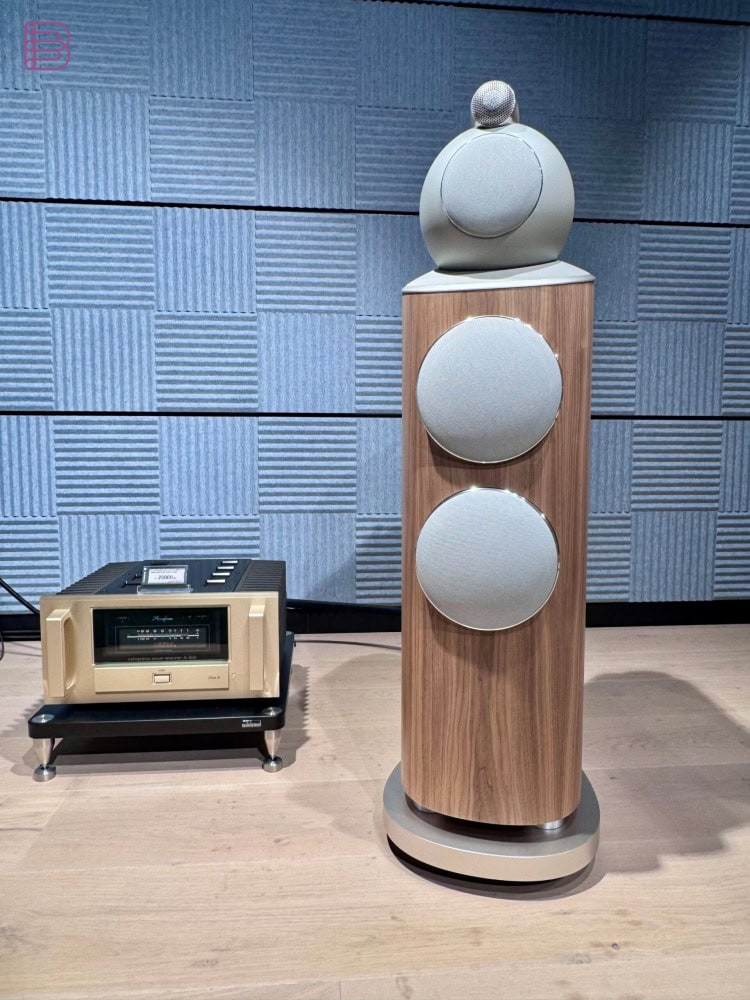
Our pair came in Light Walnut, one of four finishes alongside Stealth Black, Warm White and Dark Walnut. The warm wood veneer of the cabinet is paired with a light-grey Turbine Head, a satin aluminium top plate and a matching aluminium plinth, finished with Leather by Connolly trim. Up close, the build quality is beyond reproach: seams are tight, the veneer flows seamlessly around the curved cabinet, and the polished aluminium trim rings around the drivers catch the light beautifully.
Around the back, a ribbed aluminium spine runs from top to bottom and locks the curved cabinet in place. At 1,165 mm tall and 63.7 kg, it is a substantial speaker, yet its slim, tapering profile makes it look smaller than it is.
Drivers and technology
At the top sits the 25 mm diamond dome tweeter in its Solid Body Tweeter-on-Top housing, machined from aluminium. Diamond is extremely light and stiff, pushing the dome’s break-up frequency to 70 kHz, far above anything audible. Below it, the Turbine Head holds a 130 mm Continuum cone FST midrange. Continuum is a woven composite developed in-house to avoid the abrupt break-up behaviour of conventional cone materials, while the Biomimetic Suspension replaces a traditional fabric spider to reduce colouration. Because the Turbine Head is decoupled from the main cabinet, vibrations from the bass section barely reach the midrange.
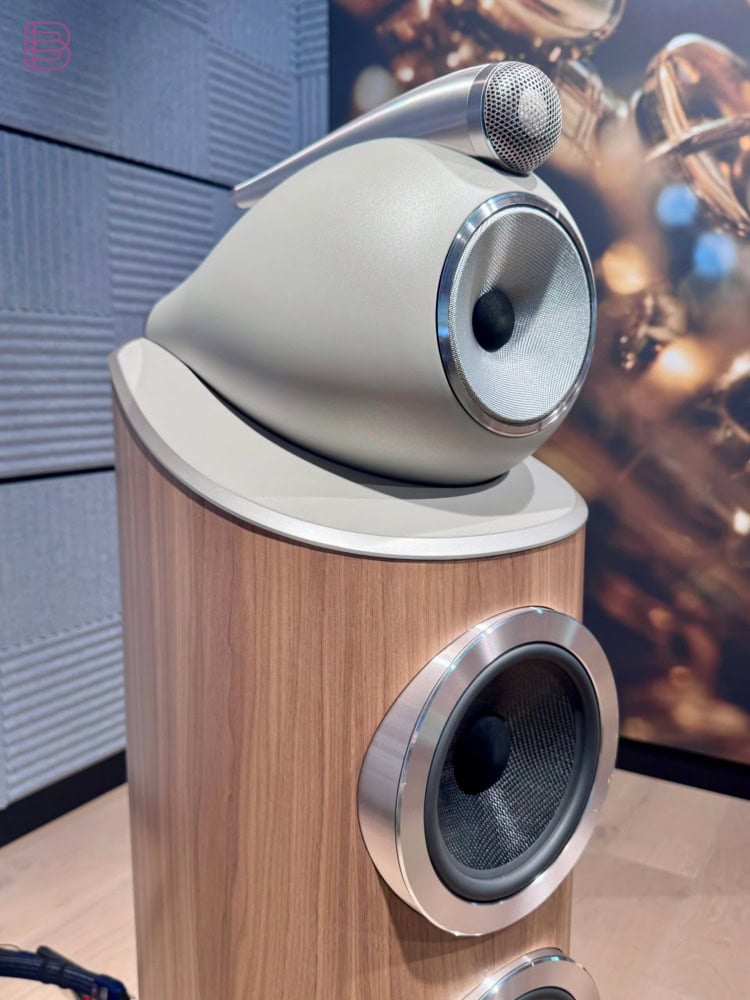
The main cabinet houses two 180 mm Aerofoil bass drivers, whose cones vary in thickness to remain stiff where it matters most. They are tuned with a dimpled Flowport, designed to reduce turbulence and port noise. Inside, the upgraded Matrix bracing is now joined by aluminium Space Frame Bracing rails and a new aluminium top plate with damping collar, while the plinth uses constrained-layer damping to keep the cabinet quiet at low frequencies. The motor systems of the midrange and bass drivers are derived from the 800 Series Signature models, aimed at lower distortion.
On paper, the 803 D5 reaches from 16 Hz to 35 kHz (−6 dB). With a sensitivity of 90 dB and a nominal impedance of 8 ohms, dipping to 3.0 ohms, it is not a hard load to drive at moderate levels, but those dips do reward an amplifier with a solid power supply and good current delivery. Bowers & Wilkins recommends 50 to 500 watts into 8 ohms.
Where it fits
The 803 D5 is designed first and foremost as a two-channel loudspeaker for medium-sized to larger listening rooms, delivering much of the 800 Series experience without the sheer bulk of the 802 D5 or 801 D5. It is equally at home in a home cinema: paired with the HTM82 D5 centre speaker, which Bowers & Wilkins designed for the 803 D5 and 804 D5, it forms the front stage of a reference-grade surround or immersive system.
Connections and practicalities
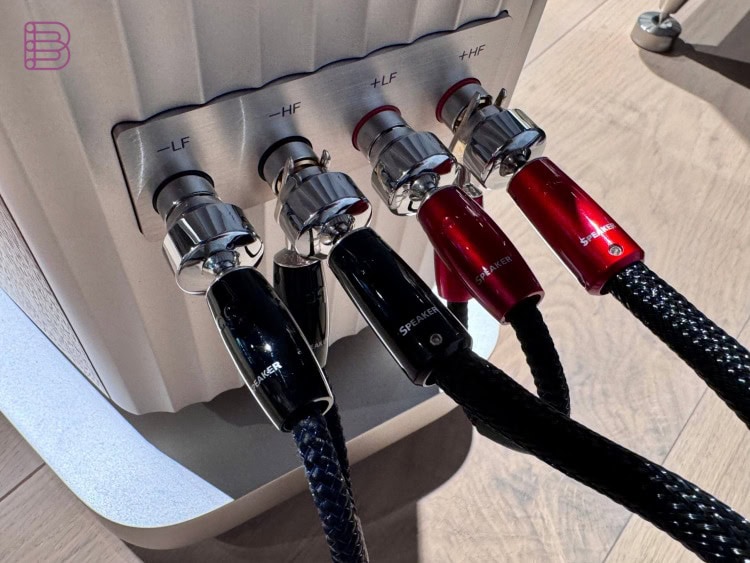
Connectivity is straightforward. The rear panel carries two pairs of high-quality binding posts, marked LF and HF, so the 803 D5 can be bi-wired or bi-amped. Jumpers for single-wire use are supplied, but during our sessions Jan replaced them with AudioQuest jumpers, connected to AudioQuest Thunderbird speaker cables. Bowers & Wilkins advises keeping the total cable impedance below 0.1 ohm.
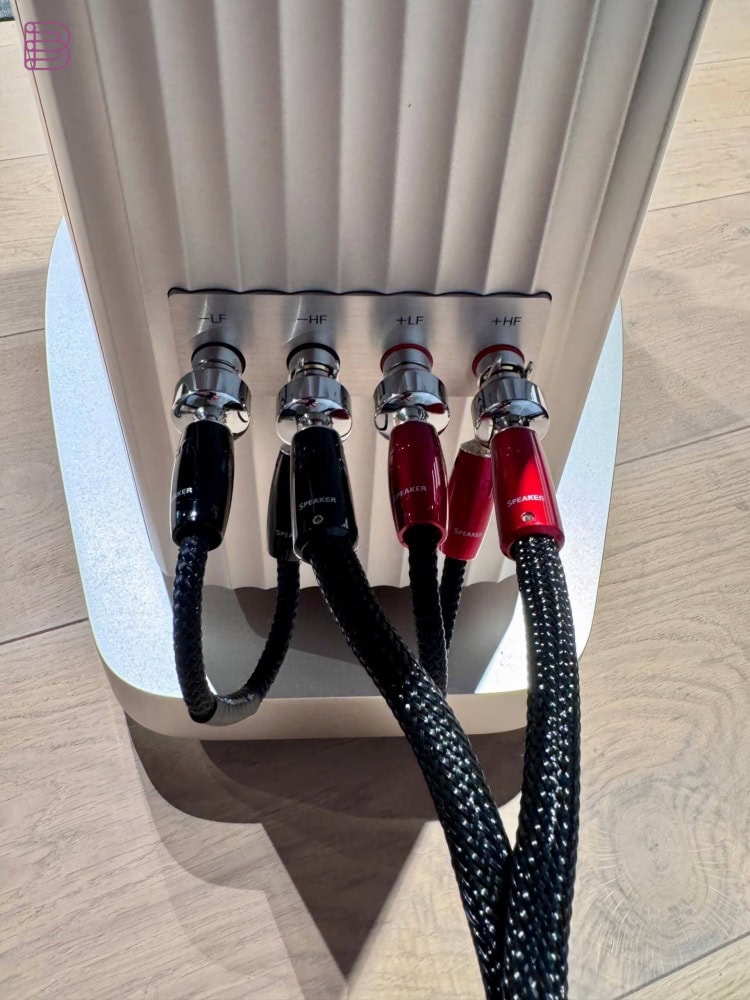
As a passive loudspeaker, the 803 D5 has no controls, settings or apps. Fine-tuning comes down to placement, toe-in, cabling and the choice of whether to use the grilles. Moving a 64 kg speaker for those adjustments is made easier by the castors supplied with it, which help get the position right before the speaker is set on its final footing.
Sound performance
For this review we put together a reference list of fifteen tracks, a varied bouquet of pop, classical, jazz, world music and film scores. Together they form a musical journey that touches every aspect of reproduction, from voices and percussion to choir, organ and the drama of a big film score. We played the full list on every system. With the first system we listened to all fifteen tracks from start to finish; with the three systems that followed, that was no longer necessary, because the differences revealed themselves quickly.
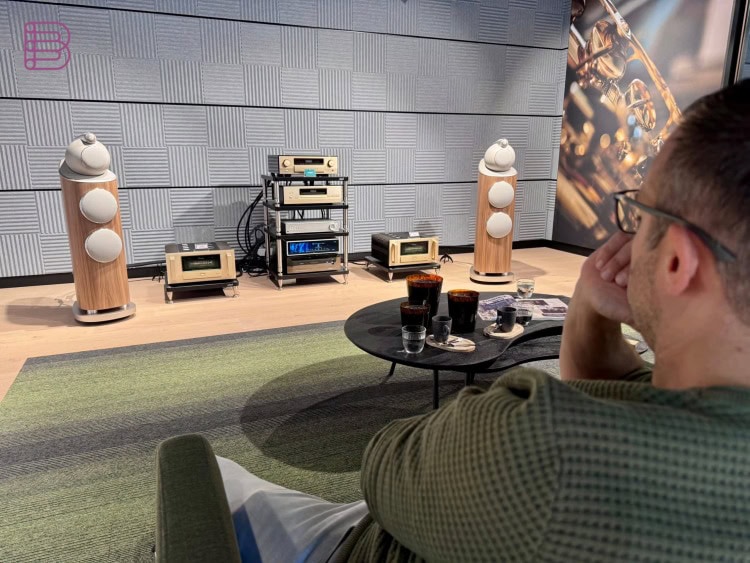
The descriptions below cover all four systems, with the loudspeaker at the centre. For each track, I describe what the 803 D5 proved capable of at its best moments, with whichever system brought that out. We are not here to judge the four systems that drove the speakers; we are here to judge the 803 D5. How the systems shaped its character follows after the track-by-track.
Track-by-track listening
“Queen Mary” – Francine Thirteen (On TIDAL)
The track opens with intriguing effects that resemble hi-hats, though to my ears they are synthesiser sounds. The real draw is her voice: beautifully recorded, free and well centred. At several points the vocal is doubled, and this is where the resolution of the 803 D5 truly shone. In the studio, those voices are layered at different pitches to blend into a single unison sound, yet the 803 D5 pulled them apart so cleanly that you could literally hear the layers on top of each other.
That offers a fascinating look into the production. Once the song has been introduced, a lovely bass foundation arrives, and the 803 D5 delivered it effortlessly. You immediately sense what this speaker can do in the low end: not shaking the room, but reproducing exactly the notes that were recorded, with a tight, well-defined line.
“Murder Song (5, 4, 3, 2, 1)” – AURORA (On TIDAL)
A classic that comes back regularly in our listening sessions. It opens with a classical guitar, which tells you straight away how good a speaker is: does the string sound real, or a touch too metallic, or too plasticky? Then the female voice enters, followed by a male voice in the background, and the two form a beautiful conversation. Here the 803 D5 showed it can convey emotion, too. On the right system, the voices became so vivid and hung so freely in the room that you could almost reach out and touch their faces. Palpable is the word. At moments they sounded silky soft and sweet. Pure listening pleasure.
“Heart” – Bo Stief (On TIDAL)
This jazz-fusion track from 1995, from the album Heart & Destiny, is the one you put on to test the absolute limits of the low end. It opens with a plucked string instrument, which immediately reveals the attack and speed of the upper midrange, and I kid you not, it was all there. You could hear every pluck and pull of the strings, with impact and a transient response that felt entirely true to life.
Then come the bass salvos, and with them the real questions: how deep can a speaker go, and is that depth controlled? All boxes were ticked. The 803 D5 delivered those deep bass blows in their entirety, down to the very lowest note, with enough power and drive. Very correct bass, very fast, very tight. Don’t expect subwoofer bass that rattles the windows, but for a 2.0 stereo system, this was highly convincing.
“Happens to the Heart” – Leonard Cohen (On TIDAL)
This track comes from Thanks for the Dance, the posthumous album built on recordings Cohen made before his death, and one of the best-recorded albums in his catalogue. I know few recordings that capture a voice at this level. Close your eyes and it feels as if your ears are the microphone and he is singing straight into it. Of course it remains a recording, and if you have some background in production, you hear the studio chain in it: what compression and mastering add to make a voice sound this realistic and this sweet.
The result conveys an enormous amount of emotion. Cohen speaks and sings, and he simply stands in the room, right in front of you, rendered so vividly and so breathtakingly that it gave me goosebumps.
“Broken Boy Dreams” – Febe (On TIDAL)
A more recent track, from 2023: fun, poppy, with playful effects and voices that hang and float beautifully in the room. There is a lot of information in the low end, and the 803 D5 reproduced it very neatly, with enough power and a pleasant depth. The voices float freely between the speakers, and the resolution across the whole track lets you follow every element of the mix. With lesser systems, it all tends to stick together into one mass; here, it was pulled apart beautifully.
That was a general trend throughout the day, and partly to the credit of the excellent cabling Jan Nelissen had selected for us: near the top of the AudioQuest range, with superb copper conductors. A very fine match that passes everything through one to one. Highly revealing, it brings out every musical detail, and that is a joy.
“Arrival to Earth” – Steve Jablonsky (On TIDAL)
On to film music, with this piece from the Transformers score. There is a lot going on. It opens with a series of thunderous low-frequency hits, each with its own character and level, and here the bass drivers and the cabinet volume really shine: the 803 D5 dares to show those differences, proof of genuine resolution in the low end. Halfway through, after a break, a choir enters, and this is where we discovered that the 803 D5 benefits from distance to the wall behind it.
The first system stood in the fixed rack; the other three were pre-assembled on mobile racks placed in front of it, and the speakers were moved forward with them to keep everything on the same line for a fair comparison. With more space behind them, the speakers came into their own: more depth in the soundstage, a freer, more open presentation. The choir passage in Arrival to Earth was gorgeous, hanging high above the speakers.
“Dacoit Duel” – A.R. Rahman (On TIDAL)
We chose this track for two reasons. The first is subtlety: it opens with a long introduction on a violin-like string instrument, ideal for judging the synergy between the midrange driver and the tweeter. What struck me, and what is typical of the 803 D5, is that it has almost the character of a studio monitor: what you put in comes out.
It is a true transducer that lets you hear exactly what you feed it. That also means you can shape its sound to your own musical taste, because it is versatile enough to follow any system’s character. On this track the differences were mainly audible in the upper midrange: one system put the accent on the warmth of the midrange, another on the accuracy of the transient, the attack and bowing of the strings, bringing the tweeter more into play.
The second reason is the finale in part two, with a barrage of large drums. That is where you can score a speaker’s dynamic capability. Here, too, the impression varied per system, from more dynamic to warmer and sweeter, but overall those drum rolls were delivered with great conviction. Even at high volume, neither the systems nor the speakers ever ran out of breath; they kept playing with authority and overview.
“I Will Survive” – Petra Magoni & Ferruccio Spinetti (On TIDAL)
A vocal jazz gem from the album Musica Nuda, literally “naked music”, and that is exactly what it is: her voice and his double bass, in a cover of the Gloria Gaynor classic. What I listen for here is the extent to which a speaker can render the double bass as an instrument in its own right. It is one of the largest string instruments in the orchestra, with a big resonating body, and when you hear it live you want to take in the volume of that body, its colour and the bowing of every note.
That alternated beautifully with Petra Magoni’s lovely vocal timbre. Depending on the system, her voice became tangible and honey-sweet, and the body of the bass was truly resonating: you could feel the musical waves, the vibration of the wood conveyed so realistically that it sent a shiver down my spine. Across all four systems there was no problem whatsoever; some played more neutrally and with more accuracy. It is pick and choose, to season the whole to your own taste.
“Pink Panther” – markusphilippe (On TIDAL)
Staying in the jazz mood, we moved on to the saxnbass version of the Pink Panther. The star here is the saxophone: magnificent. You hear the brass, the breath, the air moving through the instrument. What resolution this speaker delivers. Hats off to Bowers & Wilkins here, because the design is not only iconic but also functional: the bass has its own enclosure, the midrange its own sphere and the tweeter its own tapered tube.
Every drive unit has a separate enclosure, and that pays off when it comes to conveying the very last details. This was a jazz ensemble simply making music in the room; we were witnesses to an almost live performance.
“Gut Genug” – KitschKrieg, Blumengarten & Shirin David (On TIDAL)
Something completely different: a pop track from Kitschkrieg Zwei, again with a male and a female voice. But the opening is mostly about the different kinds of bass, and the bass section of the 803 D5 reproduces them perfectly. Midway through, you can hear the producers turning the EQ, and the 803 D5 lays that out one to one. That is not something every speaker or every system can do. Once the track gets going, a full, thick bass arrives that is meant to create a party vibe, edging towards subwoofer territory, and the 803 D5 proved well up to it.
“ilomilo” – Billie Eilish (On TIDAL)
I think Billie Eilish is a fantastic artist, not least for the arrangements and the way her songs are built: truly next level. As the system at our HQ grew and I got to hear better and better products, I heard her songs grow with it. At first I found her voice rather small and not very revealing; now I know how well these songs are recorded, and how free and rich in colour her voice actually is.
Her tracks also contain a lot of low-frequency information and playful little effects, and ilomilo is no exception. This became almost a track to watch: it was unravelled and laid out in its separate parts so beautifully that you could practically see the music. Great fun.
“Nikko no Mori” – Hikarï (On TIDAL)
Back to jazz, with flutes, piano and a bass line. The piano is recorded very close up, with lovely dynamics, and it is presented as a full instrument in its own right; the 803 D5 translated that beautifully. But the finale lies in the flutes. In the break, several flutes begin to play in unison, and this was a moment that gave me chills: the waves of the music, created by the breath through the flute, were rendered so tangibly and so full of emotion.
I can’t put it any other way: the musical intent of the performers came through one to one. And that is exactly what you want when you listen to music, for it to reach you completely.
“Nature Boy” – Lisa Ekdahl (On TIDAL)
The same was true of this recording, even though it is almost thirty years old. It is a lovely recording of a fine ensemble playing at a relaxed tempo. Her voice, already very distinctive, was rendered with plenty of character, and the piano and double bass were just as convincing. You could follow every instrument separately, and the musical line of the song with ease. Another moment of pure enjoyment.
“Come to Me” – Anna Lapwood & The Chapel Choir of Pembroke College, Cambridge (On TIDAL)
From the album Firedove. With choral music, three things matter. The first and most important: do you feel as if you are sitting in the church? This is a very spacious recording, in which you clearly hear the acoustics of the chapel, and with the 803 D5 you hear them, too; you feel part of the performance. The second is the choir itself. Close your eyes: do you see the choir standing in front of you?
A choir has four voice types, two male and two female, each with its place in the formation, and you should be able to locate them. The third is the dynamic contrast when the choir swells. When all of that is ticked off, as it was here, this track becomes a genuinely moving experience.
“Allegri: Miserere (excerpt)” – Choir of King’s College, Cambridge; Stephen Cleobury (On TIDAL)
We closed in the same vein, with a true finale. This is a small ensemble with a limited choir, and the magic lies in the treble line, sung by the young choristers, which at a certain point climbs ever higher and enters into a beautiful dialogue with the rest of the choir. On a top speaker with a top system, that conversation is spine-tingling. What is especially telling is how high those young voices appear to float: that is the ultimate proof of how good the system is. I kid you not: they hung just below the ceiling. Check.
Four systems, one loudspeaker
I won’t judge the four systems in their own right. They consist of many components I don’t yet know well enough, and I lack the listening experience with them to give a fair verdict. What I can describe is the kind of sound profile each system produced through the 803 D5. Because those profiles clearly differed, they add valuable context about the speaker’s capabilities. We deliberately worked our way down from the most expensive system: once you have heard the best, it is easier to ask, with each step down, what is different and whether anything is missing. That approach worked perfectly for us.
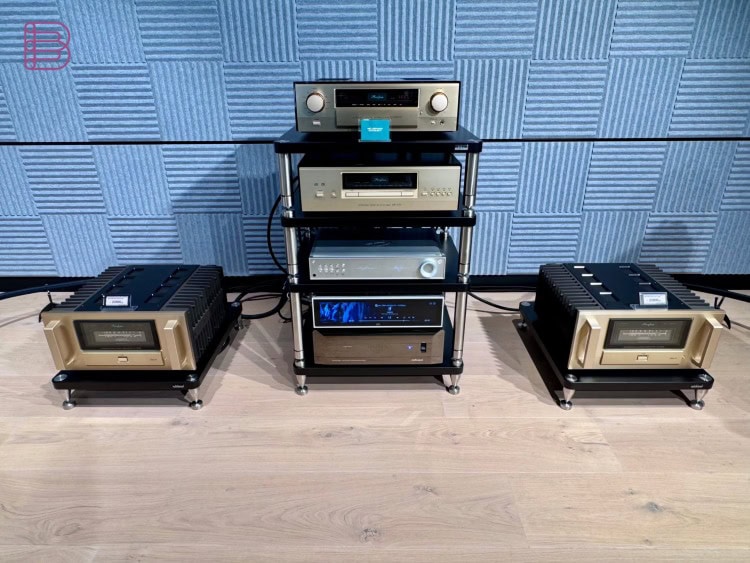
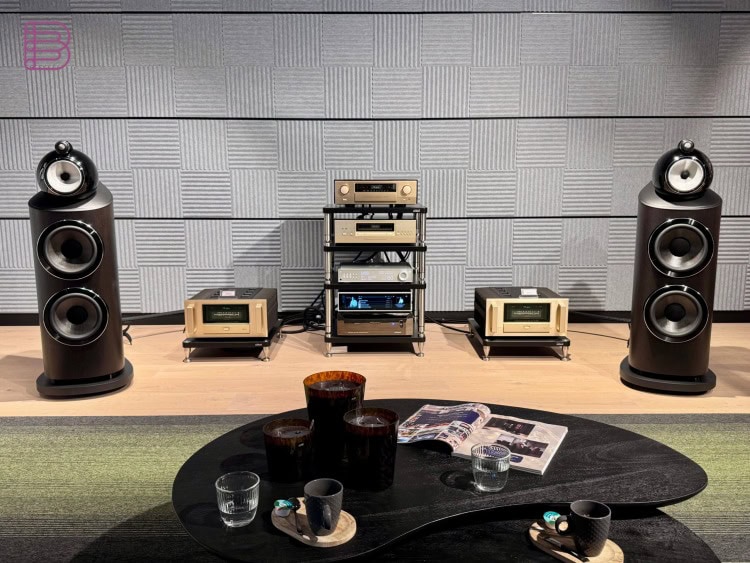
System 1: Accuphase
The Accuphase system was the sweetest and warmest-sounding of the four. Listening fatigue simply never sets in here; you could sit in front of it 24/7 without ever tiring. It sounds so pleasant, and at times so vivid thanks to the Class A amplification, that you can almost pluck instruments and voices out of the air and touch them. This system was also able to convey an enormous amount of emotion at times. A true top system.
System 2: Luxman
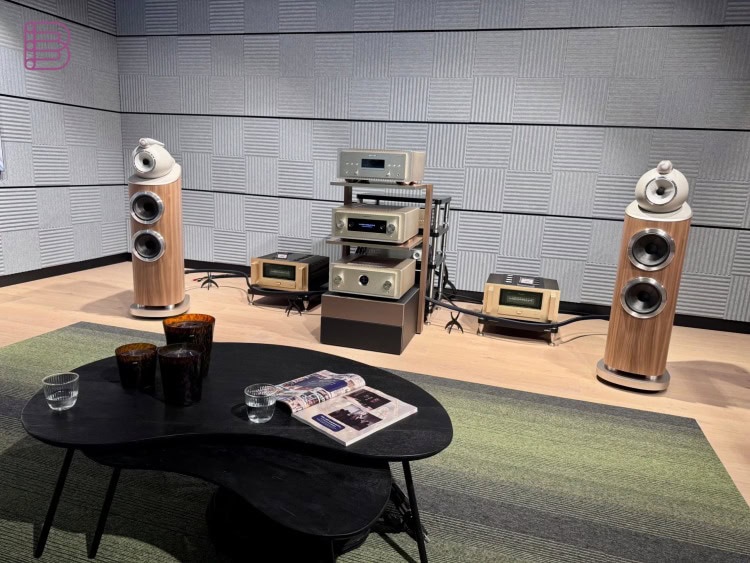
Compared with the Accuphase system, the Luxman system sounds more neutral. What it gives up in absolute sweetness and warmth, it gains in speed and dynamics. That makes it a very interesting set as well, depending on where your musical preferences lie, and here too you could listen for 24 hours without ever growing tired. In fact, that held true for every system we heard.
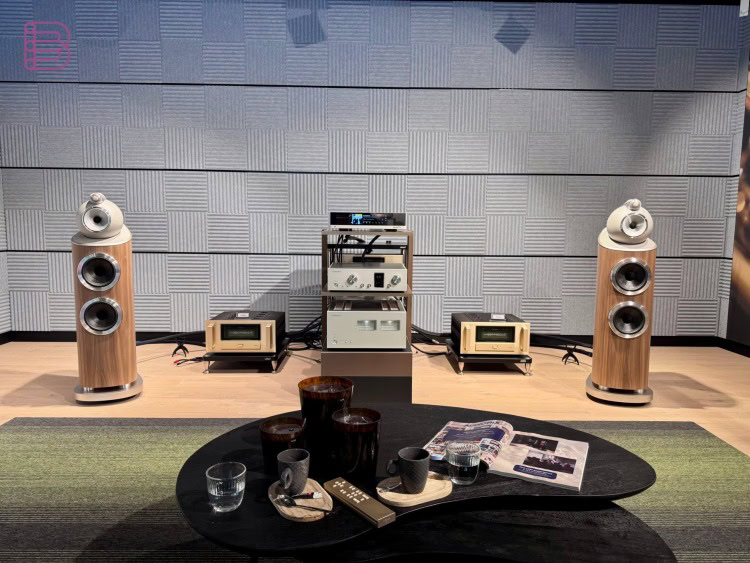
These two are the top systems, both carrying a price tag well above that of the speakers. It is to the 803 D5’s credit that it already achieves beautiful things with systems and budgets in the region of its own price. But if you invest more and build an even more high-end system, the speaker simply grows with it. In that respect, the sky is the limit.
Systems 3 and 4: Marantz and NAD Masters
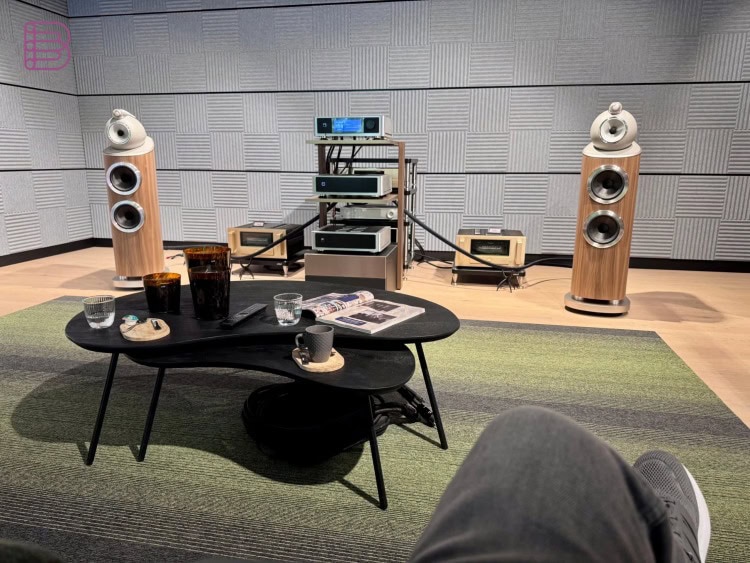
The Marantz and NAD Masters systems take a simpler, more accessible approach: two components instead of a full set of separates. In both cases a streaming preamplifier drives an amplifier; with NAD that is a genuine power amplifier, while the Marantz MODEL 10 is an integrated amplifier used as a power amplifier here.
The difference with the high-end systems is what you would expect, given the price class and the concept of the equipment: with the Accuphase and Luxman systems, the soundstage is somewhat larger, extends further beyond and above the speakers, and has more depth. It is also typical of Bowers & Wilkins: the more power you feed an 800 Series speaker, the more at ease it feels, the more dynamic it sounds and the more force it can convey.
Between the two, the differences mirror those between the Accuphase and Luxman sets. The Marantz sounds a touch warmer; forgiving is perhaps not quite the word, but it is rounder, with broader, softer contours. The NAD Masters system, whose power amplifier is built around Purifi modules, sounds more neutral and more precise.
The 801 D5 as the finale
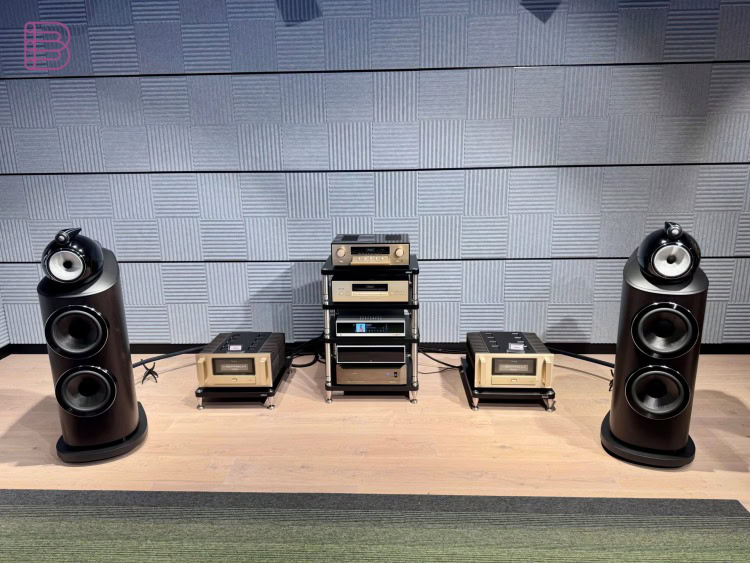
We ended the day where we began: with the Accuphase system, the most high-end set we had at our disposal. There, we also listened to the 801 D5, to hear what the bigger budget and the larger speaker add. The answer can be summed up simply: more of the same. Even more resolution, an even larger soundstage, more power, and more force in the low end thanks to the larger bass cabinet and bigger woofers.
So it comes down to deciding how far you need to go, and the magic formula is what your room requires. With a living room of 80 to 100 square metres, you can go all in and look at the 802 D5 or the 801 D5, both of which need space to come fully into their own, the 801 D5 especially. With a medium-sized living room of 40 to 60 square metres, I stand by my view: the 803 D5 is the golden choice. And since most music lovers live in that segment, I believe it is also the most attractive speaker in the range.
Conclusion
Two things stand out. Compared with the first generations of the 800 Series, these speakers have become considerably more expensive, but they have also become considerably better in every respect. And the 803 D5 remains an icon of design. It is not just a loudspeaker; it is something to look at while you listen. Its looks draw you in, you never tire of looking at it, and it is a piece of furniture that catches everyone’s eye before a single note has played. That is not the reason you buy a speaker like this, of course, but it comes with the package.
One piece of advice: give this loudspeaker proper speaker cables. The 803 D5 has something of a studio monitor about it. I wouldn’t call it one, but it shares that trait of “what goes in, comes out”. Everything you put in front of it, from the speaker cables to the entire system, determines how well it performs. The better and more carefully matched the combination, the closer you get to truly top-level performance. And amplifier power is something an 800 Series speaker can never get enough of: more is always better. That has been my experience for years, and the 803 D5 is no exception.
Beyond that, it is a matter of budget and taste. We heard four systems, and the question is simply: what kind of sound do I want? Accuracy and precision, speed and an enormous transient response? Or, at the other end of the spectrum, beautifully rounded lines and a sweet, warm sound you can listen to day and night? Everything in between is possible. The 803 D5 translates it literally to you as a listener. That makes it a remarkably versatile loudspeaker, and one I recommend wholeheartedly.
So, does the old flame still burn? It does. Bowers & Wilkins has found its way back to genuine progress, and the 803 D5 is the proof: a speaker with a heart for music, with the resolution to back it up.
Price
The Bowers & Wilkins 803 D5 has a recommended retail price of €30,000 per pair (£25,500 in the UK, US$35,000 in the US).
Technical specifications
Specifications as published by Bowers & Wilkins.
| Specification | Bowers & Wilkins 803 D5 |
|---|---|
| Description | 3-way vented-box system |
| Technical features | Diamond dome tweeter; Solid Body Tweeter-on-Top; Continuum cone FST midrange; Anti-Resonance plug; Biomimetic Suspension; Turbine Head; Matrix bracing; Aerofoil bass cones; Flowport |
| Drive units | 1 × 25 mm (1 in) Diamond dome high-frequency; 1 × 130 mm (5 in) Continuum cone FST midrange; 2 × 180 mm (7 in) Aerofoil bass |
| Frequency range | 16 Hz – 35 kHz (−6 dB) |
| Frequency response | 19 Hz – 28 kHz (±3 dB) |
| Sensitivity | 90 dB |
| Harmonic distortion | 2nd and 3rd harmonics (90 dB, 1 m on axis): <1% 80 Hz – 20 kHz; <0.3% 100 Hz – 8 kHz |
| Nominal impedance | 8 Ω (minimum 3.0 Ω) |
| Recommended amplifier power | 50 W – 500 W into 8 Ω on unclipped programme |
| Max. recommended cable impedance | 0.1 Ω |
| Height | 1,165 mm (45.8 in) including tweeter and plinth |
| Width | 301 mm (11.9 in) cabinet only; 359 mm (14.1 in) including plinth |
| Depth | 473 mm (18.6 in) including grille and terminals; 499 mm (19.6 in) including plinth |
| Net weight | 63.7 kg (140.3 lb) |
| Cabinet finishes | Stealth Black, Warm White, Light Walnut, Dark Walnut |
| Grille finishes | Black (Stealth Black, Dark Walnut); Grey (Warm White, Light Walnut) |
Software list
All tracks were streamed from TIDAL via the network streamer in each system.
| # | Artist | Title | Album | Year | Label | Genre |
|---|---|---|---|---|---|---|
| 1 | Francine Thirteen | Queen Mary | Queen Mary | 2017 | Self-released | Art-pop |
| 2 | AURORA | Murder Song (5, 4, 3, 2, 1) | All My Demons Greeting Me as a Friend | 2016 | Decca / Petroleum Records | Art-pop |
| 3 | Bo Stief | Heart | Heart & Destiny | 1995 | Private release | Jazz / fusion |
| 4 | Leonard Cohen | Happens to the Heart | Thanks for the Dance | 2019 | Columbia / Legacy | Singer-songwriter |
| 5 | Febe | Broken Boy Dreams | Single | 2023 | Independent | Pop ballad |
| 6 | Steve Jablonsky | Arrival to Earth | Transformers: The Score | 2007 | Warner Bros. Records | Film score |
| 7 | A.R. Rahman | Dacoit Duel | Between Heaven and Earth (OST) | 2004 | Sony Classical | Film score |
| 8 | Petra Magoni & Ferruccio Spinetti | I Will Survive | Musica Nuda | 2004 (remaster 2024) | fonè | Jazz / vocal |
| 9 | markusphilippe | Pink Panther | saxnbass | 2013 | Self-released | Jazz duo |
| 10 | KitschKrieg, Blumengarten & Shirin David | Gut Genug (mit Blumengarten & Shirin David) | Kitschkrieg Zwei | 2026 | KitschKrieg (prod.) | Pop |
| 11 | Billie Eilish | ilomilo | When We All Fall Asleep, Where Do We Go? | 2019 | Darkroom / Interscope | Electropop |
| 12 | Hikarï | Nikko no Mori | Wandering Memories | 2022 | — | Jazz |
| 13 | Lisa Ekdahl | Nature Boy | Back to Earth | 1998 | RCA / BMG | Vocal jazz |
| 14 | Anna Lapwood & The Chapel Choir of Pembroke College, Cambridge | Come to Me | Firedove | 2025 | Sony Classical | Choral |
| 15 | Choir of King’s College, Cambridge; Stephen Cleobury | Allegri: Miserere (excerpt) | Essential Renaissance | 2010 | EMI Classics / Warner Classics | Sacred choral |
Review setup
All listening took place in the acoustically treated master listening room at Audiomix in Begijnendijk, Belgium. The Bowers & Wilkins 803 D5 (Light Walnut) was used with four complete systems. Cabling and power were kept identical wherever possible, so that the amplification and sources were the main variables. To close the day, the 801 D5 was used for comparison.
Common to all systems
- Power conditioning: AudioQuest Niagara 5000 power conditioner (€3,995)
- Speaker cables: AudioQuest ThunderBird ZERO with banana plugs (from €6,799 per 3 m pair), with AudioQuest ThunderBird BiWire Jumpers (€399 per set of four)
- Interconnects: AudioQuest ThunderBird XLR (€4,599 per 1 m pair)
- Power cables: AudioQuest NRG Thunder (from €999 per 2 m)
- Network: Matrix Audio SI-1 active optical network isolator (€899); AudioQuest Vodka Ethernet cable (from €599)
System 1: Accuphase (electronics approx. €88,200)
- Preamplifier: Accuphase C-3900S stereo preamplifier (€32,100)
- Power amplifiers: Accuphase A-300 Class A monoblocks (€46,000 per pair)
- Streamer: HiFi Rose RS130 network streamer (€4,799)
- DAC: HiFi Rose RD160 D/A converter (€5,299)
- Pre-to-power interconnects: AudioQuest Black Beauty XLR (€1,199 per 1 m pair)
- Furniture: Solidsteel HY-4 rack (€2,200) and Solidsteel HY amplifier platforms (from €435 each)
System 2: Luxman (electronics approx. €52,000)
- Source: Matrix Audio MS-1 streamer/DAC, without preamplifier (€11,999)
- Preamplifier: Luxman C-10X stereo preamplifier (€19,999)
- Power amplification: Luxman M-10X stereo power amplifier, 2 × 150 W with the first 12.5 W in Class A (€19,999)
- Pre-to-power interconnects: AudioQuest Pegasus XLR (€2,199 per 1 m pair)
System 3: Marantz (electronics €28,000)
- Streamer / preamplifier: Marantz LINK 10n streaming preamplifier (€12,500)
- Amplifier: Marantz MODEL 10 integrated amplifier (€15,500)
- Pre-to-power interconnects: AudioQuest Pegasus XLR (€2,199 per 1 m pair)
System 4: NAD Masters (electronics approx. €11,600)
- Streamer / preamplifier: NAD M66 BluOS streaming preamplifier (€6,799)
- Power amplifier: NAD M23 V2 stereo power amplifier (€4,799)
- Pre-to-power interconnects: AudioQuest Pegasus XLR (€2,199 per 1 m pair)
Comparison
- Loudspeakers: Bowers & Wilkins 801 D5 (€50,000 per pair)
Prices are recommended retail prices in euros at the time of writing and may vary by dealer and country.
Frequently asked questions
How much does the Bowers & Wilkins 803 D5 cost?
The Bowers & Wilkins 803 D5 has a recommended retail price of €30,000 per pair (£25,500 in the UK, US$35,000 in the US). It sits between the 804 D5 (€18,000) and the 802 D5 (€37,000) in the 800 Series Diamond D5 range.
How does the 803 D5 compare with the 801 D5?
The 801 D5 offers more of the same: even more resolution, an even larger soundstage and more power and weight in the low end, thanks to its larger bass cabinet and bigger woofers. It also needs considerably more space. For living rooms of 80 to 100 square metres, the 802 D5 or 801 D5 are worth considering; for medium-sized rooms of 40 to 60 square metres, the 803 D5 is the golden choice.
What amplifier pairs well with the 803 D5?
With a sensitivity of 90 dB and a nominal impedance of 8 ohms dipping to 3.0 ohms, the 803 D5 rewards amplifiers with a solid power supply and good current delivery; Bowers & Wilkins recommends 50 to 500 watts. In our experience, an 800 Series speaker can never get enough power. We heard it with Accuphase, Luxman, Marantz and NAD Masters systems, and it follows each system’s character faithfully, from warm and sweet to fast and precise.
Does the 803 D5 need a lot of space?
The 803 D5 suits medium-sized to larger rooms. It benefits clearly from distance to the wall behind it: with more space at the back, the soundstage gains depth and the presentation becomes freer and more open.
What is new in the 800 Series Diamond D5 generation?
The D5 generation adds aluminium Space Frame Bracing, a new aluminium top plate with damping collar, improved Matrix bracing and motor systems derived from the 800 Series Signature models, all aimed at lower distortion. The crossover is mounted on the back of the cabinet, isolated from the air pressure and vibration inside the enclosure. The diamond dome tweeter, now in its fifth generation, breaks up only at 70 kHz.
Bowers & Wilkins 803 D5 floorstanding loudspeaker
30.000 EUR per pairThe Bowers & Wilkins 803 D5 is the smallest model in the 800 Series Diamond D5 range to wear the Turbine Head, and for most music lovers it may well be the most attractive one. We heard it with four very different systems at Audiomix in Belgium, from an accessible NAD Masters pairing to a dream system built around Accuphase Class A monoblocks, and the speaker revealed its character every time: tight, dry and full-bodied bass, a vivid and tangible midrange, and a velvety, clear treble that never oversteps. What makes the 803 D5 special is its resolution. Doubled vocals separate into their layers, a saxophone breathes, a double bass resonates, and a choir rises to just below the ceiling. Every driver sits in its own enclosure, from the Aerofoil bass cabinet to the decoupled Turbine Head and the Tweeter-on-Top, and you hear that in the detail and the open, convincing soundstage. The 803 D5 also behaves almost like a studio monitor: what goes in comes out. That makes it remarkably versatile, following the sweetness of a Class A amplifier as readily as the precision of a Purifi-based design, but it also means it exposes budget cabling and asks for powerful, high-quality electronics. Give it space behind it, and the stage grows larger and more layered still. Build quality is beyond reproach, and the design remains iconic. At €30,000 per pair it is not inexpensive, and only top-flight partnering equipment unlocks its full potential. But in a medium-sized room of 40 to 60 square metres, the 803 D5 is the golden choice in the range: a speaker with a genuine heart for music. Wholeheartedly recommended, and a worthy winner of the Best of High End Award.
Pros
- Iconic design
- Exceptional build quality
- Separate enclosures for each driver section
- A speaker with a genuine heart for music
- Tight, dry and full-bodied bass
- Vivid, tangible midrange
- Velvety, clear treble that never oversteps
- Builds a spacious, convincing soundstage
Cons
- Prefers powerful amplification
- Scales with every upgrade: only top-flight electronics unlock its full potential
- A larger, more layered stage unfolds with space behind it, which is not practical in every room
- So revealing it exposes budget speaker cables

The Bowers & Wilkins 803 D5 is a three-way floorstanding loudspeaker that scores 9.1/10 in our testing — an iconic, superbly built speaker with tight, full-bodied bass, a vivid midrange and a velvety treble, earning the Best of High End Award. Best for music lovers with a medium-sized living room who are prepared to partner it with powerful, high-quality amplification and cabling.
What we loved
- +Iconic design
- +Exceptional build quality
- +Separate enclosures for each driver section
- +A speaker with a genuine heart for music
- +Tight, dry and full-bodied bass
- +Vivid, tangible midrange
- +Velvety, clear treble that never oversteps
- +Builds a spacious, convincing soundstage
Worth considering
- –Prefers powerful amplification
- –Scales with every upgrade: only top-flight electronics unlock its full potential
- –A larger, more layered stage unfolds with space behind it, which is not practical in every room
- –So revealing it exposes budget speaker cables
Compare more
Other loudspeakers we've tested
 9.4/10LoudspeakersHarbeth SHL5plus XD2 reviewPerformance95Features92Build95Value94Superb, lifelike midrange and vocalsConvincing instrumental timbreNo matching stands from HarbethRead the review
 8.8/10LoudspeakersBowers & Wilkins 707 S3 Prestige Edition reviewPerformance85Features90Build95Value90Beautiful, richer rosewood finishSlightly lighter, more open sound than the standard 707 S3Bass depth is still limited by the compact dimensionsRead the review
 9.3/10LoudspeakersPMC Prophecy 7 reviewPerformance94Features94Build95Value85Exceptionally neutral and transparent; true reference-grade…Bass performance is superbPricing positions it against other highly competitive…Read the review