

Sixty years ago, a Worthing radio-shop owner with a head full of ideas about “true sound” borrowed a shopkeeper’s inheritance and turned it into a loudspeaker company. Today, on the eve of the launch of the new 800 Series Diamond D5, we travelled to that same corner of West Sussex to see how a Bowers & Wilkins flagship loudspeaker is actually built — from a stack of raw veneer to a diamond dome weighing less than a grain of rice. This is the story of 60 years of Bowers & Wilkins, told from the factory floor.
60 Years of Bowers & Wilkins: How It All Began
Bowers & Wilkins traces its roots to August 1946, when John Bowers and Roy Wilkins — who had met during wartime service together — opened a radio and television shop in Worthing, on England’s south coast. The shop sold and repaired radios and record players, rented out televisions, and supplied PA systems to local schools and churches. It was in the workshop behind that counter, run alongside colleague Peter Hayward, that Bowers began tinkering with and designing his own loudspeakers on the side.
The company as we know it was effectively founded on a stroke of luck. In 1966, a wealthy Worthing customer and former opera singer, known as Miss Knight, died and left Bowers £10,000 in her will — worth roughly £200,000 today — specifically so he could leave retail behind and dedicate himself to loudspeaker design. Bowers took Hayward with him to found B&W Loudspeakers Ltd, while Wilkins kept running the original shop (still family-run today). The company’s first product, the P1 floorstanding column loudspeaker, followed within a year, built in garages behind the old shop that had been converted into design, production, measurement and dispatch departments.
The following decade set the pattern for everything that followed: the DM70 electrostatic hybrid in 1970, the Kevlar-coned DM6 in 1976, and finally, in 1979, the original 801 — a three-enclosure design that Abbey Road Studios adopted almost immediately as its reference monitor, followed swiftly by Decca, Deutsche Grammophon and EMI. Sixty years on, Bowers & Wilkins still designs and builds its flagship loudspeakers in Worthing, a few miles from where John Bowers first picked up a soldering iron.
Who Was John Bowers?
John George Frederick Bowers was born in 1922. At 17 he joined the Royal Corps of Signals, and his aptitude for radio work saw him recruited into a specialist wing of the Secret Intelligence Service, stationed at Whaddon Hall — an offshoot of Bletchley Park — where he maintained clandestine radio contact with agents and resistance fighters in occupied Europe. It was there that he met Roy Wilkins, the man who would become his business partner. After the war, Bowers studied telecommunications engineering at Brighton Technical College before the two men opened their Worthing radio shop together in 1946.
Colleagues who knew him described a slim, modest, endlessly enthusiastic engineer with a genuine perfectionist streak — someone who loved classical music, fast cars and cooking as much as he loved circuit diagrams. His guiding design philosophy has outlived him by decades: “The best loudspeaker isn’t the one that gives the most, it’s the one that loses the least.” He wanted a loudspeaker to be, in his words, “to the ear what a flawless pane of glass is to the eye” — a philosophy the company still calls True Sound.
John Bowers died on 20 December 1987, after a short illness. At the time of his death he had been researching a “perfect dipole” loudspeaker free of cabinet coloration — unfinished work that he passed to a young engineer named Laurence Dickie, who would turn it into the Nautilus.
The Most Iconic Bowers & Wilkins Loudspeakers
Across six decades, a handful of Bowers & Wilkins models have gone on to define entire eras of loudspeaker design:
- P1 (1966/67) — the company’s first product, a four-foot column loudspeaker that funded its earliest test equipment.
- DM70 (1970) — a striking curved electrostatic mid/treble panel over a conventional bass box, fully engineered in-house.
- DM6 “Pregnant Penguin” (1976) — the first Bowers & Wilkins design to use a Kevlar-fibre midrange cone, a material that stayed in the range for decades.
- 801 (1979) — the three-enclosure design that made Bowers & Wilkins the reference monitor of choice at Abbey Road, Decca and EMI.
- Matrix 801 (1987) — introduced the internal lattice bracing, invented by Laurence Dickie, that still underpins every 800 Series cabinet.
- Nautilus (1993) — the sculptural, tapering-tube flagship described in detail below.
- Zeppelin (2007) — the brand’s first lifestyle speaker, an “airship”-shaped iPod dock that has since been inducted into the Hi-Fi Hall of Fame.
- 800 Series Diamond (2005) — introduced the CVD diamond dome tweeter that remains a Bowers & Wilkins signature.
- 800 D3 (2015) — a ground-up redesign with the solid-aluminium Turbine Head, Continuum Cone and Aerofoil bass cones.
The Nautilus: A Design Unlike Any Other
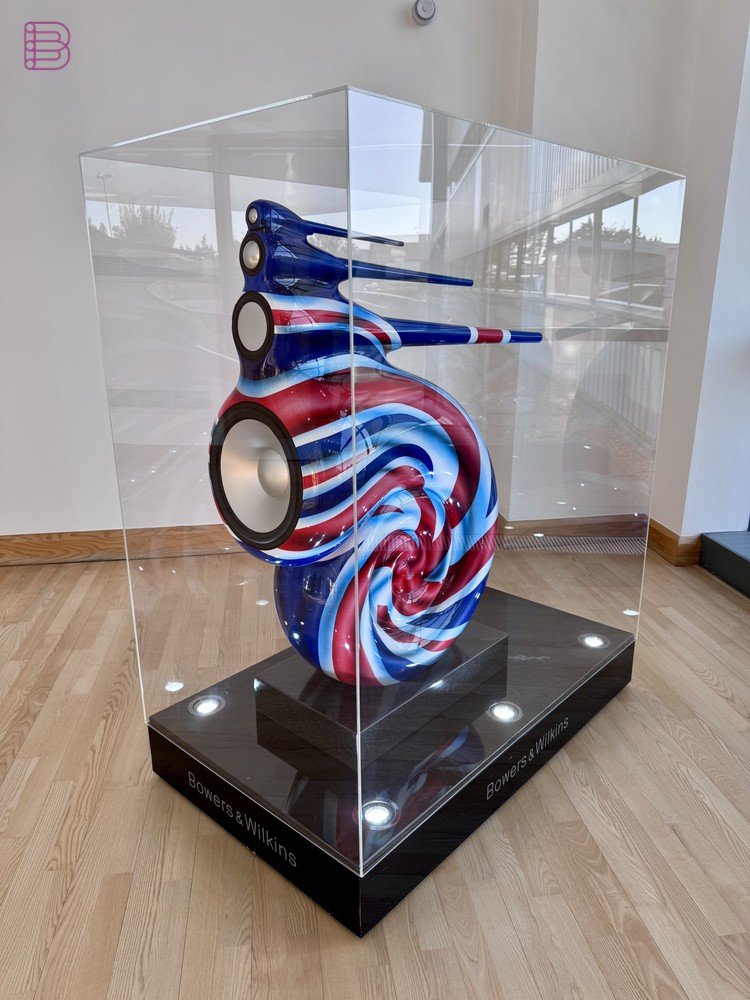
No Bowers & Wilkins product tells the John Bowers story better than the Nautilus. Prototyped from 1991 and launched in 1993 after roughly five years of research, it was built from the unfinished “perfect dipole” work Bowers left behind at his death, developed further by engineer Laurence Dickie. Rather than housing each drive unit in a conventional sealed box, Dickie mounted every driver — bass, two mids and tweeter — at the mouth of its own reverse-tapered, exponentially narrowing tube, packed with absorbent wool. Instead of reflecting rearward sound back through the cone, the tapering tube absorbs it almost entirely, virtually eliminating cabinet resonance and coloration.
The now-famous curled shape is simply what happens when a would-be three-metre-long straight bass tube is coiled into a compact spiral — nicknamed “the snail” inside the company, officially “Nautilus” for its resemblance to the chambered shell. Each Nautilus is still hand-built in Worthing: the three-piece cabinet shell alone takes about a week to construct, followed by up to twelve coats of hand-sprayed lacquer and three full days of machine polishing. It launched at £57,750 a pair; the 30th-anniversary edition in 2023 was priced closer to $100,000. Demand has always outstripped supply.
The Nautilus never became a mass-market product, but its ideas did: the tapering tube tweeter head and the entire “head on top of a body” philosophy went on to define the Nautilus 800 Series in 1998, and every 800 Series Diamond generation since — including the Turbine Head and Solid-Body-Tweeter enclosure on today’s 801 and 802 D5.
From the Original 801 to the 800 D5: The Evolution of a Flagship
The 800 Series is, in a real sense, Bowers & Wilkins’ entire history in miniature. It began with the original 801 in 1979: a three-way, three-enclosure design with a separate sealed bass box and a distinctive aramid-fibre midrange, adopted almost overnight by Abbey Road, Decca, Deutsche Grammophon, EMI and Skywalker Sound as a studio reference. In 1987, the Matrix 801 introduced Laurence Dickie’s internal lattice bracing — a cabinet-stiffening technique still used today — plus a larger bass driver extending response down to 20Hz.
The Nautilus 800 Series arrived in 1998, bringing the tapering-tube tweeter pod and rounded Marlan midrange head from the Nautilus flagship into a full, more accessible range. In 2005, the 800 Series Diamond introduced the CVD diamond dome tweeter that remains a Bowers & Wilkins hallmark, followed by the refined D2 generation in 2010. The 800 D3 of 2015 was a total rebuild: a solid-milled aluminium Turbine Head replaced the old Marlan head, curved “Reverse Wrap” cabinets joined by an internal metal spine, a new Continuum Cone midrange, and composite Aerofoil bass cones. The 800 D4 followed in 2021, refined further with the 2023 D4 Signature — the technical donor platform for today’s flagship.
Which brings us to now: the 800 Series Diamond D5, unveiled at High End Munich — sorry, Vienna — in June 2026 and arriving in dealers this September, explicitly framed by Bowers & Wilkins as a celebration of the company’s 60th year.

Inside the New 800 Series Diamond D5 Line-up
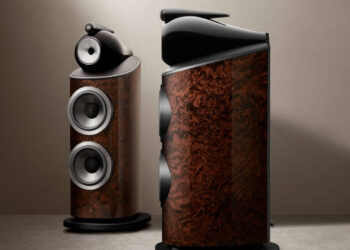
The D5 line-up mirrors the D4 generation’s structure: five stereo models plus two dedicated centre channels, all still hand-built in Worthing and offered in four new finishes — Stealth Black, Warm White, Light Walnut and Dark Walnut, the last inspired by last year’s 801 Abbey Road Limited Edition.
- 801 D5 — the 3-way flagship tower, around €50,000 per pair
- 802 D5 — a smaller 3-way tower sharing the 801’s cabinet philosophy, around €37,000 per pair
- 803 D5 — a compact “headed” 3-way tower, around €30,000 per pair
- 804 D5 — the most accessible 3-way tower in the range, around €18,000 per pair
- 805 D5 — a 2-way standmount, around €12,000 per pair
- HTM81 D5 — a 3-way centre channel for the 801/802 D5, around €12,000 each
- HTM82 D5 — a 3-way centre channel for the 803/804 D5, around €10,000 each
Dedicated stands (FS-805 D5 and FS-HTM D5) complete the range. As with every 800 Series generation before it, the D5 was designed and measured at Bowers & Wilkins’ Southwater Research Establishment, the successor to the original Steyning facility opened in 1982.
The New Technology Behind the 800 D5
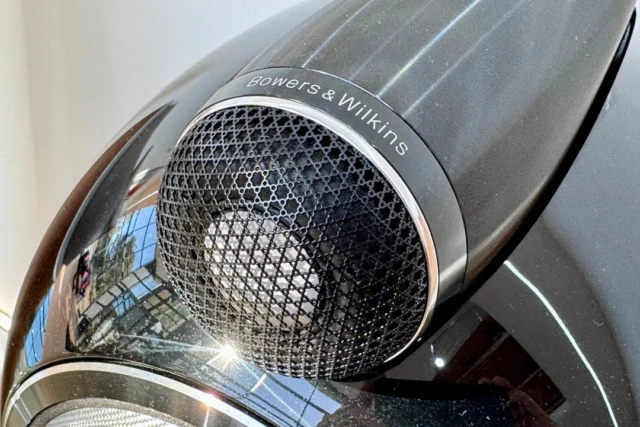
Much of what makes an 800 Series speaker sound the way it does carries straight over from the D4 generation: the CVD diamond dome tweeter, the Continuum Cone FST midrange, Aerofoil composite bass cones, and the Turbine Head/Solid-Body-Tweeter enclosure all remain, now paired with the finer diamond-tweeter grille mesh first developed for the 801 D4 Signature.
What’s genuinely new is largely structural. A completely new Space Frame Bracing system — parallel aluminium rails bolted to the rear of the cabinet — works alongside a thicker, more heavily ribbed Enhanced Matrix at the front to stiffen the enclosure further; Bowers & Wilkins calls it the most mechanically quiet cabinet it has ever built. A new aluminium top plate, with revised decoupling mounts and a Signature-derived leather-trimmed collar, carries the Turbine Head, while a new tuned-mass-damped plinth with constrained-layer damping and integrated outriggers replaces the old base on every floorstanding model. The 804 D5 gains its own dedicated aluminium midrange enclosure for the first time, isolating the Continuum Cone assembly the way the larger models already do. Every drive unit borrows lower-distortion, Signature-derived motor systems, and the crossovers themselves have been upgraded and — on the stereo models — mounted to an aluminium plate coupled directly into the new bracing for extra rigidity.

Building a Flagship Loudspeaker: A Symphony of Sound
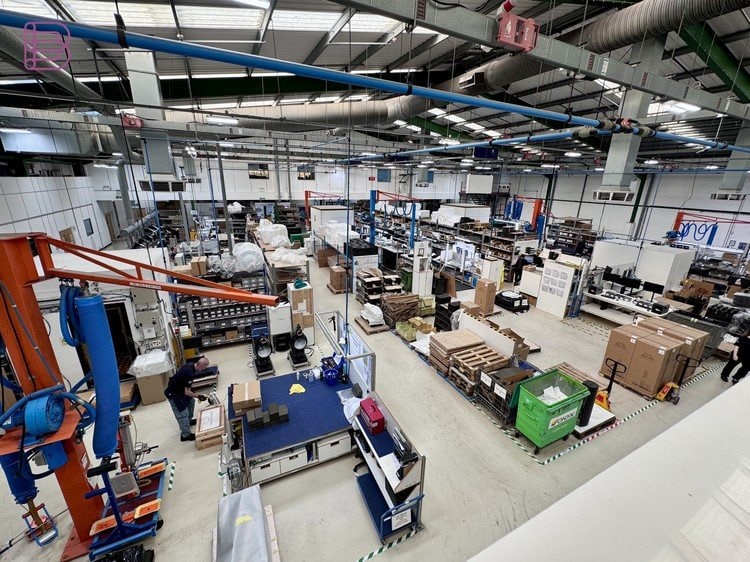
Andy Kerr, who oversees sound and product at Bowers & Wilkins, has a memorable way of describing what actually happens on the Worthing factory floor: “I’ve described the factory as a symphony of sound. It’s all a process, and everything is a process, and in the factory there are lots and lots of different processes, but they all have their own unique character — and if you combine them together, bizarrely, you kind of create this symphony of sound.”
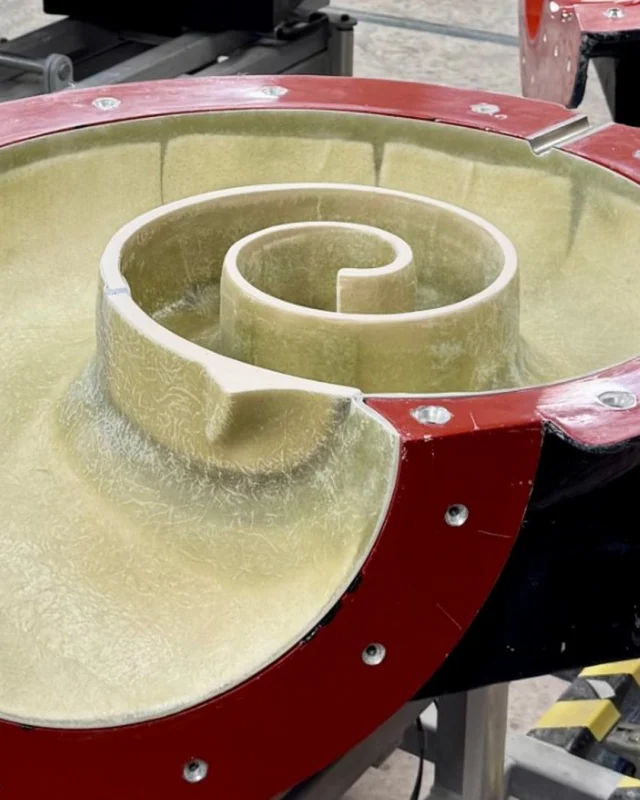
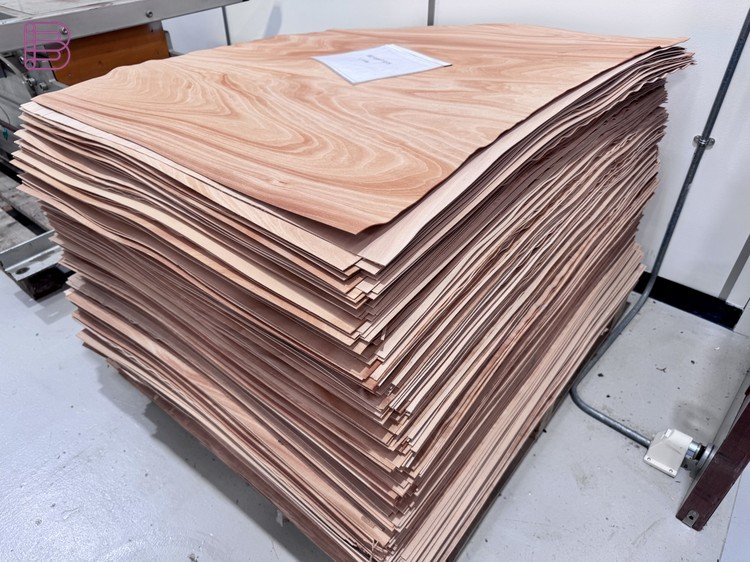
That symphony starts with flat sheet wood, cut to size and pressed, under heat, into Bowers & Wilkins’ own plywood on what Kerr calls “a massive, enormous piece of Dickensian engineering” — a forming press powerful enough to bend wood into shape while the heat activates the glue that bonds it. From there, cabinets move to a five-axis CNC robot that Kerr describes as “almost balletic” in how it spins, pivots and turns along its programmed path.
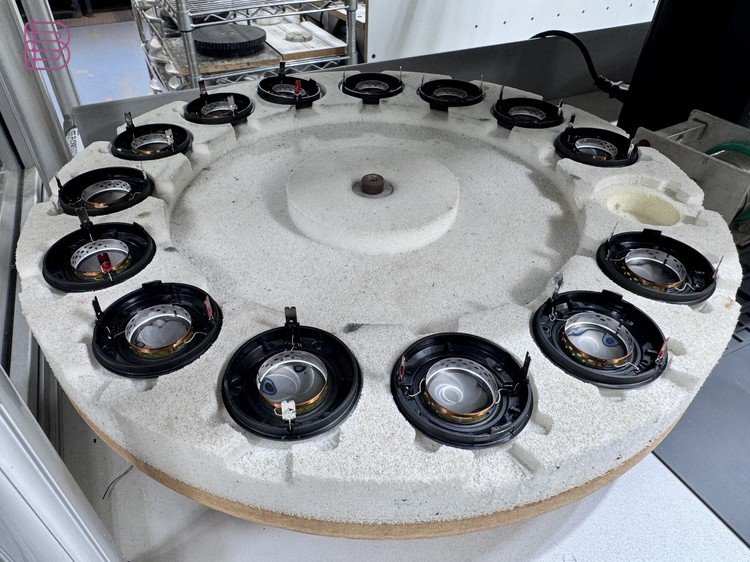
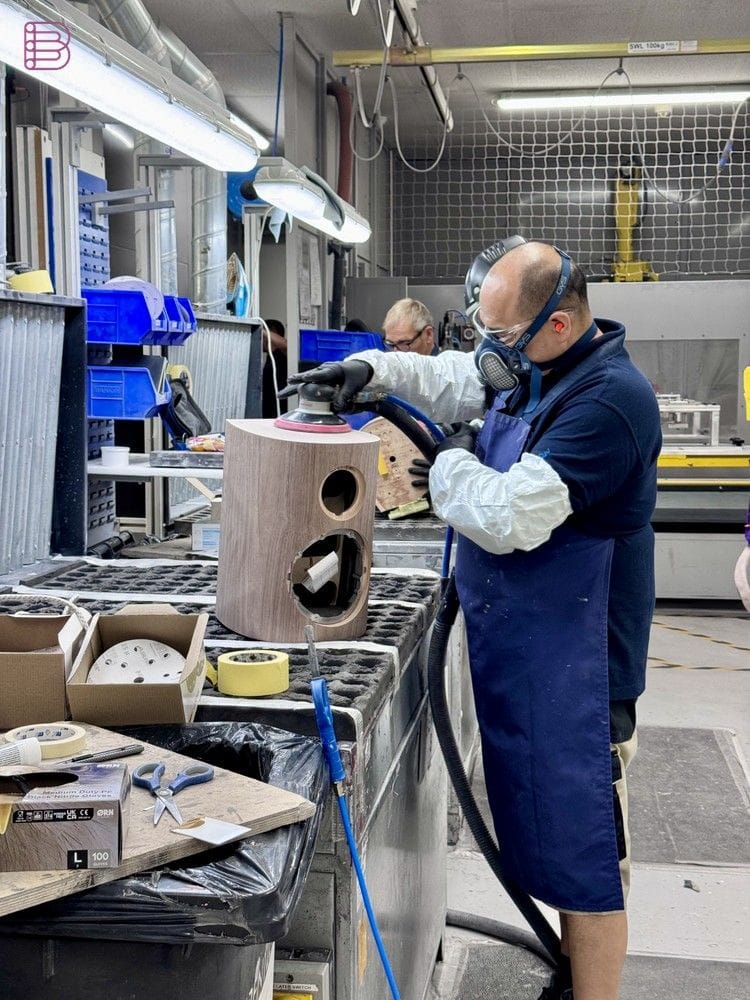
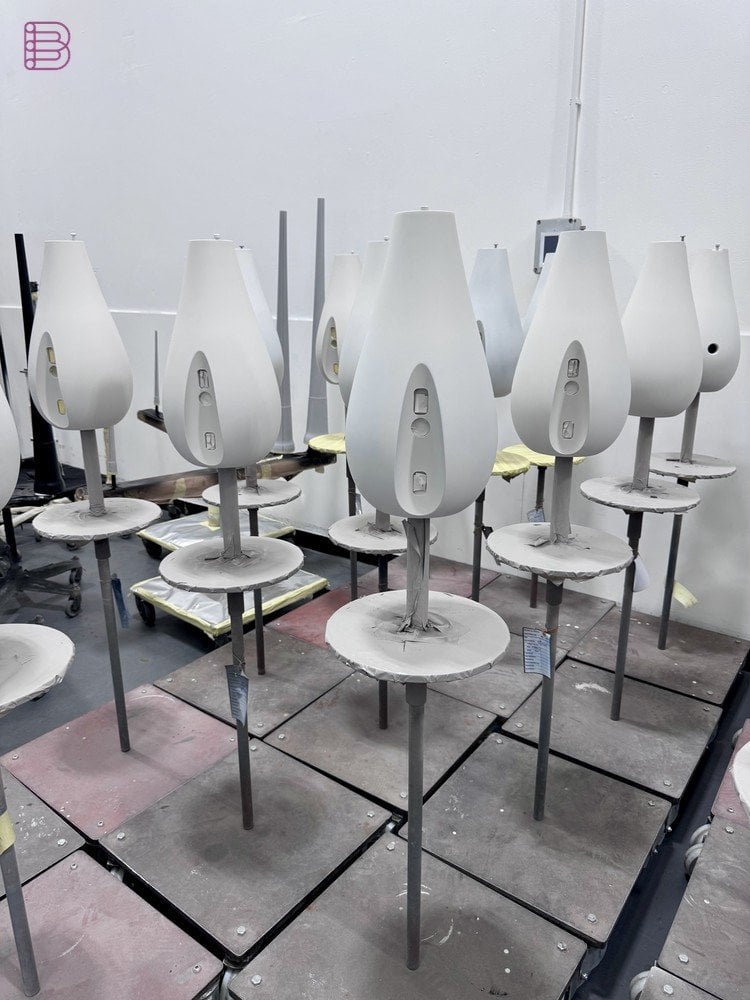
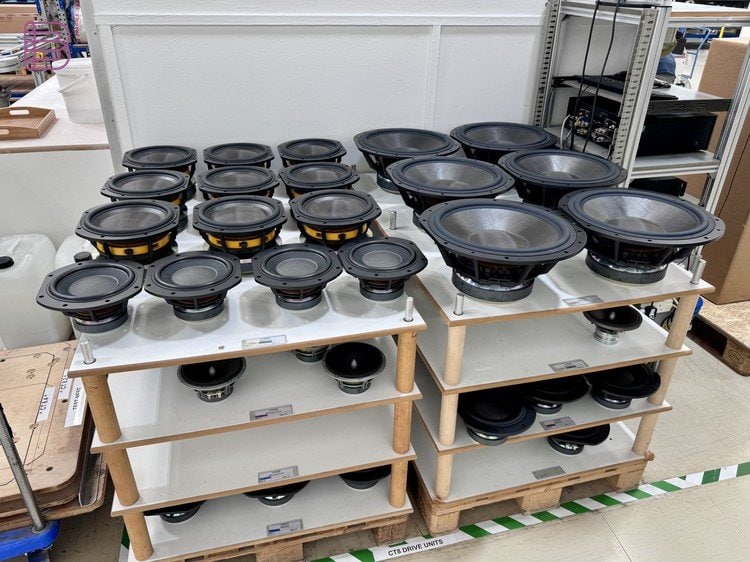
Once a cabinet is assembled, it moves to surface preparation — sanding, then painting and polishing to what Kerr calls “the highest possible standards” — before the two halves of the factory come together: cabinet-making on one side, drive-unit manufacturing on the other. It’s here that Bowers & Wilkins still hand-builds its diamond dome tweeters, growing the diamond material artificially before shaping domes just 40 microns thick and weighing 88 milligrams.
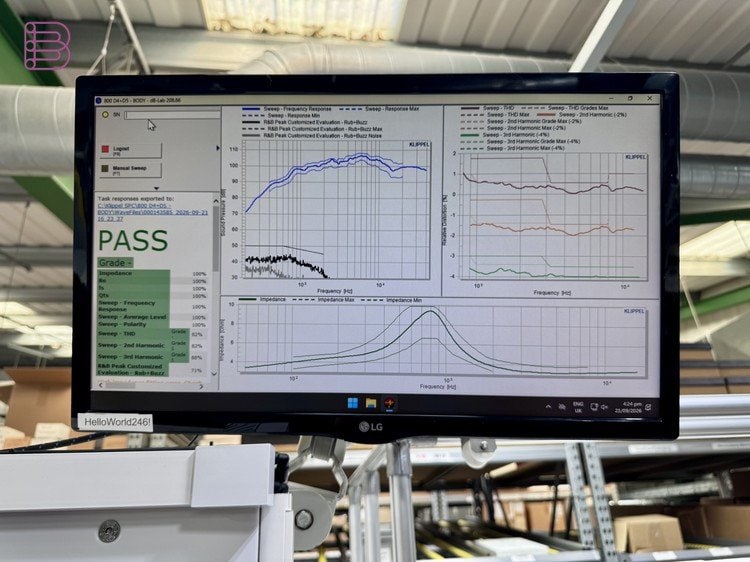
“Precision is, without question, the most fundamental element of everything we do,” Kerr says. “You have to think about loudspeakers as known science. We’re cutting wood to a tolerance of plus or minus 0.2 of a millimetre… if you are measuring, you measure precisely; if you’re weighing, you weigh precisely.” Every finished drive unit and cabinet is tested before it ever reaches a final assembly line — a Klippel measurement rig checks frequency response, distortion and impedance against a strict pass/fail threshold before anything ships.


As Kerr puts it: “The fascinating thing about what we’re doing is we’re using our engineering knowledge, and our technology, and all of the best, most advanced devices that we have, and all the biggest brains that we have, to replicate an imperfect thing. And the imperfect thing is music. You don’t get that reaction from most other home appliances — but you do from loudspeakers, and I think that’s why people connect with them so profoundly, and that includes the people who make them.”
From Sound United to Harman: Bowers & Wilkins’ New Chapter
Bowers & Wilkins has changed hands more than once this century. EVA Automation acquired the company in 2016; Sound United took over in October 2020; and in 2022, Masimo Corporation — the medical device company behind the pulse oximeter, run by founder Joe Kiani — bought Sound United’s entire portfolio of audio brands, including Bowers & Wilkins, Denon, Marantz, Polk Audio and Definitive Technology. That chapter proved turbulent: activist investor Politan Capital Management pushed for years to have Masimo spin off its consumer-audio division, and several senior executives departed during the standoff.
It ended this year. In May 2025, Masimo agreed to sell Sound United to HARMAN International — the Samsung-owned audio group — for $350 million in cash, with the deal closing on 23 September 2025. Sound United, Bowers & Wilkins included, now operates as a standalone Strategic Business Unit within HARMAN’s Lifestyle Division. Dave Rogers, President of that division, called it “a strategic step forward in the expansion of HARMAN’s core audio business,” adding that Sound United’s brands are “rooted in a deep passion for sound, innovation, and commitment to quality that aligns with HARMAN’s own values.”
For Bowers & Wilkins specifically, the practical promise is continuity: the Worthing factory keeps building, the 800 Series keeps evolving, and the company enters its seventh decade backed by one of the largest audio groups in the world — with, if HARMAN’s stated ambitions are anything to go by, a bigger role still to come across Samsung’s phones, TVs and HARMAN’s automotive audio business.
FAQ
For more on the brand’s flagship loudspeakers, see our earlier coverage of the Bowers & Wilkins 800 Series Diamond D5 launch. Further information is available directly from Bowers & Wilkins.