

For decades, calling an amplifier “Class D” was almost an apology. The topology promised efficiency and a small footprint, but among purists it carried the stigma of a budget shortcut — fine for a soundbar or a car stereo, not for a serious listening room. That reputation is now badly out of date. Anyone following Class D amplifier high-end audio design over the past few years has watched the same switching topology once dismissed as “good enough” move into flagship integrated amplifiers and monoblocks costing tens of thousands of euros. The question worth asking is not whether Class D belongs in high-end audio anymore, but why it took so long to get there.
A Reputation Built on Compromise
The first Class D amplifiers of the 1970s and 1980s worked on a simple idea: instead of continuously varying the output transistors between “on” and “off” the way a linear Class A or Class AB stage does, a Class D stage switches its output devices fully on or fully off, hundreds of thousands of times per second, and lets a filter reconstruct the music from that stream of pulses. It was a clever way to cut heat and power waste, but early implementations were let down by noisy switching, limited feedback, and output filters that interacted badly with real loudspeaker loads. The sound was often described as flat, grainy, or simply uninvolving — and that first impression stuck for a generation of listeners.
What changed the story was work by engineers such as Bruno Putzeys, whose career (detailed in an earlier profile on this site) took self-oscillating switching design from a theoretical curiosity to a commercially viable, measurably transparent amplification method. His Purifi Eigentakt platform, discussed in depth in our look at the Purifi EVAL5 evaluation board, is one of the clearest examples of how far the underlying engineering has moved since those first noisy switching stages.
Why Class D Amplifier High-End Audio Design Finally Works
At its core, a Class D amplifier still does what it always did: it uses pulse-width modulation (PWM) to encode the analogue music signal as a rapid train of on/off switching pulses, then relies on an output filter to turn that switching into a smooth analogue waveform again. The reason this approach is so power-efficient is straightforward — a transistor that is either fully on or fully off dissipates very little power as heat, unlike a linear output stage that is always partially conducting. That is why a Class D power amplifier can deliver several hundred watts per channel from a chassis that stays close to room temperature, with efficiency figures above 90 percent against roughly 20 to 30 percent for a typical Class AB design.
The historical weak point was linearity: without careful engineering, the switching process itself introduces distortion and noise into the audio band. Modern high-end designs solve this with aggressive, wide-bandwidth feedback and error-correction loops that continuously compare the amplifier’s output against the incoming signal and correct deviations before they become audible. Purifi’s own Eigentakt technology page puts a number on this: its self-oscillating, error-corrected topology holds loop gain above 75dB across the entire audio band, which is what allows a switching amplifier to now measure — and increasingly sound — as neutral as the best linear designs, without the heat, weight, or inefficiency that used to come with high power output.
Two High-End Amplifiers That Prove the Point
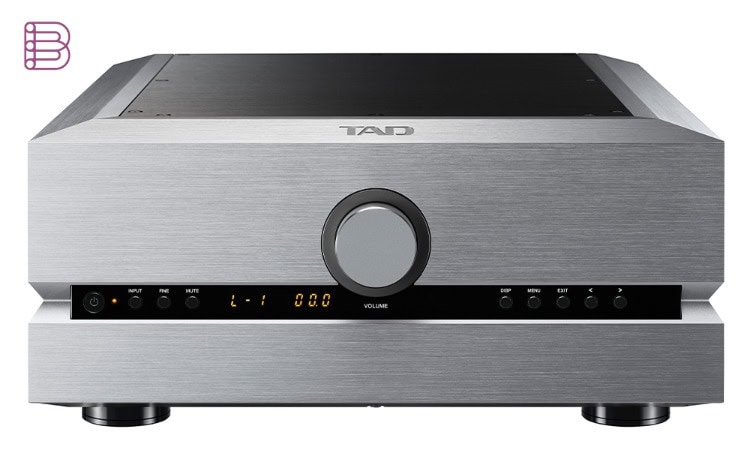
Nowhere is this shift clearer than in TAD’s A1000 integrated amplifier, the Japanese manufacturer’s first product to fuse its preamplifier and power amplifier circuits into a single chassis. TAD builds the A1000 around a Class-D output stage feeding 250 watts into 4 ohms, but wraps it in the same symmetrical, error-suppressing circuit layout the brand uses in its reference-level electronics. The result, according to TAD, is a design intended to reproduce “the artist’s intent with absolute purity” — a claim that would have sounded almost absurd next to the word “Class D” fifteen years ago, and today is simply part of the brand’s flagship pitch.
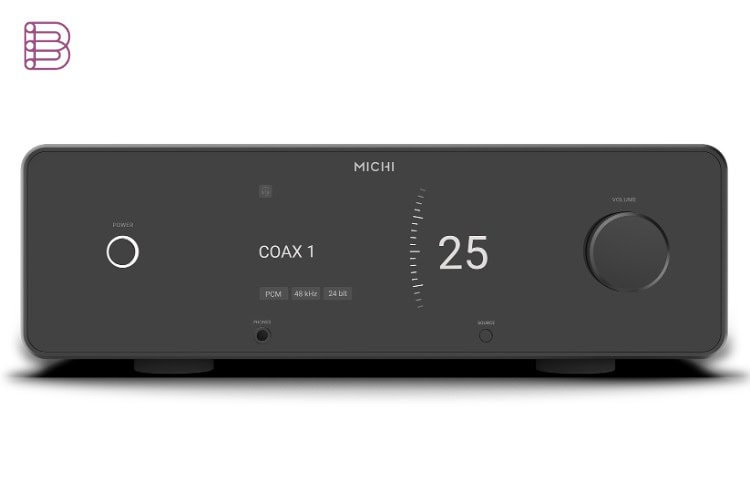
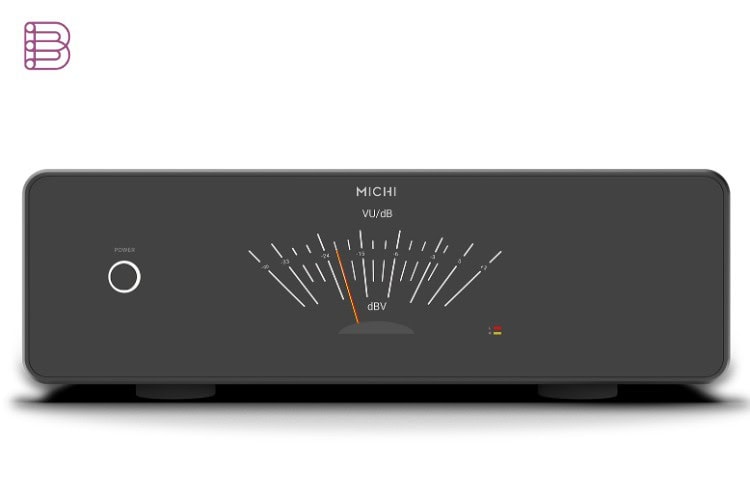
Rotel makes a similar case at a different price point with the Michi Prestige P430 preamplifier and S430 power amplifier. The S430 uses a Class D output stage to deliver 230 watts per channel into 8 ohms, and 390 watts into 4 ohms, from a chassis that shares its compact 431 x 148mm footprint with the rest of the Prestige range — a footprint that would be very difficult to achieve with a comparably powerful linear design. Paired with the P430’s low-noise analogue preamplification stage, the combination shows how Class D output stages are increasingly treated as one component in a larger amplifier design, rather than a shortcut that defines the whole product.
Where Class D Amplification Goes Next
What TAD and Rotel have in common is that neither treats its Class D output stage as the headline feature — it is simply the most sensible way to deliver serious power without a serious heatsink, freeing engineering budget and chassis space for the parts of the amplifier that shape the sound in other ways: power supplies, input stages, and mechanical damping. As more component-level platforms reach Purifi-grade linearity and more established high-end brands validate the approach in flagship products, the old dividing line between “Class D” and “high-end” keeps eroding. A prospective buyer auditioning an integrated amplifier or power amp today would do well to stop asking which output topology is inside, and start asking, as with any amplifier, how it actually sounds in their own room with their own speakers — because on current evidence, a well-engineered Class D stage is no longer a compromise to listen past.