

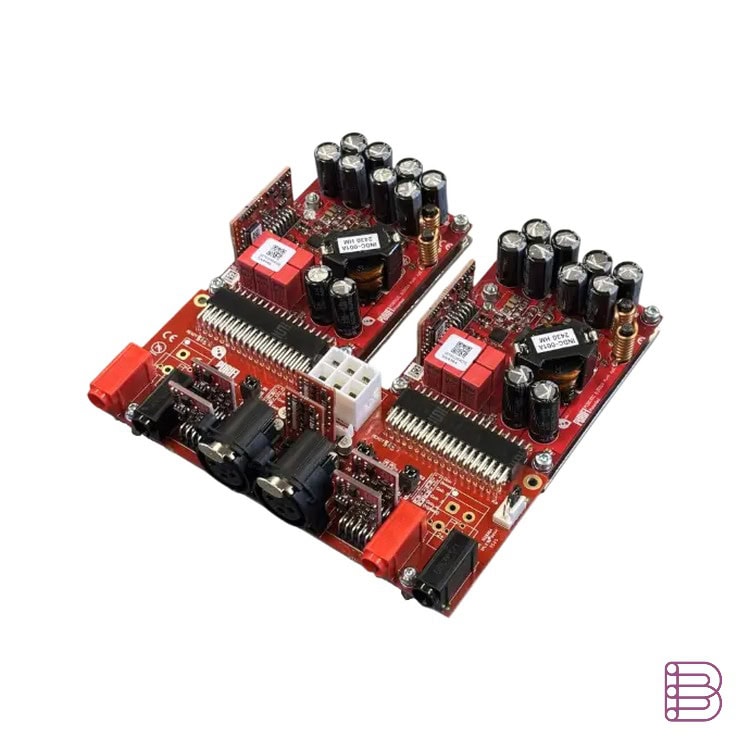
In this Tech Talk, Bruno Putzeys — co-founder of Purifi Audio and the engineer behind Hypex‘s UcD and Ncore amplifier modules, as well as co-founder of Kii Audio — walks through the Purifi EVAL5, the evaluation platform built around Purifi’s second-generation Eigentakt amplifier module. It is, in his own words, a compact but genuinely capable evaluation kit: the kind of board that lets engineers and serious hobbyists hear exactly what a modern Class D amplifier module can do, without the compromises baked into off-the-shelf consumer gear.

What the Eigentakt platform actually is
The Purifi EVAL5 is built around the second generation of Purifi’s Eigentakt amplifier module, model ET90|40. Compared with the first-generation Eigentakt modules, this second generation delivers meaningfully lower noise and lower distortion — the kind of measurable improvement that comes from refining an already-advanced self-oscillating, global-feedback Class D topology rather than starting from scratch. It is precisely the platform Purifi built to let people evaluate that improvement directly, hence the name: an eval kit, not a finished consumer amplifier.
Where the EVAL5 came from
Interestingly, the module wasn’t conceived as a hobbyist product first. Its origin traces back to a custom OEM request: a manufacturer needed a bridge-type-load (BTL) module built to specific requirements, and the engineering work Purifi did to satisfy that brief became the foundation for what eventually shipped, more broadly, as the EVAL5 platform. Building for a demanding OEM client first, then generalizing the result, is a pattern that shows up repeatedly in Putzeys’ work — the constraints of a real, paying customer tend to sharpen a design in ways an open-ended hobby project rarely does.
The Deluxe input buffer, and why it matters
The “Deluxe” designation refers to the kit’s input buffer stage — a detail that’s easy to dismiss as a minor add-on, but which Putzeys treats as anything but incidental. An amplifier module’s raw specifications are only ever half the story; how cleanly the signal is buffered and presented to the power stage in the first place has a direct bearing on the numbers that eval kit is designed to demonstrate. It’s a reminder that in Class D design, distortion and noise performance are decided as much by what happens before the switching stage as by the switching stage itself.
Monoblocks, star grounding, and the case for balance
Putzeys is candid about why the EVAL5 is built and sold as a mono platform rather than a stereo one. The reasoning ties directly back to balanced, differential signal connections and star-grounding practice — techniques with roots stretching back to the earliest days of professional audio wiring, when keeping grounding paths clean and symmetric was the only reliable way to keep noise out of a long cable run. A monoblock topology keeps each channel’s ground reference genuinely independent, which is exactly the kind of discipline a serious evaluation platform needs if the numbers it produces are going to mean anything.
Power specs and the sibling module
The headline figure for the Purifi EVAL5 platform is 750 watts into 4 ohms — comfortably in the territory where a single module can drive a demanding loudspeaker without breaking a sweat. Purifi also offers a lower-power sibling module in the same Eigentakt family, aimed at applications that don’t need the full 750-watt ceiling but still want the same second-generation noise and distortion performance. Between the two, the EVAL5 remains the flagship: the platform built to show what the Eigentakt topology can do without any power-budget compromises.
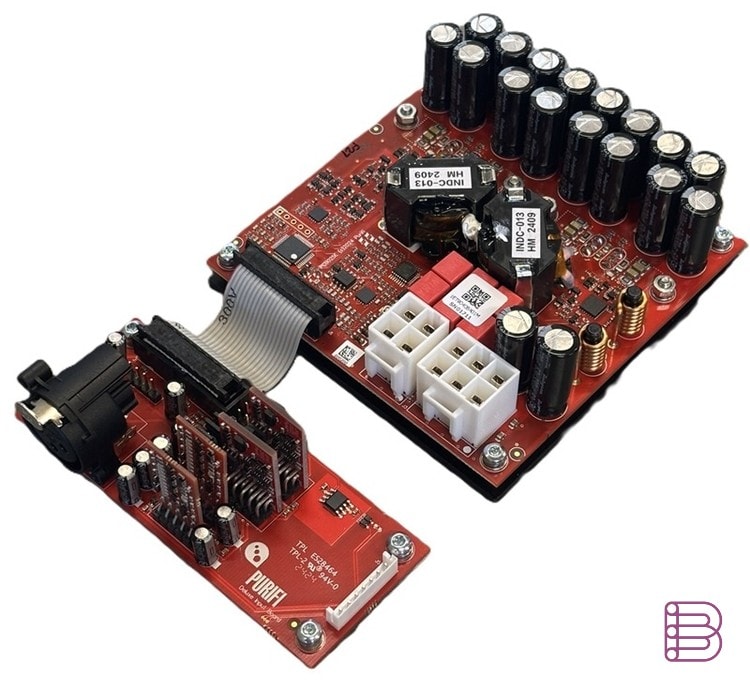
Taken together, the Purifi EVAL5 is less a single product than a demonstration of a philosophy Putzeys has followed since Hypex’s UcD days: build the cleanest possible switching amplifier topology, then build the cleanest possible evaluation platform to prove it. It is a compact but genuinely capable evaluation kit that offers audiophiles and engineers a versatile solution for testing and experiencing high-fidelity Class D sound at close to its current state of the art.
Frequently asked questions
What is the Purifi EVAL5?
It’s an evaluation platform built around Purifi’s second-generation Eigentakt amplifier module (ET90|40), designed to let engineers and enthusiasts measure and hear what that module can do, rather than a finished consumer product on its own.
Where did the EVAL5 module originally come from?
It began as a custom bridge-type-load (BTL) module built to a specific OEM manufacturer’s request. The engineering work behind that project became the foundation for the broader EVAL5 platform.
What does the “Deluxe” input buffer add?
It’s an input buffer stage that shapes how cleanly the signal is presented to the power stage before amplification. Putzeys treats it as directly relevant to the module’s overall noise and distortion performance, not a cosmetic extra.
Why is the EVAL5 a monoblock design rather than a stereo unit?
Putzeys ties this to balanced, differential connections and star-grounding practice, which keep each channel’s ground reference independent — a discipline that matters for an evaluation platform whose measurements need to be trustworthy.
How much power does the EVAL5 deliver?
750 watts into 4 ohms. Purifi also offers a lower-power sibling module in the same Eigentakt family for applications that don’t need that full power budget.