

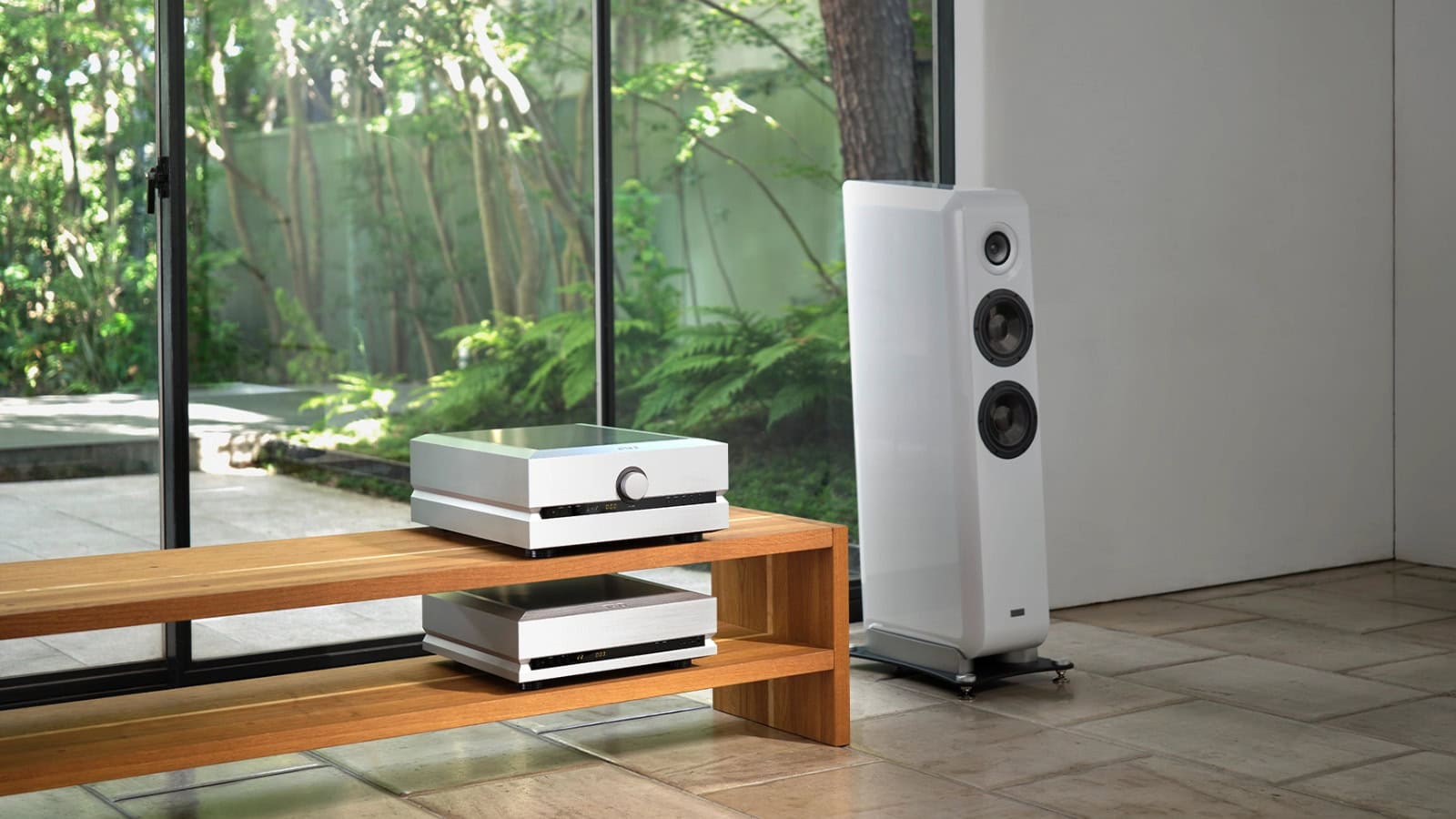
The TAD A1000 is the first integrated amplifier ever built by Technical Audio Devices Laboratories (TAD), the Japanese high-end brand that traces its roots to a Pioneer research lab founded in 1975. Slotted into TAD’s Evolution Series, the TAD A1000 fuses the company’s separate preamplifier and power-amplifier expertise into one fully balanced chassis rated at 250 watts per channel. It has spent the past year collecting international awards, and TAD has just confirmed a digital-equipped sibling for October, proof the platform is far from finished.
TAD A1000: A First for the Brand’s Amplifier Line
TAD built its reputation on separate preamplifiers and power amplifiers for its Reference and Evolution Series systems, so the TAD A1000 marks a genuine departure: input selection, preamplification, and speaker drive now live in one 440 x 200 x 553 mm case. TAD combined the current-feedback preamplifier circuitry and resistance-ladder volume control developed for its separates with a Class-D output stage, without asking listeners to compromise on the brand’s usual measurement and finish standards.
Symmetry From Circuit Board to Chassis
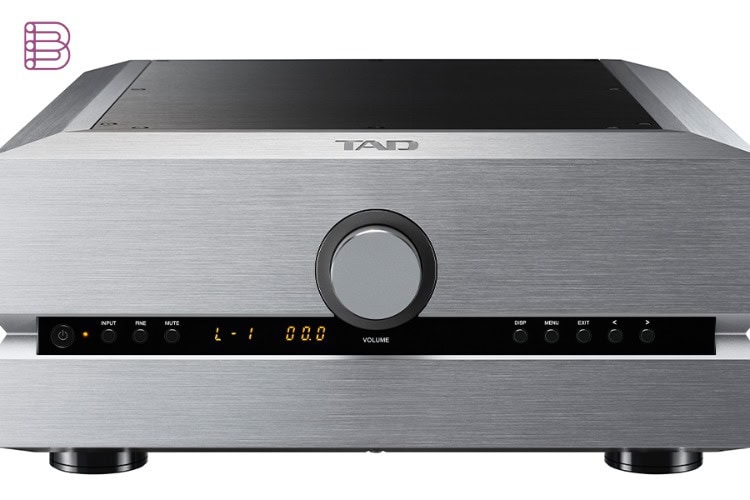
TAD’s engineers describe the design philosophy behind the amplifier as “ultimate symmetry.” A bridge-tied load (BTL) configuration connects two complete amplifiers for the left and right channels, and the transformer coils, rectifying circuits, and smoothing stages are duplicated per channel rather than shared, down to matching wiring lengths. Separate grounding points isolate the preamplifier and power-amplifier stages, and three toroidal transformers are arranged symmetrically around the chassis for balanced weight distribution. It is the same obsession with channel-matching that shaped the brand’s own TAD Reference Series M600 power amplifier, whose dual-mono construction the TAD A1000 now condenses into a single integrated unit.
250 Watts of Class-D Power, Built for TAD Speakers
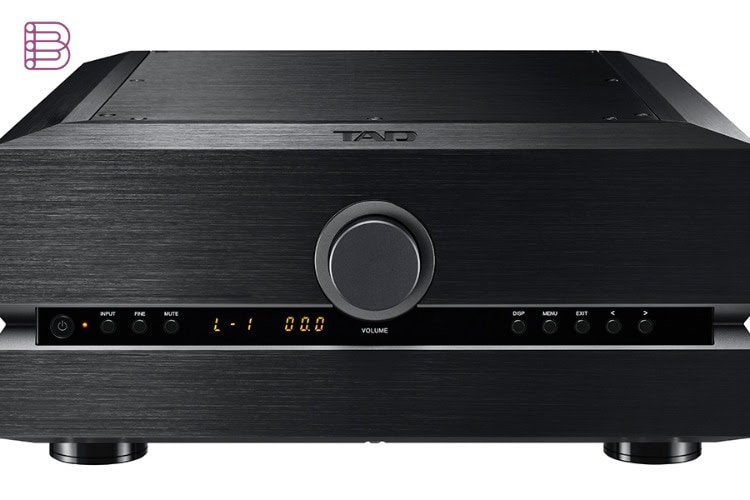
Behind the symmetrical layout, twin toroidal transformers and four proprietary 33,000 microfarad electrolytic capacitors feed a Class-D output stage built around direct FET devices in leadless packages. TAD rates the amplifier at 250 watts into 4 ohms with distortion below 0.05 percent at 125 watts, a signal-to-noise ratio above 100 dB, and a frequency response reaching from 10 Hz to 50 kHz. Four independent internal chambers isolate the preamplifier, power amplifier, transformer, and control circuitry, while three spiked feet decouple the chassis from the floor. Full technical detail, including the ball-bearing-mounted volume knob TAD carried over from its Evolution Series speakers, is available on TAD’s official A1000 product page.
Awards, Reviews, and a Digital Sibling Already on the Way
Since shipping began in December 2025, the TAD A1000 has picked up a Reviewer’s Choice award from Part-Time Audiophile, an Outstanding Product citation from Hi-Fi News, and the Grand Special Prize at Phileweb’s 2026 awards, alongside reviews from SightsNSounds, TecSArt, and Japan’s Stereo Sound. TAD is not standing still on the platform either: on 2 September 2026 the brand announced the TAD-A1000D, a version that adds a third-generation UPCG master clock and a current-feedback DAC stage for digital sources, due in late October. TAD confirms the original, purely analogue amplifier remains in the lineup alongside it.
Pricing and availability
TAD has not published an official price for the amplifier on its global website. Third-party retailers and reviewers cite a European MSRP of roughly €26,000 including VAT (TecSArt), a UK price near £27,995, and a US price around $32,995 — figures mentioned here with attribution rather than as confirmed TAD pricing. The silver TAD-A1000-S has been available since December 2025 through TAD’s network of authorized specialty dealers; the black TAD-A1000-K is offered on a built-to-order basis.
Key specifications
- Model: TAD-A1000 (Silver TAD-A1000-S; built-to-order Black TAD-A1000-K)
- Power output: 250 W at 1 kHz into 4 Ω per channel
- Rated distortion: less than 0.05% at 1 kHz, 4 Ω, 125 W
- Signal-to-noise ratio: 100 dB or more
- Frequency response: 10 Hz to 50 kHz, +0/-3 dB
- Gain: 41.5 dB
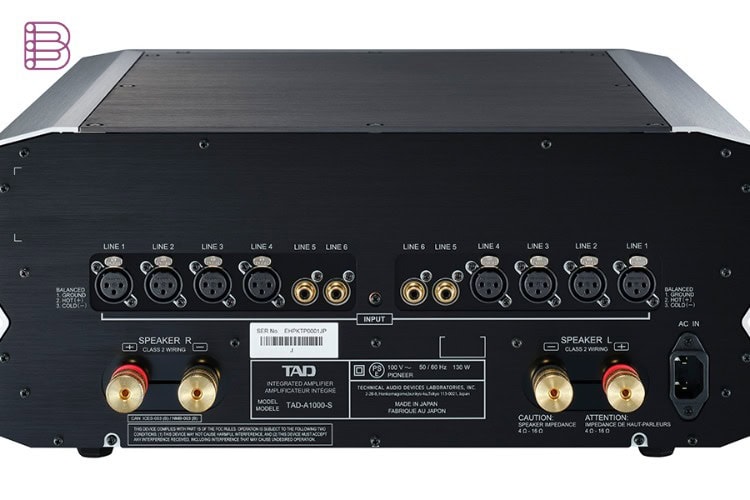
- Inputs: 4 balanced XLR (100 kΩ), 2 unbalanced RCA (50 kΩ)
- Power consumption: 130 W (standby 0.5 W or less)
- Dimensions: 440 (W) x 200 (H) x 553 (D) mm
- Weight: 29 kg