

Purifi Audio is best known outside the industry for a single, blunt claim: the lowest-distortion loudspeaker drivers and amplifiers ever measured. In this Tech Talk, Peter Lyngdorf explains how that Danish startup’s engineering ended up inside two very different Lyngdorf products — the multi-channel MXA-8400 power amplifier and the CUE-100 standmount loudspeaker — and why getting there took three engineers who, by his own account, could never quite agree on which of them was the smartest.
From Snell Acoustics to Purifi Audio
Peter Lyngdorf traces his own interest in this area back to the early 1990s, when he owned Snell Acoustics and the company was among the first to demonstrate digital room correction technology — the lineage that, decades later, led to RoomPerfect. Read more about that early history in our profile of Peter Lyngdorf. It was in the late 1990s that he met Lars Risbo, then a young engineer working on a fully digital amplifier — a project Lyngdorf helped finance, and which Risbo eventually sold to Texas Instruments in 2000, going on to lead its digital amplification engineering team.
The two stayed close friends, and by the early 2010s were talking again about doing something driven purely by sound quality rather than corporate roadmaps. Risbo brought in Bruno Putzeys, another engineer he rated extremely highly — the two of them, according to Lyngdorf, could never quite agree on which of them was the smarter of the pair. Together with Lyngdorf providing financing and structure, the three founded Purifi Audio, with one explicit rule: it had to remain work that Risbo and Putzeys actually wanted to do.

Why Purifi started measuring loudspeaker drivers differently
Purifi’s engineers rented office space from Carsten Tinggaard, the former chief engineer at Scan-Speak, Vifa and Peerless, who was developing drivers for clients including Genelec. Working alongside him, Risbo grew curious about how loudspeaker drivers were actually measured — and concluded that even the best commercially available measurement equipment did not capture enough.
According to Lyngdorf, the team built entirely new measurement technology to study driver behaviour in far more detail, and discovered that a driver’s intermodulation distortion, the distortion generated when multiple tones are reproduced simultaneously, is chaotic and depends on what the driver played moments earlier. That makes it effectively impossible to predict or cancel out through digital signal processing alone, which is why Purifi turned to redesigning the physical driver itself rather than trying to correct around it.
The resulting drivers use a visibly different surround, alongside changes throughout the motor system, cone and chassis that Lyngdorf says were derived largely through in-house mathematical modelling — to the point where, he claims, the most recent woofer designs went straight from computer simulation to production tooling with no further prototyping needed. One specific finding illustrates how much had been overlooked elsewhere in the industry: the closed-loop shape of a driver’s aluminium chassis near the magnet was itself found to generate distortion, once every other, larger source of distortion in a conventional driver had been engineered out.
Eigentakt: Bruno Putzeys’ amplifier technology
Where Purifi’s driver work is credited mainly to Risbo, Lyngdorf describes the Eigentakt amplifier technology as primarily Bruno Putzeys’ own contribution: a feedback loop designed to react far faster, and with a far tighter grip on the amplifier’s output, than earlier Class D designs. The practical result is an extremely high damping factor — a measure of how firmly the amplifier’s output stays fixed regardless of what the connected loudspeaker’s own impedance is doing — which, according to Lyngdorf, effectively decouples the amplifier’s sound from the speaker’s electrical behaviour.
Two very different products, one engineering source
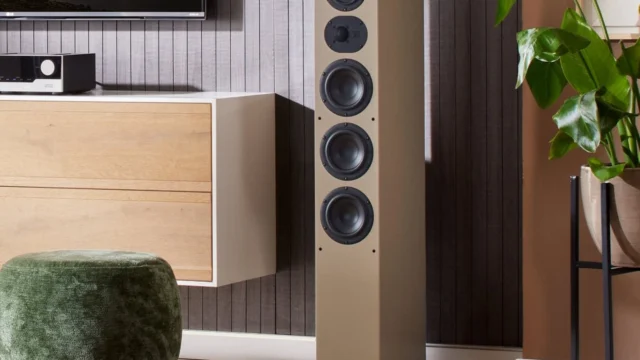
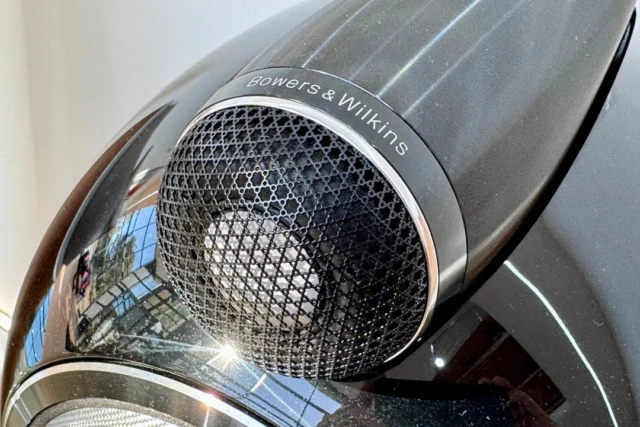
The CUE-100 is, in Lyngdorf’s words, the first genuine high-end loudspeaker carrying the Lyngdorf name, built as a tribute to Purifi’s drivers: a triangular, deliberately asymmetric cabinet designed to avoid internal resonances, paired with the same AMT tweeter used in Steinway Lyngdorf’s own systems.
Unlike most of the wider Lyngdorf range, which favours two-way systems paired with separate powered woofers, the CUE-100 is a standalone 2.0 design aimed as much at how it looks in a room as at outright output — a deliberate departure that Lyngdorf frames as not entirely “his own baby” as a self-described bang-for-the-buck hi-fi enthusiast, but one that has found a clear audience regardless. Read our full CUE-100 review for a closer look at how it performs in practice.
Purifi’s driver and amplifier technology has come up before on Best of High End: our earlier Tech Talks cover how Purifi Audio itself came together, Bruno Putzeys’ career from Philips to Eigentakt, and the Eigentakt amplifier technology in more technical detail.
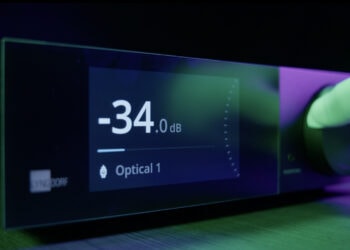
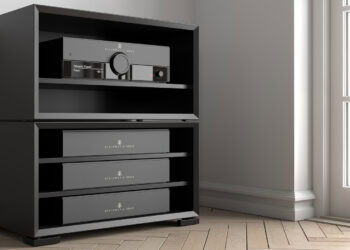
The MXA-8400, by contrast, is built for multi-channel amplification and uses Purifi’s Eigentakt topology across eight channels, paired with what Lyngdorf describes as an unusually powerful, purpose-built switch-mode power supply engineered specifically to avoid feeding electrical noise back into the mains — a problem, he notes, that never shows up in an amplifier’s own published specifications but can still degrade the sound of every other component sharing that circuit. According to Lyngdorf, the amplifier is capable of sustaining close to full output across all eight channels simultaneously, a scenario he says most amplifier reviews never actually test.
Frequently asked questions
What is the connection between Purifi Audio and Lyngdorf Audio?
Purifi Audio was co-founded by Lars Risbo and Bruno Putzeys, with financing and structural support from Peter Lyngdorf, founder of Lyngdorf Audio and Steinway Lyngdorf. The company operates independently, but its driver and Eigentakt amplifier technology now appears in select Lyngdorf products, including the CUE-100 loudspeaker and the MXA-8400 amplifier.
What makes Purifi’s loudspeaker drivers different from conventional designs?
According to Purifi and Peter Lyngdorf’s account, the drivers were redesigned from first principles using purpose-built measurement technology and in-house mathematical modelling, targeting sources of distortion — including intermodulation distortion and chassis-related resonance — that conventional driver measurement and design processes did not previously address.
Is the CUE-100 a typical Lyngdorf product?
Not entirely. Most of the Lyngdorf range pairs two-way loudspeakers with separate powered subwoofers. The CUE-100 is a standalone 2.0 design and, according to Lyngdorf, the first product built specifically as a showcase for Purifi’s driver technology within the Lyngdorf lineup.
What does Eigentakt mean for amplifier performance?
Eigentakt is Bruno Putzeys’ Class D amplifier topology, built around a very fast, tightly controlled feedback loop. In practice this produces an unusually high damping factor and very low distortion, which Purifi and Lyngdorf both describe as clearly audible rather than a purely theoretical specification improvement.