

Set up a turntable for the first time and you’ll run into a small switch on the back of your phono stage, or buried in a preamp menu, labelled “MM” and “MC.” Get it wrong and the sound is either a whisper you have to crank the volume dangerously high to hear, or a distorted mess. That switch exists because of a fundamental design fork at the heart of every phono cartridge: the moving coil vs moving magnet cartridge question. Both designs do the same basic job, converting the physical wiggle of a stylus tracing a record groove into an electrical signal, but they do it in mechanically opposite ways, and that difference cascades into everything from output level to price to how the cartridge should be matched to the rest of your system.
A brief history: the practical standard and the purist’s choice
Moving magnet (MM) cartridges became the practical consumer standard from the 1960s onward, largely because Shure’s patented design made high-quality MM cartridges affordable and easy to manufacture at scale. Crucially, MM cartridges also popularised the replaceable stylus: when the diamond tip wears out, you simply pull out the stylus assembly and click in a new one, no need to send the whole cartridge away or buy a replacement outright.
Moving coil (MC) cartridges, by contrast, trace their roots to professional and studio applications, where the priority was tracking accuracy and fine detail retrieval rather than user convenience. That professional, no-compromise lineage is why MC cartridges are still often described as the audiophile “purist” choice: the design trades away the replaceable stylus and the higher output of MM for lower moving mass and, in many listeners’ experience, a more precise, textured sound. That basic trade-off — output and convenience versus precision and detail — is the moving coil vs moving magnet cartridge debate in miniature.
The technique: how moving coil vs moving magnet cartridges actually generate a signal
In an MM cartridge, tiny magnets are attached to the cantilever (the small rod holding the stylus) and move within fixed coils of wire mounted in the cartridge body. As the magnets move, they induce a voltage in those coils, similar in principle to a small electrical generator. Because the coils can have many hundreds of turns of wire, MM cartridges typically produce a relatively strong output, generally in the range of 3 to 6 millivolts, which is enough for most phono stages to amplify to line level without much extra gain.
An MC cartridge flips the arrangement: the coils themselves are mounted on the cantilever and move within a fixed magnetic field. This is mechanically the more elegant solution for tracking accuracy, because the coils can be made extremely light and small, reducing the moving mass that has to follow the groove at high speed. But those tiny coils can only hold a handful of turns of very fine wire, so MC cartridges typically output a fraction of what MM cartridges do, often 10 to 20 times lower, sometimes as low as 0.2 to 0.5 millivolts. That’s why MC cartridges almost always need either a dedicated MC phono stage with extra gain built in, or a step-up transformer (or head amp) placed ahead of a standard MM phono stage to boost the signal before it’s amplified further. Skip that step and you’ll simply hear background noise instead of music.
Lower moving mass is the other half of the moving coil vs moving magnet cartridge story. Because an MC cartridge’s coils are lighter than the magnet-and-frame assembly in most MM designs, the stylus can respond faster and more precisely to the groove modulations, which is often cited as the reason MC cartridges tend to sound more detailed and dynamically alive, at the cost of the fixed, non-replaceable stylus and typically a significantly higher price.

Today’s flagships: two current examples of the MC philosophy
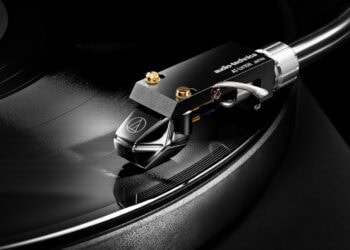
Two recent high-end launches make the moving coil vs moving magnet cartridge theory concrete. Audio-Technica’s flagship AT-MCD1, unveiled at HIGH END Vienna 2026, represents the Japanese brand’s most advanced moving coil design to date, aimed squarely at listeners who want to hear exactly what the lower-moving-mass MC approach can deliver at the top of a catalogue.
Ortofon, one of the most established names in cartridge design, has taken the same philosophy further still with the MC Vertex, its most advanced moving coil cartridge ever. It introduces a new “Vertex” stylus geometry paired with a diamond cantilever, engineering choices aimed at squeezing even more precision and lower moving mass out of the MC design than the brand’s existing range. Both cartridges are firmly in flagship territory on price, underlining that the moving coil vs moving magnet cartridge choice at the very top of the market almost always lands on MC.
So which one do you actually need?
For most listeners starting out or running a modest system, a good MM cartridge remains an entirely sensible choice: it’s easier to live with thanks to the replaceable stylus, works with virtually any phono stage without extra gear, and modern MM designs are genuinely excellent. Where MC earns its keep is in higher-resolution systems where the extra tracking precision and lower moving mass translate into an audible step up, and where the added cost of a dedicated MC phono stage or step-up transformer isn’t the limiting factor in the budget. In short, the moving coil vs moving magnet cartridge decision isn’t really about which technology is “better” in the abstract. It’s about matching a cartridge’s strengths to what the rest of your system, and your ears, can actually resolve.
Key details
Here’s the moving coil vs moving magnet cartridge comparison at a glance:
- Moving magnet (MM): magnets on the cantilever, fixed coils; higher output (~3-6mV); replaceable stylus; works with any standard phono stage
- Moving coil (MC): coils on the cantilever, fixed magnets; much lower output (~0.2-0.5mV); fixed stylus; needs a dedicated MC phono stage or step-up transformer
- Lower moving mass in MC designs is the main technical reason for their reputation for tracking precision and detail
- Current flagship examples: Audio-Technica AT-MCD1 and Ortofon MC Vertex, both current top-of-range MC cartridges
- Rule of thumb: MM for simplicity and easy stylus replacement, MC for maximum tracking precision in a higher-resolution system