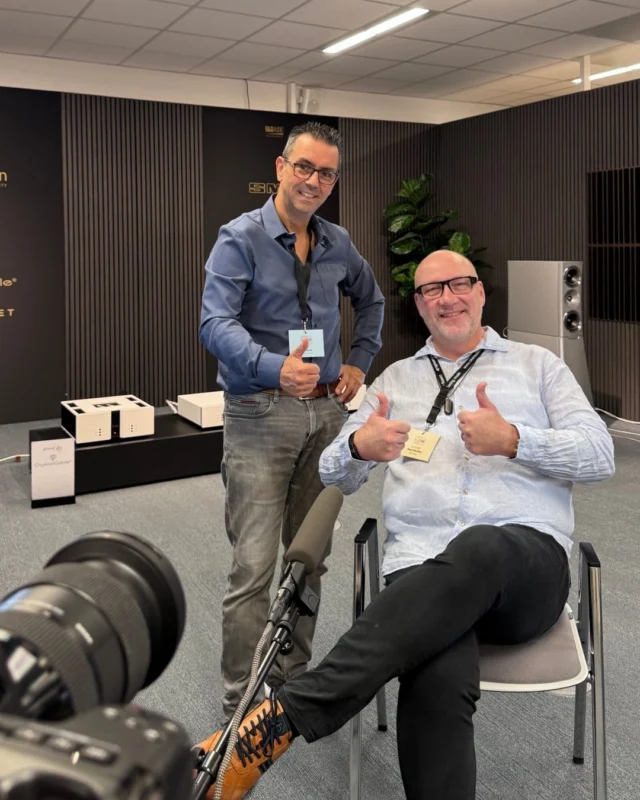


A piano and a violin can play the exact same note, yet nobody would ever mistake one for the other. In this Tech Talk, Roland Hoffmann, Director of Product Marketing at Steinway Lyngdorf, explains harmonic frequencies — the overtones layered above an instrument’s main pitch that give it its character — and why the same overtones that make music sound alive can quietly ruin a hi-fi system if the wrong component starts adding its own.

What harmonic frequencies actually are
Every instrument produces a main tone, its fundamental frequency, but what separates a piano from a violin playing that same note is the pattern of overtones — the harmonic frequencies — layered on top of it. The label “harmonic” is really just a description of how pleasing that pattern sounds to human ears; measured objectively, there’s nothing inherently special about it. It’s simply the specific combination of frequency layers that different instrument families evolved to produce, and that our ears and culture have learned to recognise as musical.
Why a pure tone sounds boring and overtones add character
A perfectly pure tone, with no harmonic content at all, would sound flat and lifeless. Overtones — sidebands of extra frequencies engaged alongside the main note — are what give an instrument, a voice or even a deliberately designed sound effect its richness. It functions a little like resonance, but a wanted kind: not the unwanted resonance an engineer tries to damp out of a loudspeaker cabinet, but the specific, pleasant pattern that makes an instrument recognisably itself rather than a plain electronic tone.
Why adding harmonic frequencies in audio gear is a trap, not a feature
It’s tempting to think that, since overtones and resonances sound pleasant on instruments, adding more of them in an audio product must also be a good idea — which is exactly the logic behind loudspeaker cabinets designed to resonate in a “flattering” way, or tube amplifiers whose non-neutral measurement is treated as a feature. Hoffmann pushes back hard on this: the character that belongs to a recording should come entirely from the instrument, the voice, the room and the microphone used to capture it — full stop. Every downstream component, from DAC to amplifier to loudspeaker, should reproduce that captured sound faithfully and add nothing of its own. Any extra harmonic content introduced along the way is coloration, and the trap is that it then gets applied uniformly to every instrument and every voice in the recording, whether or not it was ever really there.

Why capturing harmonic frequencies well starts with the microphone
Recording harmonic detail well requires genuinely good equipment, the same way amplification choices further down the chain affect what survives to your speakers: a smartphone microphone and a proper studio microphone will capture wildly different amounts of the fine, minute detail that exists in an instrument, a voice, and the room around it. The better the microphone, the more of that harmonic information makes it into the recording in the first place — and the more faithful and fascinating the eventual playback can be, provided nothing downstream adds coloration of its own.
Do harmonic frequencies sound the same to everyone?
Just as real acoustic instruments are hard to reproduce faithfully, cultural background shapes which harmonic patterns sound most natural or pleasing to a listener — a European ear and an Asian ear, for example, can react quite differently to the same melodic ornamentation or overtone pattern, and instruments native to different regions of the world, from Africa to Ireland to India, developed around different harmonic characters entirely. Crucially, Hoffmann stresses that this cultural variation exists on the creation side of music, not the reproduction side: a well-designed loudspeaker or amplifier should reproduce any instrument’s true character faithfully, regardless of where in the world that instrument comes from. A better loudspeaker is simply a better loudspeaker, everywhere.

Frequently asked questions
What are harmonic frequencies in music?
Harmonic frequencies, or overtones, are the additional frequencies layered above an instrument’s fundamental note. They’re what makes a piano and a violin sound different even when playing the identical pitch, giving each instrument its recognisable character.
Why do some hi-fi components deliberately add extra harmonics?
Because certain overtones sound pleasant, some loudspeaker cabinets and tube amplifiers are designed to add their own resonance or distortion. Roland Hoffmann argues this is a mistake, since it colours every instrument and voice in a recording the same way, moving the reproduction away from the original.
Does recording quality affect how well harmonic frequencies are captured?
Yes, significantly. A high-quality microphone captures far more of the fine harmonic detail present in an instrument, voice or room than a basic microphone does, which directly affects how fascinating and true to life the final recording sounds.
Do people from different cultures hear harmonic frequencies differently?
Yes, cultural background influences which overtone patterns and instrument characters sound most natural to a listener, which is part of why musical traditions vary so much between regions like Europe, Asia and Africa.
Should audio equipment try to enhance harmonic frequencies for a better sound?
No. According to Roland Hoffmann, playback equipment should reproduce the harmonic content that was actually captured in the recording as faithfully as possible, without adding any of its own coloration, regardless of what genre or culture the music comes from.