

Steinway Lyngdorf technology started with a question, not a product: could a loudspeaker ever be as good as a piano? In this Tech Talk, Roland Hoffmann, product marketing manager at Steinway Lyngdorf and Lyngdorf Audio, walks through the company’s origin, its full loudspeaker and electronics range, and why the answer to that original question turned out to be more nuanced than a simple yes.

How Steinway Lyngdorf technology began
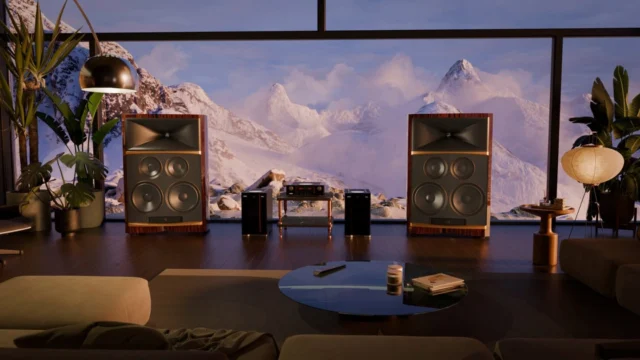
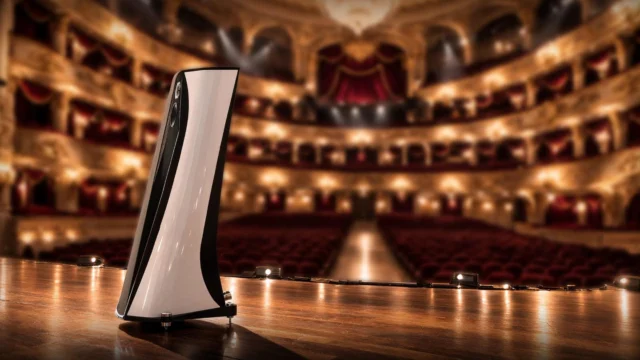
Steinway Lyngdorf started in 2007, not long after Lyngdorf Audio was founded in 2005, as a meeting between Steinway & Sons’ management and Peter Lyngdorf around one specific idea: whether a loudspeaker could ever authentically reproduce the sound of a piano. Steinway’s initial reaction was sceptical — a piano is a piano — but there was no product yet to prove or disprove the idea either way. That product became the Model D, a two-metre-tall open-dipole loudspeaker still in the current lineup today, unchanged in essence because, sonically, it remains the company’s reference.
More than a piano speaker
The brand name on the cabinet reads Steinway & Sons, not Steinway Lyngdorf — a deliberate choice, since the ambition was never limited to reproducing a piano convincingly. Every instrument, voice, orchestra and movie soundtrack needed to reach a quality level worthy of the Steinway & Sons name. The original test — can you close your eyes and believe this is a real piano — was only the proof of concept for a much broader goal covering the full range of what a listener might play through the system.

The loudspeaker range: Model D through Model S
Above the Model D sits the Model B, another open-dipole design that removes the cabinet almost entirely to minimise coloration and let the drive units perform with minimal added character — at the cost of amplifier efficiency, which is why Steinway Lyngdorf scales up its own digital amplification to compensate. For rooms or preferences that don’t suit a large open-dipole speaker, the range extends to the Model O, an entry-level speaker built specifically for close wall placement working in tandem with RoomPerfect, and the Model A, a similar wall-friendly design with two larger woofers reaching further into the bass. The Model S, the most versatile in the lineup, is a compact on-wall speaker for use beside a television or as a surround channel, always paired with dedicated woofers since it carries no bass on its own — Hoffmann calls it deceptively small for how it actually sounds once woofers are added.
Electronics: a closed system by design
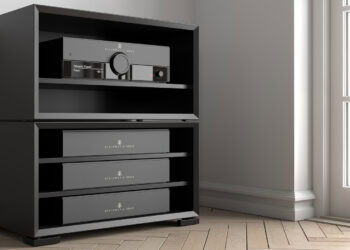
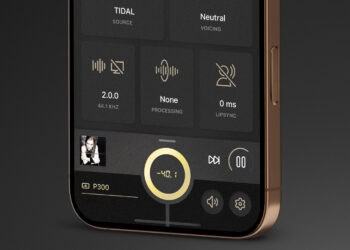
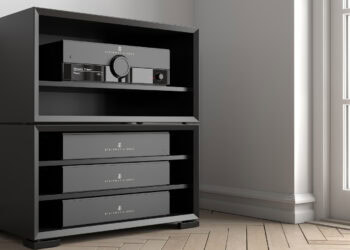
Steinway Lyngdorf’s own amplification is fully digital — turning the volume control increases the output voltage of the power amplifier directly, with the signal reaching the amplifier digitally over a CAT cable, at 400 watts per channel, with most speakers bi- or tri-amped for tighter driver control. The processor lineup spans the stereo-focused SP1 up to the multi-channel P100 and P300, all built-in streamers with Tidal Connect, Spotify Connect and web radio, decoding everything from two-channel stereo through Dolby Atmos and DTS:X. Every component is engineered as a closed system including RoomPerfect calibration, specifically so a Model D or Model S delivers consistent sound quality regardless of room or seating position.
Current highlights: Model C and the 85-inch soundbar
Hoffmann’s personal highlight is the Model C — essentially the middle section of the reference Model D combined with scalable boundary woofers that can be hidden in room corners, delivering Model D-level performance from a visually much lighter, more open design. The other recent highlight is a soundbar purpose-built for 85-inch televisions, effectively three Model S units plus dedicated woofers in one shallow enclosure, with each woofer individually driven by its own 400-watt amplifier channel — a genuinely reference-grade soundbar in a market segment that, according to Hoffmann, previously had no true flagship option.
Who actually buys a Steinway Lyngdorf system
Hoffmann describes the typical customer as someone who loves music and attends concerts regularly, but isn’t necessarily a hi-fi hobbyist who reads audio magazines or enjoys mixing and matching separates. They demand a great deal from what they buy without wanting to manage the complexity themselves — which is part of why Steinway Lyngdorf builds a closed, fully-integrated system rather than a collection of components to assemble, and why the visual design of each speaker, down to how it’s lacquered and finished, matters as much as its measured performance.

Frequently asked questions
When did Steinway Lyngdorf technology begin, and why?
In 2007, following a meeting between Steinway & Sons and Peter Lyngdorf around a single question: could a loudspeaker ever authentically reproduce a real piano. The Model D loudspeaker was built specifically to answer that question and remains the company’s reference speaker today.
What loudspeakers does Steinway Lyngdorf currently offer?
The open-dipole Model D and Model B, the wall-friendly Model O and Model A, the compact on-wall Model S, and the newer Model C, which combines the Model D’s reference midrange section with scalable boundary woofers.
Is Steinway Lyngdorf only designed to reproduce piano music well?
No. While the brand’s proof of concept was reproducing a real piano authentically, the goal from the start was reproducing every instrument, voice, orchestra and movie soundtrack at a quality level worthy of the Steinway & Sons name.
Why is Steinway Lyngdorf built as a closed electronics system?
To guarantee that sound quality stays consistent across every speaker, room, and seating position. Amplification, processing and RoomPerfect room calibration are engineered together from the ground up rather than sold as separate, mix-and-match components.
Who is the typical Steinway Lyngdorf customer?
Usually a serious music lover who attends concerts and has demanding, well-trained ears, but isn’t a traditional hi-fi hobbyist interested in mixing and matching separate components from different brands.