

Purifi speaker drivers didn’t start with a cone or a magnet — they started with a measurement problem. In this Tech Talk, Bruno Putzeys explains why Purifi spent nearly two years building a model before designing a single driver, how a Purifi speaker driver’s motor ended up nearly free of one of the oldest known distortion mechanisms in loudspeaker design, and why the real breakthrough turned out to be hiding in the rubber surround, not the magnet.

Why Purifi speaker drivers start with a physics model, not a magnet simulation
Standard magnetic simulation software can predict what a driver’s motor will do, but not why — not how a specific change in geometry or magnet placement produces a specific change in behaviour. Purifi spent close to two years developing a simplified, physics-based motor model that could explain that relationship in a form simple enough to reason about on paper. That model successfully predicted almost every distortion mechanism in a driver’s motor, with one exception: magnetic hysteresis, the same phenomenon Purifi later had to tackle separately in its amplifier output chokes.
The insight that unified three “different” distortion effects
The model’s biggest early payoff was recognising that three effects long treated as distinct — the voice coil’s own field adding to or subtracting from the magnet’s field depending on current direction, reluctance force pulling the voice coil into the iron regardless of current direction, and the way a moving coil’s self-inductance changes with cone position — are, in Lars Risbo’s words, “not simply related, they are the exact same thing.” Modelling them as one effect let Purifi design it out directly, publishing the underlying paper and keeping driver inductance essentially constant across an enormous range of cone excursion. That work also produced Purifi’s in-house measurement rig, nicknamed the red box: an oversized, precisely calibrated sound card and amplifier that probes a driver’s motion and voltage to derive its parameters, including suspension stiffness, far faster than a magnetic simulation — and one that Purifi has verified matches simulation and physical measurement in lockstep.
The surprise: a Purifi speaker driver’s surround, not its motor, was the real problem
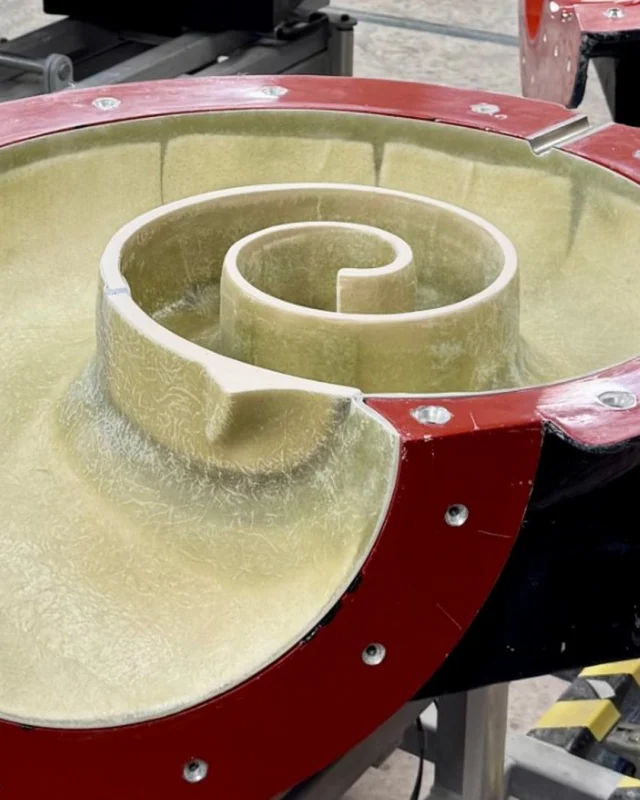
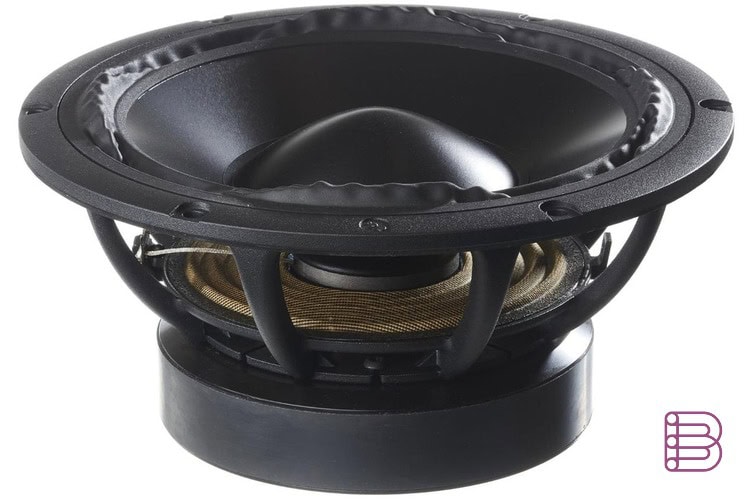
Once the redesigned motor was built, harmonic distortion barely moved — a result Putzeys calls a “massive disappointment” at the time. The actual culprit was the rubber roll surround: pushed fully out, most of a conventional surround simply locks up and stops moving, shrinking the driver’s effective radiating area; pushed the other way, the whole surround follows the cone and the radiating area grows. On a driver where that surround makes up close to 20% of the total cone area, the resulting efficiency swings by more than a decibel, producing amplitude modulation and second-harmonic distortion that the motor model alone never flagged. Purifi’s fix — internally nicknamed “Wormy” for its unusual look — cuts the surround into alternating up-and-down sections with a small stress-relief ridge that lets the rubber flex without stretching, balancing the radiating-area changes against each other. It looks unusual enough that, according to Putzeys, it has become a visual shorthand: seeing a Wormy surround now tells people at a glance that they’re looking at a Purifi speaker driver.
Choosing between Purifi’s paper and aluminium driver lines
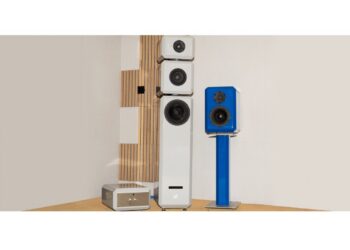
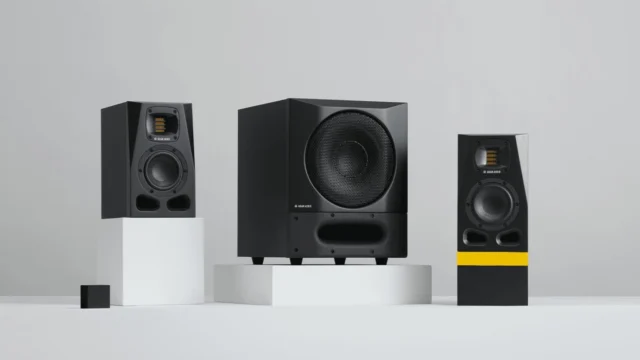
Purifi builds two driver lines from the same motor and surround technology: aluminium cones, which stay smoother for longer before a sharper breakup at higher frequencies, and paper cones, which break up more gradually but within the working band. Because Purifi’s motors are so low in distortion, cone-related distortion becomes visible in a way it normally wouldn’t on a noisier driver, so the company publishes an app note on handling the aluminium breakup peak correctly in a passive crossover — placing an LC circuit in series, which isolates the driver at that frequency, rather than notching it out in parallel. Ranges currently run from 4-inch to 10-inch drivers, chosen to launch first in the popular 6.5-inch mid-bass format before expanding in both directions — the 4-inch model featuring prominently in Purifi’s own compact demonstration speaker.
Frequently asked questions
What makes a Purifi speaker driver different from a conventional driver?
A Purifi speaker driver is built from a physics-based motor model that eliminates several long-standing distortion mechanisms, combined with a distinctive segmented “Wormy” surround that prevents the radiating surface area from changing as the cone moves.
What is the “Wormy” surround on a Purifi speaker driver for?
It solves surface-area modulation distortion. A conventional roll surround changes the driver’s effective radiating area as the cone moves, causing amplitude modulation. The segmented Wormy design balances that change out, which is also why it looks visually distinctive.
What is Purifi’s “red box” measurement system?
It’s Purifi’s in-house driver measurement rig — an oversized, highly calibrated sound card and amplifier that probes a driver with a large signal to quickly and accurately derive its parameters, cross-checked against both magnetic simulation and Purifi’s physics-based motor model.
Should I choose a Purifi aluminium or paper cone driver?
Aluminium cones offer a smoother response with a sharper breakup at higher frequency and need a specific series-LC crossover treatment for best results, detailed in Purifi’s app notes. Paper cones break up more gradually and are more forgiving in a simple crossover design.
What sizes of Purifi speaker drivers are available?
Purifi’s range currently spans 4-inch to 10-inch drivers. The company started with the popular 6.5-inch mid-bass format before expanding both smaller and larger.