


Ahead of IFA 2026, Samsung didn’t wait for the show floor. At Samsung Connect Berlin — the brand’s own showcase running alongside IFA — Best of High End sat down with Ankush Garg, who heads Samsung’s European TV and Sound device team (EVO) out of the UK headquarters, and Charlie Bae, Head of Product Management within that same team, responsible for TV and sound devices across Europe. Between them, they walked us through the technology Samsung is betting its living-room future on: Micro RGB, a design-first lifestyle range, an AI companion that talks back, and a sound strategy built for homes that don’t have room for five speakers and a subwoofer.

Micro RGB: smaller LEDs, purer colour

Samsung’s headline picture technology this year isn’t an incremental spec bump — it’s a different way of lighting the panel. “Mini LED, traditionally backlight is white, or blue,” Garg explained. “But we have RGB lighting, individually controlled by our AI processor.” The result, he said, is a jump in colour purity and picture quality driven by that processing power.
The “micro” in Micro RGB refers to LEDs under 100 micrometres — small enough, according to Garg, that neighbouring red, green and blue emitters don’t bleed into one another the way larger clusters can. “With those micro-sized LEDs, there’s no interference,” he said. “We can achieve zero blooming and 100% colour volume in BT.2020.” It’s a distinction Samsung is keen to draw against ordinary mini-LED sets, and one both executives returned to when asked what they’d want visitors to experience first on the stand at Samsung Connect Berlin. For a look at how that panel technology has already reached Samsung’s own line-up, see our first look at the Samsung R95H Micro RGB TV.

Design-first screens: The Frame and glare that disappears
Samsung’s lifestyle lineup on display at Samsung Connect Berlin keeps growing — The Frame now scales up to 98 inches (a US-only size for now; Europe’s largest remains smaller), Movingstyle reaches 85 inches, and The Freestyle Plus projector rounds out the range for rooms where a fixed panel isn’t the answer. What’s driving it, according to Garg, is what he called “the invisible technology trend” — European buyers who want their TV to disappear into the room rather than dominate it. “We are also a continent where home renovation and home interiors are a big part of how we want to live,” he said.
This year’s headline upgrade for The Frame is an enhanced anti-glare coating. “Almost without any reflection from the light, the painting mode looks even more realistic — almost like a real painting,” Garg said. The Frame also carries over last year’s move to Neo QLED panels for genuine TV-watching duty, plus a wireless One Connect box for a cleaner install.
Bae added a number that’s easy to underestimate: The Frame’s Art Store now holds more than 5,000 pieces, sourced through partnerships with galleries across Europe and the US. “You can enjoy your art pieces in your house, not visiting a gallery,” he said.

Vision AI Companion: from passive viewing to a screen you talk to
Samsung’s pitch for its Vision AI Companion is that it changes what a television is for. “We believe Vision AI has the potential to change the role of the TV from a device you passively view to one you can actively engage with,” Garg said. In practice, that spans everything from picture and sound tuning — AI Football Mode, which many viewers first noticed during the World Cup, and AI Sound Controller Pro, which can mute crowd or commentary noise selectively — to on-screen answers for whatever question comes up mid-programme. Garg’s example: a family watching a wildlife documentary who want to know more about the animal on screen, without reaching for a phone.

Content discovery is the use case both men came back to unprompted. “Sometimes even I, sitting with my kids, have to find content that’s right for a 10-year-old and suitable for a five-year-old at the same time,” Garg said. “You give your need to the AI agent and get recommendations you can watch together as a family.” Bae described using the same tool with his own children — asking the TV to identify an actor mid-scene rather than pausing to search. “It’s not passively watching a movie or drama anymore — we’re actually communicating with the TV.”
The AI Hub behind it — a running theme throughout Samsung Connect Berlin — isn’t Samsung-only, either: alongside its own agents, it houses Bixby, Gemini, Perplexity and Microsoft Copilot, so viewers can pick the assistant they already trust.
Sound without the seven-speaker commitment
For anyone who wants cinematic sound without a full surround system, Samsung’s answer, on show throughout Samsung Connect Berlin, starts with Eclipsa Audio, the open-source spatial format developed with Google and now rolled out across the TV lineup down to UHD models. “It has a 3D sound bubble around you,” Garg said, describing testing it at home with a K-pop concert stream. “I felt like I was actually at the concert.” He linked the appeal directly to a post-pandemic shift in expectation — a desire for that at-home “moment” rather than only getting it by going out.
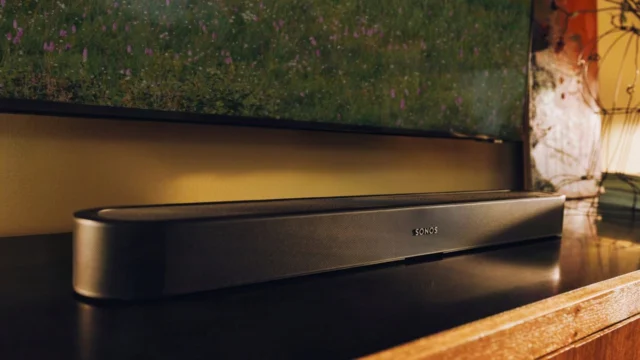
For tighter rooms, Samsung’s newer all-in-one soundbar integrates the woofer and satellite channels into a single unit, with a gyro sensor that detects whether it’s mounted horizontally or vertically and adjusts output accordingly. And on the higher end, the brand is introducing a new wireless speaker — Music Studio — designed by French designer Erwan Bouroullec, marking ten years since his first collaboration with Samsung. “It can be a showpiece as well as a speaker,” Garg said, and — like the rest of the audio range — it ties into the TV through Samsung’s Q-Symphony system, letting TV and speakers work as one.

What to actually go and look at
Asked what they’d point a first-time visitor to on the Samsung Connect Berlin floor, Garg and Bae gave two different, complementary answers. Garg’s pick is the Micro RGB flagship: “The whole system works like a beautiful machine, and the colour volume you get is out of this world — it’s almost like stepping into reality. And to cap it off, there’s a glare-free layer on it too.” Bae’s pick is that glare-free layer itself, now extended down to the more accessible OLED S90 series rather than staying exclusive to the flagship S95. “Consumers see the painful experience of too much reflection on a TV near a big window,” he said. “With glare-free technology, that disruption is gone. I love it.”