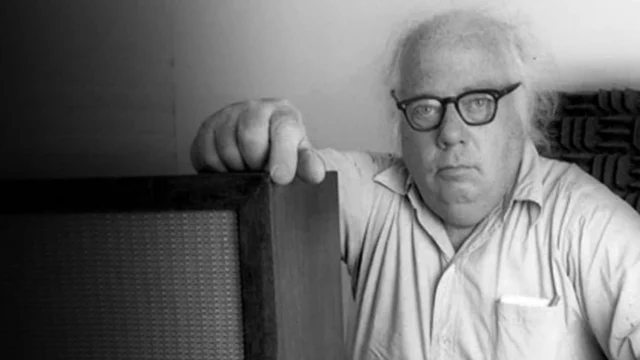


Few figures in loudspeaker history combined technical brilliance with sheer stubbornness quite like Paul W. Klipsch. In 1946, working alone in a corrugated tin shed in Hope, Arkansas, he designed and hand-built a horn-loaded loudspeaker so effective at reproducing live music that it launched a company, a design philosophy, and a legend that is still in continuous production more than 70 years later.
From Radios to Locomotives: The Making of an Engineer
Paul W. Klipsch’s path to loudspeaker design was anything but direct. After graduating from New Mexico State University, where he played cornet in the university band, he went to work for General Electric designing radios later sold under the RCA name. In 1928 he answered a notice on the GE bulletin board and spent three years maintaining electric locomotives in Chile, before entering graduate school at Stanford. With his engineering degree in hand, he worked as a geophysicist for two Texas oil companies. Paul W. Klipsch also served in the U.S. Army during the Second World War, reaching the rank of Lieutenant Colonel. It was during his posting at the Southwest Proving Grounds in Hope, Arkansas, that he began refining a corner-horn loudspeaker design in his own officer’s quarters, to the astonishment of visitors who heard it.
The Tin Shed: Birth of the Klipschorn
Paul W. Klipsch received a patent on his loudspeaker design in 1945 and registered Klipsch & Associates a year later, building each cabinet with his own two hands until he hired his first employee in 1948. The speaker itself did not even get its name from him: during an early sales call in New York, a prospective customer told him, “We’ve heard all about your corner horn,” and Paul W. Klipsch simply replied, “We call it the Klipschorn.” The Klipschorn went on to prove that a loudspeaker could reproduce the scale and dynamics of a live orchestra inside an ordinary living room, and it remains the only loudspeaker in the world to have stayed in continuous production for more than seven decades — still built by hand in Hope, Arkansas today.

The Four Principles of Klipsch Sound
Klipsch’s engineering philosophy rested on four acoustic principles that still guide the brand: high efficiency with low distortion (what he called Klipsch’s Law, efficiency inversely proportional to distortion), controlled directivity that directs sound where it is needed without wasting acoustic energy, wide dynamic range from the softest passages to the loudest peaks, and controlled frequency response free of artificial coloration. He was uncompromising about the physics behind these ideas. As he put it: “My theories on audio and audio reproduction will be proven wrong only when the laws of physics change.”

A Character to Match the Engineering
Paul W. Klipsch was as famous for his personality as for his patents. Disgusted by loudspeaker advertisements forever claiming “another major breakthrough,” he once hurled a hi-fi magazine into the air during a 1960s marketing meeting and shouted “Bullshit!” — a moment that gave rise to the company’s irreverent “Bullshit” lapel buttons, still handed out at trade shows today, and the tongue-in-cheek pamphlet “Ho Hum, Another Major Breakthrough.” Away from the workshop, his two other passions were trains and aircraft. “My first great love was railroads,” he once said, “but then in 1911 I saw Lincoln Beechey flying in and out of Purdue stadium and I fell in love with airplanes. I didn’t forsake my first love, I just became polygamous.”

Iconic Designs and a Growing Heritage
Beyond the original Klipschorn, Paul W. Klipsch personally developed the loudspeakers that still anchor the brand’s Heritage line:
- Klipschorn — the original corner horn, in continuous production since 1946
- La Scala — a more compact horn design developed for professional touring use
- Cornwall — a three-way floorstander for listeners without a usable room corner
- Heresy — originally built as a center-channel companion to the Klipschorn
- Rebel and Belle — further variations on his horn-loaded philosophy
Today’s Klipsch Heritage Series — the Klipschorn, La Scala II, Cornwall III and Heresy III — remains in production and is still regarded as among the finest loudspeakers in the world, exemplified by the modern Klipschorn AK7.

Legacy
Paul W. Klipsch’s acoustics career spanned more than half a century, from founding one of America’s first dedicated loudspeaker companies in 1946 to publishing a paper in the Journal of the Audio Engineering Society as late as 2000. Along the way he accumulated 23 patents, received the Audio Engineering Society’s Silver Medal in 1978, and was inducted into the Engineering and Science Hall of Fame in 1997 alongside Thomas Edison and the Wright brothers, followed by the Consumer Electronics Hall of Fame in 2004. He died on May 5, 2002, at the age of 98. As his son Fred Klipsch put it: “Paul was a verifiable genius who could have chosen any number of vocations, but the world sounds a lot better because he chose audio.” Today, Klipsch Group is part of Premium Audio Company, a subsidiary of Gentex Corporation, but every Heritage speaker built in Hope, Arkansas still carries forward the four principles Paul W. Klipsch laid down in that tin shed nearly 80 years ago. (Source: Klipsch’s official founder biography.)