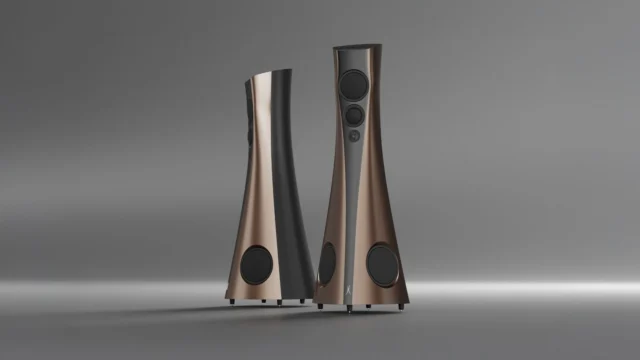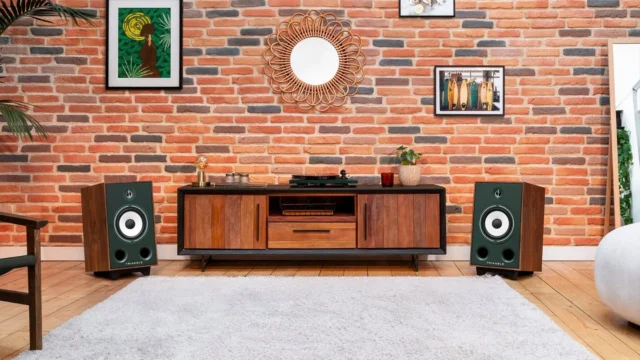


Brooklyn-based studio monitor maker Ex Machina Soundworks has combined its Terra active monitors with dedicated Gravity subwoofers into a single, unified 2.2 system. Marketed simply as Ex Machina Terra Gravity, the package pushes the acclaimed Terra’s linear low-frequency extension from 40Hz down to 30Hz while lifting maximum output to 112dB at 1kHz, without asking the user to integrate a third-party subwoofer or bass-management processor.
A Unified 2.2 System, Not a Bolt-On Subwoofer
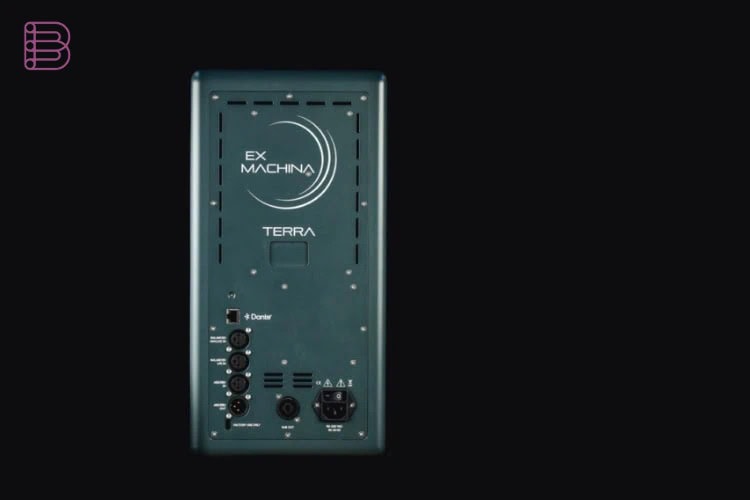
Most near-field setups gain bass extension by adding an independent subwoofer, complete with its own amplifier, its own level control, and its own phase-alignment guesswork. Ex Machina’s approach is different: Gravity is a passive design, powered directly from Terra’s rear-panel amplification, so the pair of monitors and the pair of subwoofers share one signal path, one conversion stage and one noise floor. There is no separate bass-management box to configure and no external amplifier to level-match.

PuriFi-Powered Precision
Terra’s three-way coaxial cabinet pairs an 18cm coaxial midrange/tweeter, now in its third generation, with an 18cm PuriFi PTT6.5W96-08 woofer fitted with a custom concave aluminum diaphragm. Gravity contributes a 26cm PuriFi subwoofer per enclosure, so the complete four-driver system leans on the same low-distortion driver technology throughout. Ex Machina says using a stereo pair of subwoofers, rather than a single .1 unit, preserves stereo bass information and keeps the whole array inside the listening triangle for coherent phase behaviour, a detail that matters as much in a critical listening room as it does in a professional studio.

Zero-Phase Integration and Living Calibration
Terra’s Peregrine DSP, built around an Analog Devices ADSP-21569 SHARC+ processor, handles crossover integration and time alignment for the full four-driver configuration, including a zero-phase LR4 digital crossover at 80Hz between Terra and Gravity. Amplification runs on Hypex NCoreX modules, with an ESP32 co-processor providing WiFi control and over-the-air calibration updates, meaning the Ex Machina Terra Gravity system’s driver-level corrections can keep improving after installation, rather than being fixed for the life of the product. Users retain manual control over delay compensation and subwoofer gain trim, and Gravity can act either as a seamless extension of Terra or accept a discrete LFE input for film and game-audio work.
Pricing and availability
A single Terra monitor is priced from $2,999, with the Gravity subwoofer pair listed at $3,999 through Ex Machina’s dealer network, putting a complete Terra Gravity pair-plus-pair system at roughly $10,000 depending on configuration and region. The system is available now through Ex Machina’s US shop and its international dealer network.
Key specifications
- Frequency response: ±1.5dB, 30Hz-30kHz (F6 at 20Hz) with Gravity engaged
- Maximum SPL: 112dB @ 1kHz, 106dB @ 50Hz
- Phase response: ±15° across the linear passband
- Drivers: 18cm coaxial midrange/tweeter + 18cm PuriFi woofer (Terra), 26cm PuriFi subwoofer per enclosure (Gravity)
- Crossovers: zero-phase LR4 digital at 200Hz, 2kHz (Terra internal) and 80Hz (Terra to Gravity)
- Amplification: Hypex NCx252MP and NCx-102EXT modules
- Connectivity: XLR balanced, AES/EBU, optional Dante Pro S1, WiFi control
- Warranty: 6 years on all components
Cabinet Engineering
Each Terra cabinet starts life as a single aluminum extrusion with 16mm solid outer walls and 9mm integral internal cross-braces, formed under a 9-kiloton press into a monocoque shell rigid enough that driver back-pressure cannot induce ringing at full output. The side panels use Durasein, a solid-surface composite chosen for the acoustic impedance mismatch it creates against the aluminum shell, preventing panel recoupling. Inside each coaxial chamber, a precision-tuned microperf metamaterial absorber targets the cabinet’s axial mode frequencies directly, reducing peaks that would otherwise reach roughly 12dB down to effectively nothing, a level of cabinet control that is unusual outside dedicated mastering rooms.