

The Steinway Lyngdorf Model B design story starts with a speaker that had to prove itself against a very high bar before it was allowed to exist at all — the first Steinway Lyngdorf loudspeaker designed primarily for stereo since the S system.
Six years of saying no
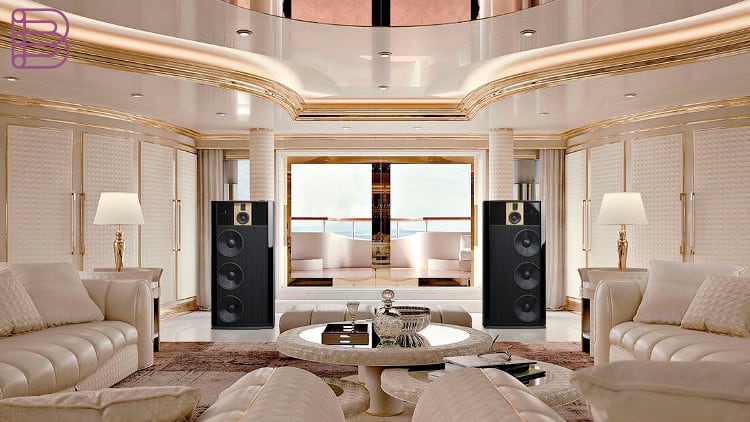
The S system, at roughly €25,000 for a complete system with electronics and speakers, had already won the Absolute Sound Golden Ear award six years running. Once the S15 woofer and its surrounding acoustics were finished, Lyngdorf’s engineers spent years proposing new designs priced at two-and-a-half times the S system’s cost — nine or ten different concepts in total. Every single one, once compared side by side with the S system, lost. For six years straight, Lyngdorf rejected every new proposal on the same grounds: more expensive, but not actually better sounding.
A 24-hour flight and a mini Model D
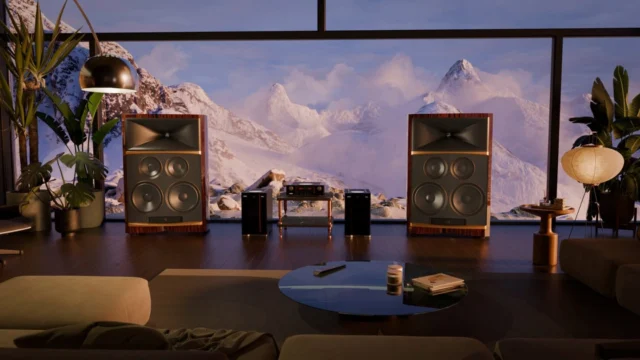
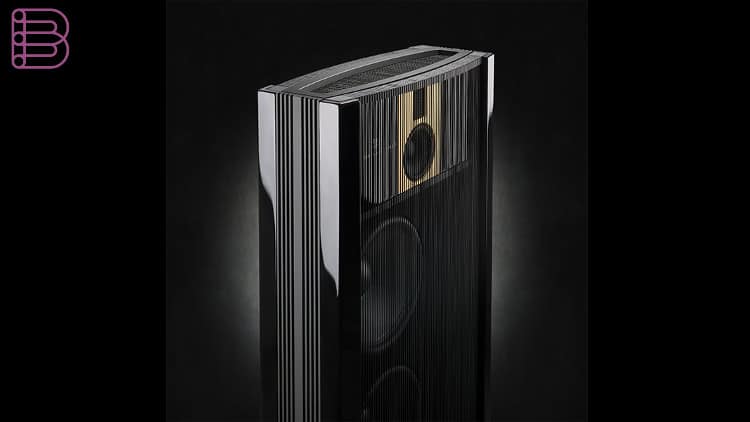
Two years before the interview, Lyngdorf shifted his own thinking: rather than chase an entirely new design, he’d aim for something closer to a compact Model D — as much performance as possible in a smaller, easier-to-manufacture, lower-cost form. The result is 60 cm wide and 124 cm tall, built around six 12-inch woofers, each carrying a 12 kg magnet. To fit that much driver area into a compact cabinet, the woofers are arranged in a folded layout, with three of the six reversed in polarity — two positive, three negative — which, within the wavelengths involved, effectively cancels second-harmonic distortion.
From drawings to production, with real headroom
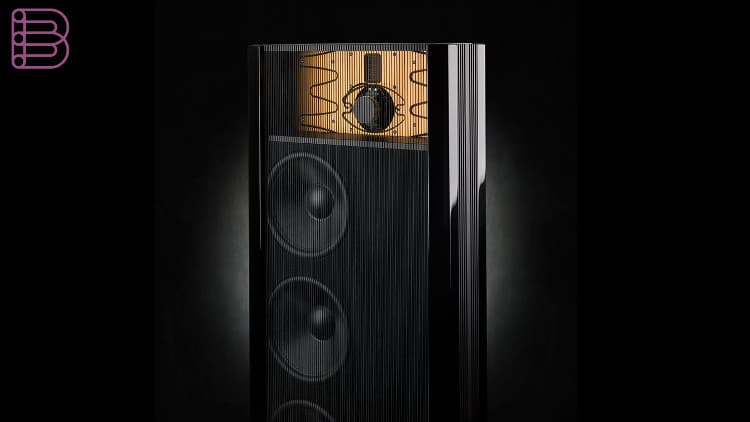
The Model B ended up with serious SPL capability, very low distortion and very deep bass, driven by Steinway Lyngdorf’s A2 amplifier delivering roughly 700 watts per speaker across four channels, with electronic crossovers and full time alignment. Lyngdorf drew the mechanical construction himself and took it close to straight from concept to manufacturing, with only minor changes made along the way to improve manufacturability. The result sells for less than half the price of the Model D, weighs close to 160 kg per speaker, and is built the same way as every other Steinway Lyngdorf product — solid aluminium, no bent metal, no plastic. It isn’t as extravagant as the Model D, but Lyngdorf considers it a match sound-wise, in a noticeably more compact and unassuming cabinet that doesn’t visually betray its dipole design. For the full technical breakdown of how that dipole design actually works, see Steinway Lyngdorf Model B: Engineering Explained — and for the broader story of how Steinway Lyngdorf itself came about, see the origin story.
Visit the Steinway Lyngdorf website.
Frequently asked questions
Why did the Steinway Lyngdorf Model B take so long to develop?
Nine or ten proposed designs were rejected over six years because none of them outperformed the existing S system, despite costing more.
How does the Model B fight second-harmonic distortion?
Three of its six 12-inch woofers are reversed in polarity relative to the other three, which cancels second-harmonic distortion within the relevant wavelengths.
How much does the Model B weigh?
Close to 160 kg per speaker, built from solid aluminium with no bent metal or plastic parts.
How does the Model B’s price compare to the Model D?
Less than half the price of the Model D, while Lyngdorf considers it a close match sound-wise.