

Steinway Lyngdorf Model B engineering, explained in detail: after reviewing the speaker, we wanted to understand how Peter Lyngdorf and his team actually reached this result — the design choices, the materials, the philosophy behind it. He agreed to walk through all of it. For the story of how the Model B project itself got started, see Steinway Lyngdorf Model B: The Design Story.
From itch to new dipole design with physical bass
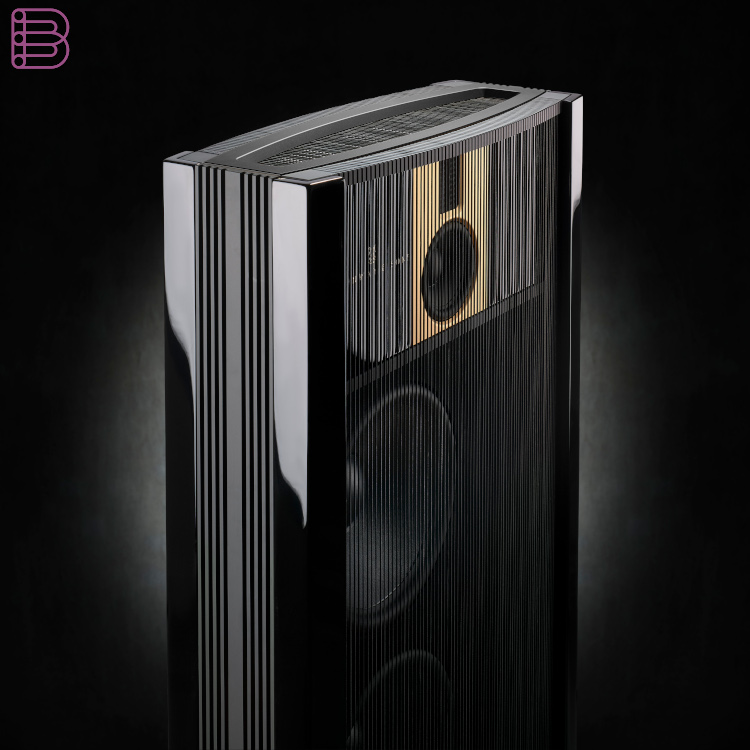
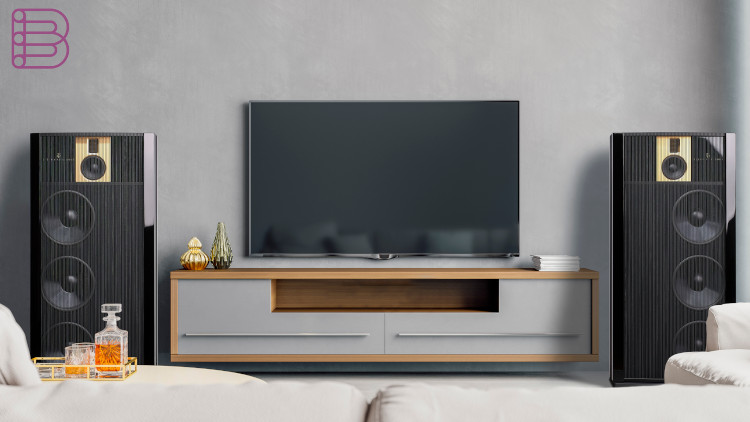
The idea for the Model B had been forming for almost two years after the Model D was finished — a speaker positioned between the Model S and the far pricier Model C. Lyngdorf’s acoustic engineer kept bringing him concepts priced above the Model S, but none of them actually outperformed it, even at three times the price, which left Lyngdorf increasingly frustrated. The breakthrough came, almost literally, mid-flight: on a roughly 24-hour trip back from Korea, it became clear the answer was to follow the Model D’s footsteps rather than depart from them — something scientifically related to the Model D, but with a smaller footprint. At two metres tall, the Model D can feel overwhelming in many Asian markets; Lyngdorf wanted something more compact that still delivered serious headroom, useful even for listeners who mostly play at moderate volumes but want the option to turn it up. Sticking with the dipole principle — well suited to RoomPerfect, since it doesn’t demand a particular kind of space — Lyngdorf worked out an efficient, zig-zag driver layout: three woofers facing forward, three facing backward, each 34 cm wide, packed into a cabinet only 60 cm across by overlapping the drivers, reversing the rear-facing set, and carefully pressure-loading the surrounding structure. The result is roughly 70 dB more headroom than the Model D, along with reduced second-order harmonic distortion from reversing the rear woofers.
Efficiency and headroom
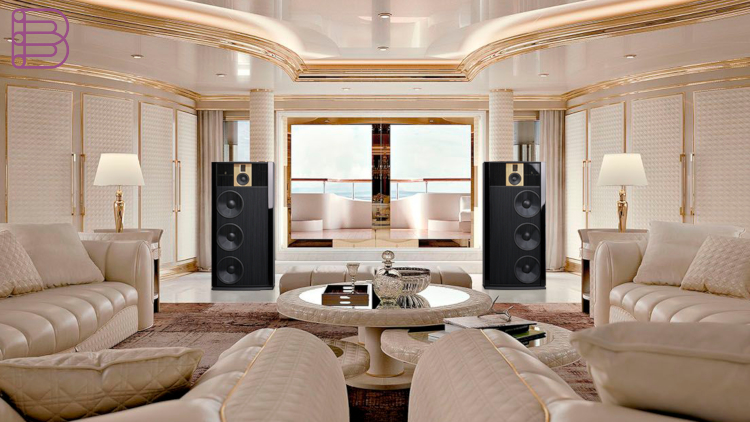
The Model B reuses the well-understood woofers from the Model D, refined with DSP filtering the team already knew how to apply — meaning it sounded excellent from the very first listen, with only a few more months needed to streamline the design before production. Since then, Lyngdorf calls it probably the most flexible speaker Steinway Lyngdorf has made: he cites a room in Norway with an 8-second reverb time that sounded wonderful once RoomPerfect was applied. The cabinets are machined from 42 mm-thick aluminium billets — around 450 kg of aluminium per speaker before machining — built with the same resonance-free, all-aluminium construction as every other Steinway speaker. Efficiency runs high, with the midrange around 95 dB and the tweeter around 96 dB, backed by roughly 4×600 watts per speaker for serious headroom (in Steinway naming, Model B stands for “big one,” Model D for “damn big one”). What stands out for Lyngdorf is the physical impact of the bass: because it’s fast, the speaker delivers more apparent level without sounding bloated or overly resonant — closer to the warm, less treble-forward balance of a real concert hall than the thin low end common on many hi-fi systems, and noticeably more bass detail and physical presence than even good headphones. The dipole principle also helps with room interaction: dipoles radiate mostly forward and backward, with very little to the sides, and because the Model B produces the same frequency response in both directions, the rear-wall reflection carries the same character as the direct sound — unlike a conventional speaker, where mismatched rear reflections can muddy the direct sound instead of complementing it.

72 Kg of woofers per speaker
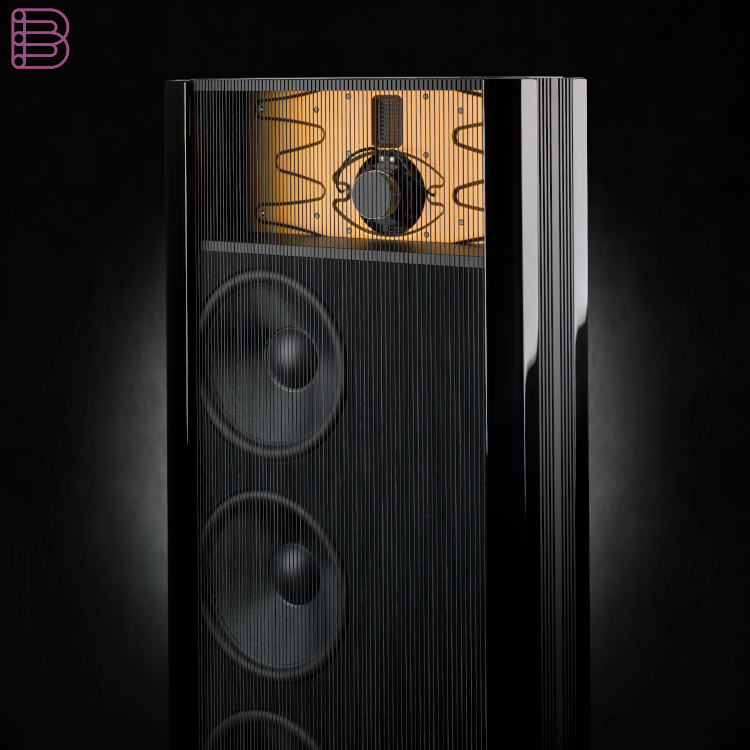
The crossover to the midrange sits at 350 Hz, and the woofers themselves are built light, with a soft voice coil and a deep magnet cap — a combination that avoids the overtone modulation typical of woofers with a short magnet cap and long voice coil, where power drops off once the coil moves away from centre. That’s why heavy bass and a male vocal can play together without the bass modulating the voice; it can sound almost like two separate speaker systems working in parallel. With that much cone area, the woofers barely need to move to deliver a genuinely physical low end — they’re optimised for speed rather than a low resonance frequency, meaning there’s essentially no ring or overshoot once the signal stops, a common issue in woofers with heavier moving mass. This is the same woofer originally developed for the Model D, each unit weighing 12 kg, for 72 kg of woofers in total per speaker. The 5.25-inch midrange driver uses a large neodymium magnet and reaches an efficiency close to a horn speaker’s, without a horn’s typical drawbacks — keeping the open, balanced character Steinway Lyngdorf is known for. Four amplifier channels drive each Model B, with power supplies sophisticated enough (a noise floor of −137 dB) that heavy current draw on the woofer channels doesn’t disturb the midrange or tweeter — unlike some bi-amped setups, where one amplifier drawing heavily can cause audible instability across the other channels.
I’m so proud that we can make this
Lyngdorf recalls hearing the Model B in venues across Singapore, China and Korea, including Hi-Fi Corner, and each time coming away thinking it had never sounded better — the kind of speaker that draws a listener in more the longer they stay with it. He credits that consistency to a team he trusts deeply: he handled the cosmetic design and the core concept, but leans on engineers dedicated to continuously improving quality, software and RoomPerfect itself — a system that, across many thousands of channels, he says has never once faulted. Steinway Lyngdorf remains, in his telling, the only high-end company designing a complete system in-house, right down to the multichannel processor.
Slower speed of sound offers us acoustics
Lyngdorf frames the deeper opportunity in human hearing itself. The ear-brain system, he argues, is more sophisticated than vision in several ways: thirty frames per second is enough to fool the eye into perceiving continuous motion, but the ear resolves time roughly 10,000 times faster than the eye does. Sound also travels about 900,000 times slower than light — the very fact that makes acoustics possible at all, since a venue’s acoustics, a reproduction system’s own character, and dispersion all interact in ways that wouldn’t exist if sound and light moved at the same speed. Designing a speaker and its associated digital room-correction system is, as a result, a genuinely complex undertaking. Human hearing also handles a far greater dynamic range than vision — roughly 120 dB versus about 50 dB for the eyes; if eyesight matched that range, Lyngdorf notes, it would never truly go dark.
It keeps getting better…
Lyngdorf doesn’t see the Model B, or Steinway Lyngdorf’s speakers generally, as ever finished — hearing continues to improve in ways that leave room for better products in years to come, which is part of why he considers it wasteful that many young listeners today rarely experience genuinely good sound. He points to research suggesting the brain engages more actively with good music than with watching a film, and doesn’t shy from a provocative view: that growing up on a phone speaker and poor headphones may mean less brain development for an entire generation. One advantage he’s particularly proud of is that Steinway Lyngdorf systems are software upgradable — since the Model B launched roughly a year and a half before this interview, updated algorithms downloaded from the internet have already made it sound better than it did at launch, at no cost to existing owners. The same has happened with the Model D over a decade of refinement. Much of that improvement comes from Lyngdorf’s own fieldwork: visiting end users, listening to how RoomPerfect performs in their actual homes, taking notes, and only pushing a refinement into the software once he’s fully confident in it.
Steinway Lyngdorf Model B details
Frequently asked questions
What inspired the design of the Steinway Lyngdorf Model B?
Peter Lyngdorf wanted a speaker with the Model D’s dipole principle and headroom, but smaller and more affordable — an idea that came together during a 24-hour flight back from Korea.
How does the Model B reduce second-order harmonic distortion?
Three of its six woofers face backward with reversed polarity relative to the three facing forward, which cancels second-order harmonic distortion within the relevant wavelengths.
How much do the woofers in the Model B weigh?
Each woofer weighs 12 kg, for a total of 72 kg of woofers in every Model B speaker.
Why does Steinway Lyngdorf believe the Model B keeps improving after purchase?
Because it’s software upgradable — refined RoomPerfect algorithms, developed from ongoing fieldwork in real listening rooms, can be downloaded for free, improving sound quality after the original purchase.