

Before Purifi, before Mola Mola, and before Hypex, Bruno Putzeys’ career started with a Philips thesis project on a Class D amplifier nobody at the company thought had a future yet. This Tech Talk traces the Bruno Putzeys career in his own words — Philips, Hypex, Mola Mola and Purifi — and the working habits that connect a 25-watt hand-built prototype to the Eigentakt modules Purifi ships today.

Bruno Putzeys career origins: a Class D amplifier Philips didn’t want
Putzeys did his thesis work at Philips on a Class D amplifier, then got hired — initially for anything but Class D, since the company felt it might be the future but wasn’t ready to invest yet. After a miserable first year designing Sanyo chip-based mini systems, he badgered his way into evaluating an unfinished Class D chip from the Natlab in Eindhoven. Within a week the chip proved not ready, so Putzeys used the rest of his month’s budget to build something of his own: a self-oscillating 25-watt amplifier he dubbed Soda, small enough to sit on a fingertip. It bought him another month of budget, and then another, in a slow drip-feed that let him keep working on Class D at Philips largely by refusing to do anything he found uninteresting.
From Marantz side-projects to the first UCD module
The first customers who actually paid for Putzeys’ Class D work were outside Philips, starting with Marantz, for whom he also built an experimental eight-phase, open-loop Class D power stage that processed DSD directly — a project that nearly became a flagship AV amplifier before it was shelved. The idea that later defined his Philips years, Universal Class D or UCD, followed shortly after: an amplifier designed to behave like a linear amplifier, with low output impedance and a flat, load-independent frequency response, that could run on an unregulated power supply and match the sound of the Class A/AB amplifiers Philips was still using. Philips itself was slow to adopt it — the first Philips product to use UCD reached market only after Putzeys had already left the company in 2005; a five-channel Yamaha receiver got there first.
Hypex, Ncore and the birth of Mola Mola
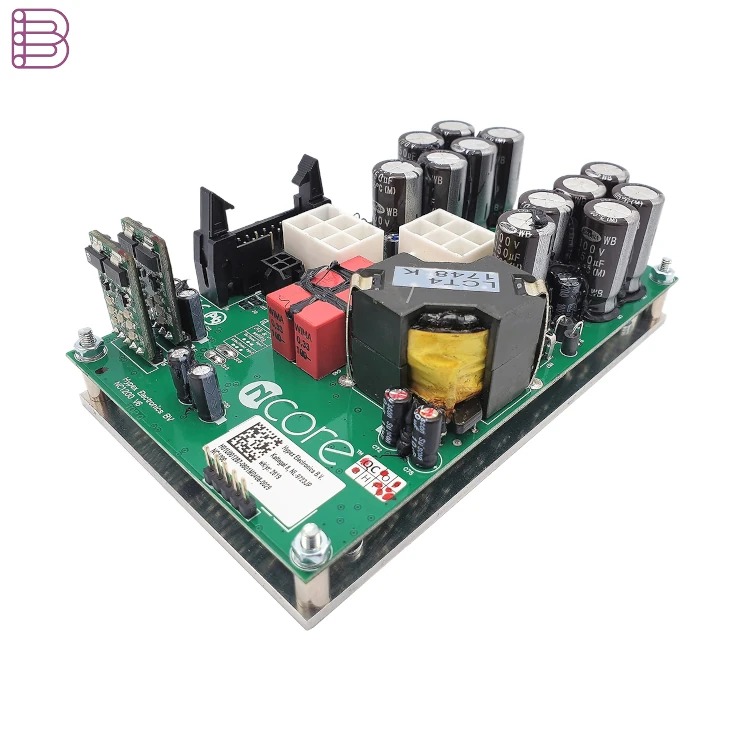
Philips did license UCD to a handful of outside companies, including a small firm from the north of the Netherlands called Hypex — at the time essentially one engineer, its founder, building linear amplifiers for active speakers. Putzeys joined Hypex about six months after signing that license, and in 2008 the technology took another step forward with Ncore, whose highest-performing module, the NC1200, was initially sold only to a handful of selected high-end customers to make sure it landed in products good enough to convince the industry that Class D had genuinely arrived in hi-fi. When customers occasionally paired that module with mismatched design choices, Hypex’s owner suggested the obvious fix: start their own end-user brand and do it properly. That became Mola Mola — nominally built around Ncore power amplifiers, though its preamplifier and DAC quickly became the more talked-about products.
How Bruno Putzeys actually works: one project at a time, on purpose
Putzeys deliberately avoids task-switching. He keeps two or three projects running in parallel at most, working a full week on one before deliberately setting it aside for a week on the other — long enough to return with fresh eyes rather than grinding on a stuck problem. Circuit board layout is the one exception: he’s found he can do it while half-listening to meetings. He also draws a sharp line against pure research, arguing that it’s the second-order problems around a basic idea — not the idea itself — that are usually the hard, worthwhile part to solve, which is why he insists on carrying a design all the way to an actual manufactured product rather than stopping at a working circuit.
Why Bruno Putzeys became a believer in negative feedback
Putzeys is unusually candid about how much can go wrong in the analogue domain around an amplifier — even a single filter capacitor on a voltage reference, he says, can have a “ridiculous” audible effect if the circuit isn’t designed to reject it. His answer is heavy use of negative feedback, a technique plenty of high-end designers avoid on principle, because it can make an amplifier largely insensitive to exactly those kinds of extraneous influences. He describes swapping an entire set of capacitors for a different brand on a modern Purifi design and hearing no difference at all — which he treats as proof the design is doing its job, not as an ideological stance. He also recalls a listening session built around a piece of music with unusually precise inter-instrument timing, where switching in phase correction on an ordinary loudspeaker crossover produced an immediately audible improvement — the kind of discovery, he says, that only shows up once you stop tweaking a product by ear and start hunting for the technical explanation behind what you hear.
Frequently asked questions
Where did Bruno Putzeys’ career in amplifier design begin?
Bruno Putzeys’ career began at Philips, where he did his thesis work on a Class D amplifier and was later hired, eventually developing the Universal Class D (UCD) amplifier concept before leaving the company in 2005.
What is Bruno Putzeys known for at Hypex?
At Hypex, Putzeys worked on the Ncore amplifier platform, including the high-performance NC1200 module, which was initially sold only to a small number of high-end manufacturers to establish Class D’s reputation in hi-fi.
Why did Bruno Putzeys help start Mola Mola?
Mola Mola was suggested by Hypex’s owner after Putzeys grew frustrated seeing his amplifier modules paired with mismatched designs by customers. It gave him a vehicle to build complete end-user products the way he felt they should be built.
How does Bruno Putzeys approach a new engineering project?
He avoids task-switching, generally working on one project for a full week before deliberately moving to another, and prioritises first-of-a-kind development over pure research, believing the real engineering challenges emerge once a design is carried through to an actual product.
Why does Bruno Putzeys rely so heavily on negative feedback in his amplifier designs?
Because it makes an amplifier’s sound largely insensitive to extraneous influences like power supply components or output filters. He points to swapping capacitor brands on a modern design and hearing no audible difference as evidence the technique is working as intended.