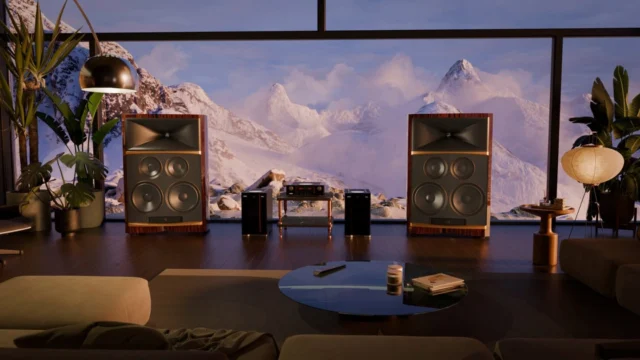


Is one subwoofer enough to excite the room properly? For a small or medium-sized room, it might just get away with it. For most systems built around anything other than full-range main speakers, the honest answer is no, as Roland Hoffmann, Director Product Marketing at Steinway Lyngdorf, explains — and the reason has less to do with marketing than with what a subwoofer is actually being asked to reproduce.
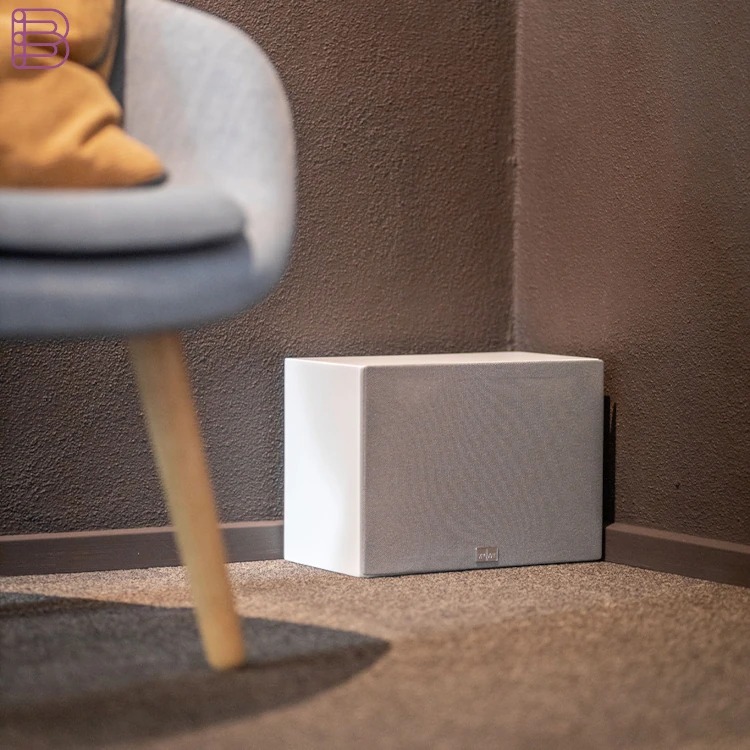
A subwoofer plays more than the LFE channel
It is tempting to think of a subwoofer as the box that handles the dedicated low-frequency effects channel: explosions, thunder, the occasional bass drop.
In practice, in any system where the main, centre and surround speakers are not genuinely full-range, the subwoofer is also carrying every bit of bass that those other speakers cannot reproduce themselves — redirected there by the system’s bass management, as explained in our Tech Talk on setting up speakers in the Lyngdorf menu. That means a five, seven or nine-speaker system can end up funnelling the low end of every single channel through one subwoofer.
A helicopter rotor, a truck engine, a low aircraft pass — none of that is strictly a low-frequency effect in the technical sense. It is simply bass, arriving as part of the regular channel content, and with only one subwoofer in the room, all of it lands on that single driver and single amplifier.
What a second subwoofer actually buys you
Adding a second subwoofer brings two distinct benefits, and it is worth separating them, because they are often talked about as one thing. The first is headroom: splitting that load across two amplifiers and two drivers means less strain on either one, which translates directly into lower distortion and more dynamic headroom at the same output level — the difference between a subwoofer that is coasting and one that is working right at its limit.
The second benefit is about the room itself, not the equipment. A single subwoofer rumbling away in one corner excites the room’s bass response from exactly one location, which means the room’s own standing waves and reflections shape that output in exactly one way, for better or worse, depending on where that corner happens to sit.
Two subwoofers, placed in different positions, excite the room’s low-frequency modes from two different locations at once, which in practice tends to even out the room’s response rather than reinforcing the peaks and nulls created by a single source.
That is a genuine acoustic effect, not a sales pitch — and it is a large part of why serious multi-channel systems are built around more than one subwoofer wherever the room and budget allow it. Whether those subwoofers are actually preserving stereo bass information, or simply duplicating the same mono signal, is a separate question — covered in our Tech Talk on why using two or more subwoofers is not all marketing.
Frequently asked questions
Is one subwoofer enough for most rooms?
In a small or medium room, a single well-placed subwoofer can be adequate, particularly if the main speakers already reach reasonably low. Once the room grows, or the system relies on smaller main, centre and surround speakers, a single subwoofer is carrying more of the overall system’s bass than its size suggests — which is exactly why the question “is one subwoofer enough” deserves a real answer, not a rule of thumb.
Does a second subwoofer just mean twice the bass?
No — the main benefits are lower distortion and more dynamic headroom from sharing the load across two amplifiers, and a more even bass response across the room because the low frequencies are being excited from two positions instead of one.
Why does a truck engine or helicopter sound count as “just bass” rather than a low-frequency effect?
Because it is part of the regular channel content in the mix, not audio specifically routed to the dedicated LFE track. With only full-range or near-full-range main speakers absent, that channel bass is redirected to the subwoofer along with everything else below the crossover point.
Does room size determine how many subwoofers are needed?
It is one factor among several — room size, how full-range the other speakers are, and how many channels are feeding bass into the system all play a role. As a rule of thumb, the more speakers redirecting bass to the subwoofer, and the larger the room, the more a second (or third) subwoofer earns its place.