

Digital music libraries place an entire world of sound at your fingertips, offering unmatched convenience and consistent quality. With streaming services, millions of tracks are instantly accessible without the need for physical storage or manual organization. Whether at home or on the move, music can be played on demand across multiple devices with minimal effort.
To understand why that convenience doesn’t have to come at the cost of sound quality, we sat down with Roland Hoffmann, Director of Product Marketing at Steinway Lyngdorf, for an Academy session on streaming and high-resolution audio.
Listen to the full conversation below, or read on for the highlights.
Why Streaming Leaves the Wear and Tear of Vinyl and CD Behind
Streaming audio is, first and foremost, about convenience: having an entire music library at your fingertips, complete with cover art and an easy way to discover something new. But there’s a second advantage that’s just as important — consistency. Streaming doesn’t rely on a needle physically tracing a groove or a laser reading a spinning disc, so all the mechanical wear that comes with those formats disappears. There’s no stylus degradation, no disc wear, no dust, no mechanical drift. That doesn’t make streaming inherently superior, but it does mean less can go wrong: a track streamed for the hundredth time, or streamed again in five years, sounds exactly the same as the first time.
Every Recording Starts as High-Resolution in the Studio
The quality chain doesn’t begin with the streaming service — it begins in the studio, where music is produced in high resolution today, typically at 24-bit and 48kHz or higher. Whatever format eventually reaches the listener, whether it’s a heavily compressed webradio stream or a high-res download of the studio master file, it all originates from that same high-quality source.
Even Today’s Vinyl Masters Begin as Digital Files
That’s true even for vinyl. When a modern analogue pressing is cut, the mastering itself is still done in the studio using digital equipment, almost always at that same 24-bit standard. In other words, the “digital-first” quality chain applies across formats — analogue included.
Streaming Services Are Where Compression Enters the Chain
If the studio doesn’t compress, and the listener’s own equipment doesn’t compress, where does compression come from? Mostly from the streaming services themselves. To reduce data size, improve stability, and cut costs, most streaming platforms compress the audio file or stream using formats like MP3 or AAC.
From the MP3 Wars to a World Without Bandwidth Limits
That compression habit is a holdover from an earlier era. The industry moved from vinyl to CD, through a phase of 20-bit and then 24-bit converters, and then into the age of Napster, MP3 and AAC — a period dominated by one question: how much can you compress before people notice? For manufacturers, that wasn’t an encouraging trend to watch unfold. But today, in 2025, storage and bandwidth are no longer meaningful constraints. There’s simply no practical reason left to compress — which is exactly why high-resolution streaming has become the standard to aim for: it’s how the music was created in the first place.
What Compressed Audio Actually Throws Away
To put the cost of compression in concrete terms: even the best MP3 encoding discards more than 60% of the information contained in CD-quality audio — and that’s without even comparing to a high-res studio master. Picture a photograph with 60% of its data removed; you’d notice immediately. Audio compression algorithms are good enough that the result doesn’t sound harshly distorted or noisy, but the underlying fact remains: the bulk of the information is simply gone, permanently, and it’s never reconstructed later in the chain. It isn’t “upsampled back in” by the playback device — it’s lost data, for good, for no real technical reason.

Built-In Streaming vs. a Dedicated External Streamer
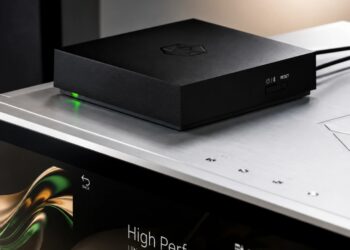
Fortunately, most modern hi-fi equipment now has streaming built in — Tidal Connect and Qobuz Connect being common examples — removing the need for a separate streaming device altogether. Keeping the streaming chipset inside an amplifier or an active speaker is the simplest approach: fewer components, fewer cables, fewer interconnects, and a shorter, cleaner signal path.
How well that’s executed still depends on price point. An all-in-one product at a modest price can typically do everything, just not everything exceptionally well; as the price rises, engineers get more room to select better components and pay closer attention to signal integrity and noise. At the other end of the spectrum sits the dedicated external streamer — sometimes without any analogue conversion at all, just a pure digital transport. The extra budget goes into R&D time spent making that external streamer as precise as possible: the lowest possible noise floor, and a signal path that stays as neutral to the source as it can be. It isn’t a night-and-day difference for every listener, but for a well-resolving system, it’s a real one.
The Worst Combination: A Compressed Stream Over Bluetooth
If there’s a scenario to avoid, it’s stacking two compressions on top of each other: a compressed stream, such as MP3, sent onward over a compressed Bluetooth connection to a pair of headphones or a speaker. That combination — compressed data plus a compressed transmission path — is about as far removed from what was created in the studio as it gets.
Can You Actually Hear the Difference?
The honest answer: it depends on your system. To hear the gap between CD-quality streaming and the same track in high resolution, you first need a system capable of resolving that difference — it isn’t a night-and-day contrast. Play the same comparison over Bluetooth, and the resolution of the source stops mattering altogether; high, low or medium-res will all sound identical once squeezed through a compressed wireless link. That doesn’t mean there’s no difference on a resolving system — it just means Bluetooth erases it before it ever reaches your ears.
What Higher Bit Depth and Sample Rate Really Add
CD quality (16-bit, 44.1kHz) is, in itself, genuinely sufficient to capture and reproduce analogue sound accurately — it isn’t a flawed format. So what does higher resolution actually add? Moving from 16-bit to 24-bit increases the signal-to-noise ratio, lowering the noise floor and widening the dynamic range — headroom that, admittedly, exceeds what’s strictly necessary for most listening. It’s not that 24-bit content has “more pixels” or finer resolution in any visual sense; it’s about that noise floor and dynamic range. Likewise, a higher sample rate — 48, 96, 176.4 or 192kHz instead of 44.1kHz — doesn’t add more detail either. What it does is push the necessary filtering further out of the audible range, so you’re less likely to notice any side effects, opening up a slightly wider margin. Neither of these, on their own, is a guarantee of better-sounding music.

Why Modern Equipment Still Benefits From 24-Bit
Some audio engineers will point out that 16-bit is technically good enough. But once equipment is designed around 24-bit processing, there’s more headroom throughout, so less can go wrong in the studio — meaning better content can be created in the first place. That’s a reason to preserve a recording at the resolution it was created in, not a reason to assume that upsampling an old 16-bit recording to 24-bit will retroactively make it sound better. Quality lives in the studio and the equipment used to make the recording — not in the bit depth of the file you happen to be holding.
Why Some Old Recordings Still Sound Better Than New, High-Res Ones
Resolution isn’t a guarantee of quality, and that’s easy to prove: plenty of recordings from the 1960s and ’70s, made entirely in analogue, sound fantastic today. Meanwhile, some recordings made this year or last, using all the latest technology, sound flat or over-compressed. Good and bad recordings exist at every resolution and in every era — hi-res is worth pursuing not because it guarantees a better recording, but because it preserves the recording exactly as it was created in the studio, without throwing anything away along the way.
The Takeaway
None of this means streaming has to be a compromise. Modern equipment increasingly builds streaming in at a high standard, the technical case for compression has quietly disappeared, and high-resolution streaming simply delivers what was captured in the studio — nothing more, nothing artificially added, and nothing needlessly thrown away.
Frequently asked questions
Why doesn’t a streamed track sound worse after being played a hundred times, unlike vinyl or CD?
Streaming doesn’t rely on a needle physically tracing a groove or a laser reading a spinning disc, so the mechanical wear that comes with those formats simply doesn’t apply — no stylus degradation, no disc wear, no mechanical drift. A track streamed for the hundredth time, or streamed again in five years, sounds exactly the same as the first time.
Where in the chain does music actually get compressed — the studio, the listener’s equipment, or somewhere else?
Not in the studio: recordings are produced in high resolution today, typically at 24-bit and 48kHz or higher, and even the digital mastering behind a modern vinyl pressing happens at that same standard. Compression almost always comes from the streaming services themselves, which shrink the file or stream using formats like MP3 or AAC to save data and cost.
How much information actually gets lost in an MP3 encode compared to CD quality?
Even the best MP3 encoding discards more than 60% of the information contained in CD-quality audio — and that’s without even comparing to a high-res studio master. That data is gone for good and is never reconstructed later in the chain; good compression algorithms simply make sure the loss isn’t harshly noticeable.
Does it still matter if I listen to high-res music over Bluetooth?
Yes — and that’s precisely the problem. Bluetooth is itself a compressed connection, so sending an already-compressed stream, such as MP3, over it stacks two compression steps on top of each other, landing about as far from the studio recording as it gets. A high-res source doesn’t help either: once the same track is squeezed through a compressed wireless link, high, medium, and low resolution all end up sounding identical. Bluetooth erases the difference before it ever reaches your ears.
Does a higher bit depth or sample rate automatically add “more detail” to a recording?
Not in the sense of extra detail. Moving from 16-bit to 24-bit mainly raises the signal-to-noise ratio and lowers the noise floor, adding headroom; a higher sample rate, such as 96 or 192kHz instead of 44.1kHz, mainly pushes the necessary filtering further outside the audible range. Neither is, on its own, a guarantee of better-sounding music — CD quality (16-bit, 44.1kHz) is already genuinely sufficient to capture and reproduce analogue sound accurately.
Do I still need a separate streamer if my amplifier or speakers already have streaming built in, such as Tidal Connect or Qobuz Connect?
Not necessarily. Keeping the streaming chipset built into an amplifier or active speaker is the simplest approach: fewer components, fewer cables, a shorter and cleaner signal path. How well that’s executed still depends on price point — an all-in-one product at a modest price can typically do everything, just not everything exceptionally well. A dedicated external streamer puts the extra budget into the lowest possible noise floor and a signal path that stays as neutral as possible. It isn’t a night-and-day difference for every listener, but on a well-resolving system, it’s a real one.