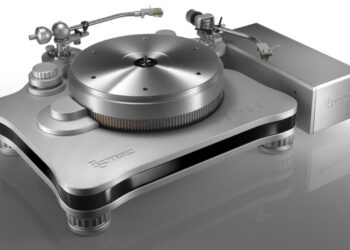


The Acoustical Systems A*Stellar turntable is what happens when a designer spends 33 years refining one flagship, then asks how much of that performance can survive being made dramatically smaller. In this Tech Talk, Dietrich Brakemeier, founder of Acoustical Systems, explains how the A*Stellar compresses the essence of the company’s $200,000 Apolyt turntable into a considerably more compact and manageable design — without giving up the features that make the Apolyt what it is.

From the Apolyt to the A*Stellar turntable
Acoustical Systems’ flagship, the Apolyt, was Brakemeier’s decades-long proving ground — a turntable he describes as a kind of breadboard that let him push every idea about analogue playback as far as it would go, without compromise on size or cost. The A*Stellar turntable is what he calls the essence of that experience: the same performance philosophy and most of the same core engineering, reduced to a considerably smaller footprint and a more accessible price. Built from three stacked layers, the two upper sections — carrying the bearing, platter and tonearm — rest on air springs that lift them clear of the lower section housing the motor, counter-wheel and control electronics the moment the turntable is switched on.
Platter
The platter is where Brakemeier says roughly 90% of the A*Stellar’s sonic performance actually comes from. Its playing surface is vinyl — the same material records themselves are pressed from — chosen specifically because it shares the same energy transfer properties and inner resonance behaviour as the record sitting on it, unlike harder, reflective materials that bounce unwanted energy straight back into the groove. Underneath that vinyl surface, the platter is built from roughly three dozen bonded layers using around 18 different materials, including tungsten, titanium, aluminium alloys and vanadium steel alongside vinyl and organic, resin-bonded layers, engineered to absorb vibrational energy rather than reflect it back in a different amplitude. The result, Brakemeier argues, is what gives the A*Stellar its blackness of background, its resolution of low-level detail, and headroom during dynamic peaks that lighter, simpler platters often struggle to control.

Bearing
The bearing is a fully maintenance-free, bi-radial magnetic design running in a Lumie-encapsulated axis around 30 millimetres in diameter. Rather than relying purely on repelling magnets, a second pair of magnets at the base pulls in the opposite direction, creating a push-pull magnetic bearing that doesn’t just levitate the roughly 22-kilogram platter but actively pre-loads it — letting Acoustical Systems adjust the bearing’s internal damping and stiffness. Small deposits of carbon inside the Lumie bearing are electrically conductive, which continuously discharges the static energy that builds up while a stylus tracks a vinyl groove, eliminating the pop that ordinarily requires a separate anti-static device to prevent.
Suspension & Plinth
The upper two layers self-level automatically the moment the A*Stellar is switched on, rising on air springs supplied from the turntable’s power unit and fitted with individual sensors. That suspension operates at a resonance frequency of roughly 1.2 Hz, isolating the bearing, platter and tonearm from the lower motor section so completely that touching the plinth during playback has no audible effect. The upper layer carries four identical, cross-symmetrical armboards arranged around the spindle, plus a fifth reserved for a tangential tracking tonearm — precision dowel-pin locators mean a tonearm and cartridge can move between any of the first four positions without needing to be realigned.

Drive
Despite using a belt, the A*Stellar isn’t a conventional belt-drive design. A symmetrically positioned motor and counter-wheel share the load, so only around 12–14% of the platter’s circumference ever contacts the belt, and the bearing itself is never dragged in any one direction — it rests essentially force-free. The bearing’s level sits exactly at the platter’s centre of mass, which itself weighs around 22 kilograms, lighter than Acoustical Systems’ own Apolyt platter yet, according to Brakemeier, delivering an even blacker, quieter background. PTFE feet with a dedicated alignment tool round out a design built, in Brakemeier’s words, to leave nothing to be desired — the A*Stellar has since replaced the Apolyt in Acoustical Systems’ own demonstration room.
Frequently asked questions
What is the Acoustical Systems A*Stellar turntable based on?
The A*Stellar is a more compact reimagining of Acoustical Systems’ flagship Apolyt turntable, designed to transfer the Apolyt’s core engineering and sonic performance into a smaller, more feasible format at a lower price point.
Why does the A*Stellar turntable use a vinyl playing surface on its platter?
Vinyl shares the same energy transfer properties and inner resonance behaviour as the record itself, which prevents the reflective interference that harder, non-vinyl platter surfaces can introduce into the groove signal.
How does the A*Stellar turntable’s magnetic bearing work?
It’s a bi-radial, push-pull magnetic bearing that both levitates and pre-loads the platter using two opposing sets of magnets, allowing its internal damping and stiffness to be adjusted, while carbon deposits in its encapsulated axis continuously discharge static build-up.
How is the A*Stellar turntable isolated from vibration?
Its upper two layers, carrying the bearing, platter and tonearm, rest on self-levelling air springs operating at roughly 1.2 Hz, fully isolating them from the lower section that houses the motor, counter-wheel and electronics.
Who designed the Acoustical Systems A*Stellar turntable?
The A*Stellar was designed by Dietrich Brakemeier, founder and director of Acoustical Systems, drawing on more than three decades of development work on the company’s flagship Apolyt turntable.