

During High End Munich 2025 — Europe’s largest hi-fi show, held over four days in Munich — we stopped at 21 stands for short, on-the-spot conversations with the people actually building the gear. Watched in order, they move roughly the way a walk through the show would: new loudspeakers first, from DALI’s CEO explaining what trickles down from the flagship Kore to the EpiKore, through PMC’s new Prophecy range and Kii Audio’s fully wireless Kii 7. From there into electronics — streaming amplifiers, DACs and a wave of new amplifier modules — and then the smaller, easy-to-miss stands: isolation feet, cryogenically treated fuses, jubilee cables, and Acoustical Systems’ compact new turntable. It closes on the show’s lighter side: We Are Rewind’s modern take on the Walkman. Each section below keeps its original interview video and text exactly as recorded on the stand.
DALI at Motorworld during High End Munich 2025

New headphone colors and a refined EpiKore range
DALI’s Motorworld booth opened with its IO-12 flagship headphones in a new beige colorway alongside the existing dark brown, still built with the same SMC (soft magnetic composite) driver technology used in DALI’s speakers, real leather, high-grade materials and the latest active noise cancellation, plus a switchable bass or standard hi-fi tuning. The lighter IO-8 offers a more fun-leaning tuning without the SMC material, and can also be used passively with a separate headphone amplifier.
The EpiKore speaker range — from the compact EpiKore 3 up to the flagship EpiKore 11 — gets a new white finish alongside the existing walnut and black, plus a new grille design. All EpiKore models share technology developed for DALI’s flagship speaker, including the Clarity Cone driver, whose intricate embossed pattern reduces cone breakup for a more linear high-frequency response, and a second-generation version of DALI’s SMC material that the brand says performs roughly two and a half times better than the previous generation. The existing Rubikore series, introduced the year before, was also on display alongside the newer models.
The V16F subwoofer: DALI’s 1,500-watt “beast”
Also on show were DALI’s M-Series in-wall speakers, including the new M88, an angled model aimed at custom installers that lets a speaker be aimed directly at the listening position even when it has to be mounted where the wiring is easiest — paired with a new EQ-profile system that automatically matches an amplifier to the installed speaker. The S100 subwoofer uses DALI’s CSS (“constant surface surround”) technology for a constant extrusion and even pressure around the driver, again paired by default with a matching DSP EQ profile.
The standout, though, is the V16F — nicknamed “the beast” by DALI’s own staff. It’s a 16-inch, 1,500-watt subwoofer built around a double-magnet motor and a flared port, with four ports tuned to roughly 35Hz and a genuinely linear response reaching up past 1,000Hz, making it behave more like a wide-range woofer than a conventional subwoofer. It weighs around 55 kilograms and is DSP-powered with switchable music and party modes. A 750-watt, four-times-more-powerful amplifier version is also available for driving larger cinema subwoofers.
DALI rounded off the booth with new color options for its Kore flagship speaker, and the IP67-rated Guardian outdoor speakers — submersible in up to 30cm of water, with a twist-and-tilt bracket adjustable up to 25 degrees, joining the existing E60 and E80 weather-resistant models and pairable with the V16F for extra outdoor bass.
DALI CEO Lars Worre talks about Kore technologies at Motorworld in Munich

The technologies behind DALI’s flagship Kore
DALI CEO Lars Worre describes the Kore, the brand’s flagship loudspeaker, as containing every technology the company has mastered. Inside the driver, low-distortion SMC (soft magnetic composite) magnet systems and a balanced-drive woofer design work to cancel out distortion in the driver’s motion. Up top, a hybrid tweeter module combines a 35mm soft dome — chosen because it moves air well at lower treble frequencies and stays very light — with a very light, narrow magnetostatic tweeter that takes over once the dome’s dispersion starts to narrow at higher frequencies, offering wider dispersion, more speed and greater bandwidth. According to Worre, combining the two “unites the best of two worlds.”
The cabinet uses DALI’s Clarity Cone, a wood-fiber cone technology refined over many years with a special embossing pattern that spreads a driver’s resonance pattern out rather than letting it concentrate at a single frequency, resulting in a cleaner-sounding driver.
From flagship to EpiKore: how the technology trickles down
Worre describes DALI’s approach to a flagship model as one of refinement rather than pure invention: rather than developing entirely new technologies from scratch, the Kore combines and refines things DALI has used before, then lets that work trickle down through the rest of the range. The hybrid tweeter module, for instance, already features in the more affordable Rubikore and Opticon series, and the latest generation of the Clarity Cone is shared with the EpiKore — a model Worre now calls his personal favorite, delivering much of what the Kore offers at a more accessible price point.
Worre is candid about what the Kore is for: an extremely revealing loudspeaker that shows exactly what’s in a recording, for better or worse, comparing it to a Formula One racer rather than a comfortable family car. It’s also a genuinely heavy, impractical product for most living rooms — which is exactly why the EpiKore exists, preserving much of the Kore’s character in a more usable package.
Keith Tonge from PMC unveils the Prophecy speaker range at High End Munich 2025

A new mid-price range, replacing the 25i
PMC’s creative director Keith Tonge introduced the Prophecy Series at High End Munich 2025 as the successor to the brand’s long-running 25i range. All five models are passive and share the same core drivers — a 27mm high-frequency unit throughout, and a 5-inch bass unit in the smaller two-way models.
The compact two-way Prophecy 1 and the taller Prophecy 5 use an identical set of drivers, with the Prophecy 5’s longer transmission line extending bass response further. The three-way Prophecy 7 adds a midrange dome originally developed for PMC’s professional studio monitors — a market that makes up half of the brand’s business. The flagship Prophecy 9 uses twin bass units rather than a single wide driver, allowing higher output levels while keeping the cabinet narrow. A dedicated center channel, the Prophecy C, rounds out the range for surround and home-theater use, using two internal transmission lines to keep dialogue and effects distinct even in complex film soundtracks.
Advanced Transmission Line loading and the new Laminar X vent
Every Prophecy model uses PMC’s Advanced Transmission Line (ATL) loading, a more sophisticated approach than a sealed or ported cabinet that lets a comparatively small box reach lower frequencies. The Prophecy 7, in particular, adds an extra absorption chamber just before the vent exit to remove coloration before air leaves the cabinet.
The most significant new development is the Laminar X vent: an aluminum-extruded fin structure at the base of each cabinet that manages airflow aerodynamically as air moves in and out during bass reproduction, keeping it laminar rather than turbulent. That reduces the port noise associated with conventional ported designs, while also improving efficiency and dynamics. Combined with the narrow baffles used throughout the range — chosen to minimize reflections and simplify placement — PMC describes the resulting sound as neutral, fast and highly involving, with a holographic, well-defined center image.
Nicholas Brown shows the latest SVS products at High End Munich 2025

The 5000 Revolution Series subwoofer
SVS’s newest subwoofer, the 5000 Revolution Series, inherits the technology of the brand’s flagship 17 Ultra Revolution, launched at the end of the previous year. It pairs a 15-inch driver with a dual voice-coil design and a dual monoblock amplifier delivering 2,000 watts of continuous power and over 5,000 watts of peak power, giving precise control over the driver for both accuracy and impact. It’s available in a sealed cabinet, for tighter, more accurate bass, or a ported cabinet favored by home-cinema listeners, which extends down to roughly 13-14Hz.
Behind that performance is a 295MHz Analog Devices DSP — six times the processing power of SVS’s previous flagship — that manages current, heat and power draw, and includes a built-in line conditioner to keep enough power in reserve for the biggest cinematic bass moments without faltering.
New Ultra Evolution towers and a full accessory line
SVS also showed its new flagship Ultra Evolution Speaker Series towers — the Pinnacle, Titan and Ultra Evolution Tower — built around a force-balance array of fully active 8-inch woofers front and back that move in and out together, cancelling internal vibration for a cleaner soundstage. A newly redesigned tweeter uses vapor deposition to apply a layer of diamond carbon dust to an aluminum dome, pushing the breakup frequency to around 40,000Hz for a smoother, less fatiguing top end. The cabinets use an angled front baffle for driver time alignment, and the range is completed by a true three-way Ultra Evolution Center channel and a dedicated height/immersive speaker.
Alongside the speakers, SVS showed its value-oriented cable and accessory line: 24-karat gold-plated RCA, subwoofer and speaker cables, isolation feet to decouple a subwoofer from the floor, and wireless adapters to eliminate long subwoofer cable runs.
Alfred Vassilkov from Estelon shows us the new A-series at High End Munich 2025

Fifteen years of Estelon
Estelon is celebrating its 15th anniversary, and founder Alfred Vassilkov used High End Munich 2025 to walk through the full lineup — from the flagship X-Diamond, whose adjustable upper section makes it easier to optimize for different rooms and acoustic conditions and which can also be finished in custom colors, down through the Red Dot Design Award-winning YB model, to the compact A-Series.
The A-Series: a three-way, four-driver monitor
The Homura was the first model in the A-Series, a three-way design with four drivers including a 10-inch bass driver, delivering a dynamic sound suited to smaller rooms. The A-Series can be extended with a matching center-channel speaker and a dedicated passive-radiator subwoofer, engineered specifically for this range: one side carries an active driver, the other a passive membrane, fed through a high-voltage input with an active/passive crossover for tight integration with the main speakers. Pricing runs from around $15,000 to $18,000 per pair depending on finish, with the matching subwoofer at around $20,000.
Revival Audio introduces the Atalante 7 EVO at High End Munich 2025

A large, three-way bookshelf flagship
Founded around two and a half years ago by CEO Dagi, French loudspeaker manufacturer Revival Audio launched its first products — the R23 and R25 bookshelf models — in 2022, followed by the R24 and the more affordable, distinctively styled Sprint 3 and Sprint 4. The Atalante 7 EVO is the newest and largest model yet: technically a bookshelf design, but large enough to need a dedicated stand.
“EVO” reflects an evolution of the driver technology already used in the well-received Atalante 3, 4 and 5. The tweeter and midrange — Revival Audio’s RASC™ Évo Tweeter, a 28mm soft dome built with the brand’s ARID technology — have been re-engineered with a new neodymium motor system for more power and precision, full aluminum construction, and a double suspension system in the midrange to further reduce resonance.
AeroVex porting and a basalt-fibre sandwich cone
The Atalante 7 EVO uses what Revival Audio calls AeroVex: a front-ported design rather than the usual rear port, chosen because the cabinet is large enough that a conventional rear port would make the speaker’s response too dependent on its distance from the wall behind it. Its 15-inch woofer extends down to 23Hz, ±3dB.
The cabinet uses Revival Audio’s basalt sandwich construction (BSC) — a material derived from lava stone that the brand says is sustainable, very light and very rigid, with better damping than comparable materials.
Sonically, Revival Audio describes the Atalante 7 EVO as a step away from the immediately accessible, easy-to-enjoy character of the Atalante 3, 4 and 5, toward a more studio-monitor-like presentation: precise, neutral and extremely balanced, with the resolution to pick out individual instruments and their positions in large-scale, orchestral material.
Michael Pressmann shows Soundspace Systems speakers at High End Munich 2025

A relaxed, highly resolving sound
Soundspace Systems builds loudspeakers designed to draw listeners into the music rather than simply reproduce it accurately. According to the brand, that resolving character was demonstrated live at the show: listeners needed less than five seconds to hear the difference between a one-step and a three-step vinyl pressing of the same recording.
Broadband drivers, a horn-loaded tweeter and an active sealed subwoofer
The smallest model in the range uses no crossover in front of the midrange at all — it’s a genuine broadband speaker. In the larger models, that broadband driver is complemented by a high-quality AMT tweeter that is horn-loaded, and at the bottom end by an active subwoofer working in a sealed enclosure with internal pre-chambers.
The result, the brand says, is a speaker that presents a near-perfect load for an amplifier and remains fully phase-coherent — meaning even something as demanding as a drum solo played at near-live levels stays coherent and controlled.
Kii Audio showcases Kii 7 at High End Munich 2025

The Kii 7 goes fully wireless
Kii Audio’s Kii 7, until now positioned mainly for the professional market, is now fully equipped for consumer use: plug a pair into the wall, connect them to Wi-Fi, and they play music immediately without any other source. Existing Kii 7 owners can get the update too — connect the speaker to the internet over Ethernet, contact Kii Audio, and the update is applied remotely, after which the speaker becomes Wi-Fi streaming capable.
Control runs through an app, alongside the existing Kii Control accessory for those who prefer a physical remote. With Spotify Connect and Tidal Connect on board — and Qobuz Connect coming soon — the speaker can be run entirely from a streaming app, with no need to open the Kii Control interface at all.
A new processing platform, the same acoustic core
Ten years on from the original Kii Three, processing power has advanced enough that Kii Audio could drop the dedicated DSP chip entirely in favor of a quad-core ARM processor running Linux and the brand’s own DSP software — giving far more room to add features purely through software updates.
Acoustically, the Kii 7 keeps the same woofers, midrange and tweeter as the Kii Three, but with a newly designed waveguide — developed with input from a colleague at amplifier-module specialist Purifi — that improves high-frequency dispersion and keeps directivity more constant than the previous waveguide. The cabinet is fully braced throughout, and the electronics, mounted in a separate cage on the back of the speaker, use custom Purifi amplifier modules built on a redesigned circuit board to fit the tight enclosure.
At the show, Kii Audio also marked its 10th anniversary with an immersive Auro 3D listening room built around brand ambassador Annette Askvik’s newly released album Liberty.
Jim Garrett talks about new JBL and Mark Levinson products at High End Munich 2025

The Mark Levinson 600 Series: a new design language
Mark Levinson used High End Munich 2025 to launch the first three products in its new 600 Series — the brand’s sixth generation of products, revealed the night before at a dedicated event. The most visible change is a new industrial design the brand calls “Tectonic,” inspired by volcanoes: each unit carries a raised element on the top panel with a glass front and red accent lighting, giving the range a more dramatic look while staying instantly recognizable as Mark Levinson.
The lineup opens with the No.632 dual-monaural amplifier, delivering around 250 watts per channel rising to 500 watts per channel into a 4-ohm load, priced at $30,000. The No.631 monaural amplifier replaces the previous No.536, returning to a tall, freestanding tower format reminiscent of the brand’s classic No.53 and No.33H reference amplifiers, priced at $40,000 each. Both amplifiers benefit from sonic refinements first developed for the ML-50 50th-anniversary amplifier.
The No.626 preamplifier, priced at $25,000, replaces the previous No.526 and No.523 and packs in a line stage with balanced inputs, a third-generation PrecisionLink DAC with USB-C connectivity, and a phono stage supporting both moving-magnet and moving-coil cartridges — plus a Class-A headphone amplifier discreetly hidden behind a hinged front panel. For digital sources, Mark Levinson points to its parent company Harman’s own Roon Nucleus Titan server as a natural streaming partner for the range, alongside any other outboard streamer connected via the digital or balanced inputs. All three products use a fully discrete, “PurePath” circuit design and an R2R resistor-ladder volume control, in keeping with Mark Levinson’s long-standing philosophy of doing no harm to the signal.
Three new flagship JBL Summit Series loudspeakers
Announced alongside the 600 Series, JBL’s new Summit Series adds three loudspeakers to the brand’s highest range — the Summit Ama, Summit Pumori and flagship Summit Makalu — continuing a naming tradition that started with the legendary 1985 Project Everest and continued with the K2. All three new models were designed from a clean sheet at JBL’s Northridge, California engineering center.
All three share the same D2 compression driver technology in a newly developed HDI horn geometry, and a hybrid carbon-cellulose (HC4) sandwich cone used across the woofer and mid-bass drivers for a stiff yet lightweight diaphragm. The compact two-way Summit Ama uses a single 8-inch HC4 woofer and is priced at $19,995 per pair including its matching stands. The three-way Summit Pumori steps up to a dedicated 8-inch midrange plus a 10-inch woofer, at $29,995 per pair. The flagship Summit Makalu tops the range with a 12-inch woofer and 8-inch midrange, both in HC4, paired with a precision-molded Sonoglass horn on the D2 compression driver, at $44,995 per pair. All three are available in a choice of an ebony wood veneer with gold accents or a piano black finish with silver accents.
Teac & Esoteric highlights at High End Munich 2025

TEAC: a fully balanced headphone amplifier and a refined power amp
TEAC’s two highlights for the year both build on its headphone-focused heritage. The HA-507 is a fully balanced headphone amplifier with every common headphone connector already on the front panel, so no adapters are needed — it can also double as a high-quality preamplifier feeding the matching AP-507 power amplifier. The AP-507 itself gets a refined chassis for better sound, and switches to a newer NCore-based amplifier module in place of the previous Ncore Hypex module, for better dynamics and a bigger, deeper soundstage. TEAC also expanded its headphone listening station at the booth, now built around two Audeze headphones.
Esoteric: the Grandioso N1T network transport
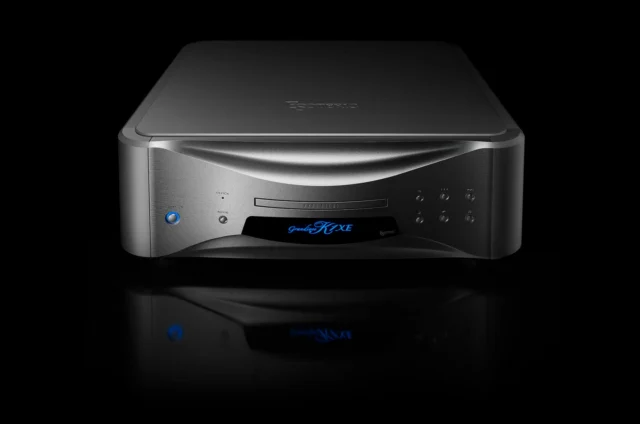
The highlight on the Esoteric side is the new Grandioso N1T network transport — the first streaming player in the Grandioso range, launched for the very first time at Munich. It’s designed to be paired with the monaural Grandioso D1X SE DAC for the brand’s best streaming performance, and offers a choice between a standard RF connection or a fiber connection, letting listeners fine-tune the transport’s sound signature to match the rest of their system.
Esoteric also showed its Grandioso D1 DAC for the first time at the Munich show, split across two chassis — one housing the power supply and control unit, the other the signal processing — and supporting both optical and standard MM/MC cartridges when paired with the Grandioso T1 turntable. The T1’s platter floats and is driven entirely by magnetic force, with no mechanical bearing and therefore no physical contact between motor and platter, resulting in a very quiet, stable turntable whose motor unit — like Esoteric’s digital sources — can also be clocked. The demo system used cabling from the Swedish brand Jorma Design throughout, paired with Mingus Quintet II Statement loudspeakers featuring a diamond tweeter and ceramic midrange.
Lyngdorf Audio unveils TDAI-2210 streaming amplifier at High End Munich 2025

Bridging the gap between the 1120 and the 3400
The TDAI-2210 is a long-awaited addition to Lyngdorf Audio’s amplifier range. Rather than simply upsizing the entry-level 1120 or downsizing the flagship 3400, Lyngdorf built the TDAI-2210 on a completely new platform to fill the gap between the two.
The volume control works the same way as on the 3400: it does not attenuate the signal at all, preserving the full dynamic range of the source. The amplifier features a color touchscreen with a real matte glass front, chosen specifically because it shows fewer fingerprints than a glossy panel.
A streaming amplifier with everything built in
True to its name, the TDAI-2210 is a fully-fledged streaming amplifier. It has Tidal Connect, Qobuz Connect and Spotify Connect on board, is Roon Ready, and supports AirPlay 2 and Bluetooth. For traditional sources, both analog and digital inputs are available, so the amplifier fits equally well into an all-digital streaming setup or a more conventional system.
Lyngdorf Audio demo’s Dolby Atmos music at High End Munich 2025
Director of Product Marketing Roland Hoffmann talks about the 2nd Lyngdorf Audio setup in their room at High End Munich 2025. He explains why they chose for a Dolby Atmos music setup. Find out more in this report video.

A Dolby Atmos Music Setup, Not a Cinema Room
Built around the MP40 2.1 processor and a new MXA 8400 power amp in a 7.2.4 configuration, this room is technically capable of movies — but its real purpose is demonstrating immersive, spatial music rather than film soundtracks.
Recreating the Concert Hall
With well-produced immersive recordings, the system can recreate the sense of specific venues — the Royal Albert Hall or the Sydney Opera House among them — using the height and surround channels to reproduce the recorded ambience of the room itself.
When Atmos Music Works Best
Not every audiophile purist is on board with remixing stereo recordings into Atmos, but a well-done spatial mix can make a track more enjoyable than the original. Music made specifically for the format — from artists like Yello, Kraftwerk and Tiësto — pushes the format’s channels and effects to their fullest, in a way that would feel flat in plain stereo.
Purifi (re)launches new products at High End Munich 2025
Purifi CEO Claus Neesgaard talks us through some new products and the release of some existing products. Find out more about their long awaited new tweeter !

A New Tweeter Driver
Purifi introduced a new 104mm tweeter with a large-diameter, hard-anodized aluminium cone, a coherent design and a matching waveguide. The combination delivers extraordinarily low distortion together with a very wide dispersion pattern — plus/minus 70 degrees, or 140 degrees total.
Second-Generation Eigentakt Amplifier Modules
Purifi also showed its second-generation Eigentakt amplifier modules: a smaller single-ended module and a bridged high-power module.
An Employee Passion Project: The Demo Speaker
Following positive feedback on last year’s Speak 16 demo speaker, Purifi employees developed it further into a more finished two-way design. It combines the brand’s 6.5-inch low-distortion, extended-excursion woofers — now with a new inverted dust cap — with side-firing passive radiators and the new tweeter.
Silent Angel at High End Munich 2025
Silent Angel CEO Eric Huang talks about the Silent Angel Extreme Trio and the Roon stack at their booth at High End Munich 2025.

The Xtreme TRIO: Switch, Clock and Power Supply
Silent Angel’s flagship system, the Xtreme TRIO, combines three components: the Bonn NX audiophile switch with eight ports plus clock and grounding inputs, the Genesis GX world clock (providing 10 or 25 MHz clock signals), and the Forrester FX power supply, which can power up to seven DC devices at once.
From IT Background to Hi-Fi Streaming
Silent Angel’s team has its roots in the IT and storage industry, which shaped an early product: a music server that streams content from a hard drive to a home audio system. That background feeds directly into the brand’s “Hi-Fi streaming perfected” approach — the Xtreme TRIO is designed to optimize the network so any streamer, including Silent Angel’s own, performs at its best.
Built-In Roon Core Support
Roon is one of the most widely used audio library managers, and Silent Angel works closely with it. Its Z1 and Z1 Plus servers can run Roon Core software directly, turning them into dedicated Roon Core servers alongside their regular music-serving duties — with the Roon Core process guaranteed to run without interruption from the rest of the operating system.
Vitus Audio introduces the SM-025 mono amplifier at High End Munich 2025
Join Alexander Vitus-Mogonsen, CEO of the AVA Group, when he introduces the new Vitus Audio SM-025 mono power amplifiers.

Introducing the SM-025 Mono Amplifiers
Vitus Audio unveiled the SM-025, a smaller and more affordable pair of mono amplifiers in its Signature lineup. First shown as a prototype the year before, the design took roughly a year to finalize. It sits below the well-known SM103 in output power, but the brand says it will comfortably suit a wide range of setups.
The Vitus Audio Sound Philosophy
Vitus Audio doesn’t release new products every year — only when something is ready to show. Across the range, the brand aims for a warm, engulfing sound that draws listeners into the music rather than calling attention to the equipment itself.
A Slightly Taller Successor
The SM-025 replaces the SM011 and stands roughly 3 cm taller to accommodate a larger transformer and beefier heatsinks. Side by side the difference is noticeable, but on its own the amplifier doesn’t look dramatically different in size.
Exhibiting Alongside Göbel, Crystal Cable and SME
Vitus Audio shared the room with German loudspeaker brand Göbel, along with Crystal Cable and SME.
ISOAcoustics introduces their GAIA Neo Series at High End Munich 2025

A refined version of a proven isolator
The GAIA Neo builds on ISOAcoustics’ long-running, award-winning Gaia isolator series, already used by many loudspeaker manufacturers. The core patented design is unchanged, but the material, thickness and durometer have been refined to extract a little more performance — the original Gaia isolators remain available as a premium option alongside it.
Height adjustment and easier installation
New to the Neo version is 8.5mm of height adjustment, achieved by rotating the lower ring — useful for compensating an uneven floor or fine-tuning a speaker’s tilt and focus. Installation has also been simplified: the old lock nuts are gone, replaced by an O-ring and a fine thread pitch where each rotation compresses the isolator by exactly one millimeter, making precise alignment straightforward. The isolator itself is directional, designed to line up with the front of the speaker.
Floor sliders are now included as standard, letting the isolator glide into position on a hard floor before the speaker is tilted back down and leveled. ISOAcoustics has also partnered with JBL, which has built the GAIA Neo isolators into its new Summit Series loudspeakers in a semi-recessed mounting.
Hi-Fi Tuning shows newest products at High End Munich 2025
A chain is only as strong as its weakest part ! That’s the motto of Hi-Fi Tuning. Their website is an informational page for all who love music and want to hear at their own Hifi – Equipment what has actually been recorded – without loss and paying too much money ! They are specialized in resistors, capacitors and operational – amplifier – IC’s.

The Supreme Series: HiFi-Tuning’s Flagship Fuses
HiFi-Tuning’s best-known products are its Supreme audiophile fuses, built from a 99% silver / 1% gold alloy running tip-to-tip through the fuse — from the end caps to the burn wire itself — housed in a ceramic casing with an anti-resonance tube. The fuses go through quantum and cryogenic treatment as part of the manufacturing process, and are available in the standard 5x20mm and larger 6.3x32mm sizes, across a range of amperages and fast/slow ratings.
A Balanced, Fatigue-Free Sound Signature
Reviewers describe the Supreme fuses as avoiding excess brightness while keeping detail intact — a balance intended to make long listening sessions less fatiguing, which fits HiFi-Tuning’s broader goal of letting a system reveal a recording without added coloration.
Purist Audio Design at High End Munich 2025
Purist Audio Design CEO Kimberly Aud-Stahl presents their 35th Anniversary phono cable and a sneak peak into the future of the company and its products.

A 35th Anniversary Phono Cable
Purist Audio Design showed its DIN-to-XLR 35th anniversary cable — currently the brand’s top-of-the-line phono cable — ahead of its 40th anniversary next year, for which further new products are already in development.
A New Generation Takes the Legacy Forward
Now led by the founder’s daughter, Purist Audio Design continues building on the company’s legacy — working with manufacturers, dealers and distributors to develop new products, alongside a new website due in the coming months.
Solidsteel presents new products at High End Munich 2025
In the halls of the M.O.C. in Munich we find the sweet Italian manufacturer Solidsteel, famous for its racks. They take immense pride in being the leading Italian manufacturer of exquisite racks and stands for hi-fi systems. The dedication to quality craftsmanship and attention to detail have made them the preferred choice for audiophiles and music enthusiasts worldwide. Check out some new products in the report video.

An Italian Family Business Since 1990
Solidsteel was founded in 1990 by Moreno Conti, whose interest in Hi-Fi furniture-making dates back to experiments with metalworking in the 1970s and ’80s. Based in Città Sant’Angelo, Italy, the company remains a family business today, producing racks, speaker stands, amplifier stands and wall-mounted shelving for audio systems.
Two New Racks at Munich 2025: S2 Series and HW-3XL
At High End Munich 2025, Solidsteel showed two updates to its range: the S2 Series, a refreshed Hi-Fi rack with redesigned MDF shelves finished in polymeric laminate, and the HW-3XL, a new AV rack engineered for larger and heavier components. Solidsteel racks are a common sight under demo systems from brands like JBL, Mark Levinson, Yamaha, Marten, Fyne Audio and Vivid Audio.
Acoustical Systems unveils different new products at High end Munich 2025
Acoustical System CTO Dietrich Brakemeier takes us on a tour in his room, introducing a lot of new products under which a new compact turntable and a full-system rack.

A Limited-Edition Vinyl Pressing
Acoustical Systems brought its first vinyl release: a one-step-pressed double album limited to 333 copies, pressed on pure, uncoloured, unfiltered virgin vinyl with no additives.
The Dark 88 Clamp
The new top-of-the-line Dark 88 reflex clamp features a titanium hood over 38 layers of Panzerholz (a dense laminated “tank wood”), with internal liquid damping. It can be screwed directly onto compatible turntables, and is also available as a standalone record weight or reflex clamp for use on any turntable.
Astella Turntable Gets a Titanium Upgrade
The Astella turntable, introduced two and a half years ago, now comes with a titanium armor top plate for additional isolation — building on the titanium already used in the brand’s tonearms, armboards and top layers for its fast energy transfer.
Avocato: A New Full-Tube Phono Stage
The Avocato phono stage offers four fully balanced inputs with independently selectable gain and impedance, an all-triode signal path, and a triode single-ended transformer-coupled output stage (both RCA and balanced on input and output). A rear-panel switch selects between hard-grounded, floating and 100-ohm grounding. The all-tube power supply — with two independent transformers — can be switched on in stages: heater first, then the plate supply once the phono stage has preheated.
Airframe — A Fully Air-Suspended Rack
The new Airframe rack uses active air suspension with automatic self-levelling — not just for the turntable, but for every component placed in it, keeping everything level regardless of load or where that load sits. It’s available in a taller four-shelf version, with scalable pillar heights in silver or black, and an optional acrylic hood for dust and airborne-vibration protection.
Apassion, the Newest Turntable in the Range
The Apassion is the newest and most compact member of the Astella family, with two arm bases positioned so a pre-aligned tonearm and cartridge can move between them without needing realignment. It shares its platter with the Astella at a slightly lower height, and comes in a more contemporary colour option.
We are Rewind newest products at High End Munich 2025

Modern Walkmans for a cassette revival
Cassette tapes are having a real resurgence — production and sales have grown massively, driven mainly by younger listeners keen to support artists directly, many of whom now release albums on cassette. French brand We Are Rewind, on the market for a little over a year and a half, builds modern players to match: Walkman-style devices with Bluetooth headphone connectivity, recording capability, a built-in battery charged over USB-C, and more than 12 hours of playback. Users can record their own mixtapes across a range of colors, including a new pink model named Edith, after Edith Piaf.
The Blaster: a Bluetooth boombox with a cassette deck
Shown for the first time, and not yet released, is the Blaster — a Bluetooth speaker with built-in cassette playback styled after the classic ghetto blaster. It’s built solid and rugged, with a replaceable battery so a depleted cell doesn’t put it out of action. It can record, and includes a microphone input for karaoke, with the ability to record and play back the results. The Blaster has already won a TechRadar Award.
What the show floor added up to
Taken together, these 21 conversations sketch what 2025’s High End Munich was actually about. The bigger brands leaned hard into integration and streaming — Kii Audio dropping the last outboard box from its speaker system, Lyngdorf building a streaming amplifier to bridge two price points, Silent Angel building Roon Core straight into its network hardware. Established names spent the show updating, not reinventing: PMC’s Prophecy succeeds the 25i, Estelon marked 15 years with a more compact A-series, Vitus Audio scaled its Signature monoblocks down to a more attainable size. And underneath all of it, the show’s smaller stands did the unglamorous work that makes the bigger systems perform — better feet, better fuses, better racks, work that rarely gets a headline but shows up in every review that follows. Between the flagship loudspeakers and the tuning accessories, We Are Rewind’s cassette decks were a reminder that not everyone at High End Munich is chasing the future — some exhibitors are just as happy bringing a good idea back.
Frequently asked questions
What is the DALI V16F?
It’s DALI’s flagship subwoofer, nicknamed “the beast” — a 16-inch, 1,500-watt design with a double-magnet motor, four ports tuned to roughly 35Hz, and a linear response reaching well past 1,000Hz.
What is new about the DALI EpiKore range?
The EpiKore 3 through 11 now come in a new white finish alongside walnut and black, and share the Clarity Cone driver and second-generation SMC material technology from DALI’s flagship Kore.
Are the DALI Guardian speakers weatherproof?
Yes, they’re IP67-rated and can be submerged in up to 30cm of water, joining DALI’s existing E60 and E80 weather-resistant outdoor speakers.
What is the DALI Kore?
It’s DALI’s flagship loudspeaker, combining a hybrid tweeter module, SMC low-distortion magnet systems and the brand’s Clarity Cone driver technology.
How does the DALI hybrid tweeter module work?
It combines a 35mm soft dome, which handles the lower treble efficiently, with a very light magnetostatic tweeter that takes over at higher frequencies for wider dispersion and greater bandwidth. The same module already features in DALI’s more affordable Rubikore and Opticon series.
What is the relationship between the DALI Kore and the EpiKore?
The EpiKore shares core Kore technologies, including the hybrid tweeter module and the Clarity Cone, at a more accessible price point and in a more practical size.
What is the PMC Prophecy Series?
It’s PMC’s new mid-price loudspeaker range, replacing the 25i Series, with five passive models from the compact Prophecy 1 up to the flagship Prophecy 9 and a dedicated center channel, the Prophecy C.
What is the Laminar X vent?
It’s an aluminum-extruded fin structure at the base of each Prophecy cabinet that keeps airflow laminar rather than turbulent as bass moves in and out, reducing port noise and improving efficiency.
Why does the Prophecy 9 use two bass units instead of one large one?
Using twin bass units lets PMC achieve higher output levels while keeping the cabinet baffle narrow, which reduces reflections and makes the speaker easier to place in a room.
What is the SVS 5000 Revolution Series?
It’s SVS’s newest subwoofer, using the same 15-inch dual voice-coil driver and dual monoblock amplifier technology as the flagship 17 Ultra Revolution, available in sealed and ported cabinet versions.
How powerful is the 5000 Revolution Series subwoofer?
It delivers 2,000 watts of continuous power and more than 5,000 watts of peak power, controlled by a 295MHz DSP with six times the processing power of SVS’s previous flagship.
What is new about the SVS Ultra Evolution towers?
They use a force-balance array of active woofers front and back to cancel internal vibration, plus a new diamond-carbon-dust tweeter for a smoother, less fatiguing high end.
What is the Estelon A-Series?
It’s Estelon’s compact loudspeaker range, led by the three-way, four-driver Homura model, designed to deliver a dynamic, powerful sound from a smaller footprint suited to smaller rooms.
Can the Estelon A-Series be extended into a full surround system?
Yes. The range can be paired with a matching center-channel speaker and a dedicated passive-radiator subwoofer engineered specifically for the A-Series.
How much does the Estelon A-Series cost?
Pricing runs from around $15,000 to $18,000 per pair depending on finish, with the matching A-Series subwoofer priced at around $20,000.
What does “EVO” mean on the Revival Audio Atalante 7?
It marks an evolution of the RASC™ Évo Tweeter and midrange drivers already used in the Atalante 3, 4 and 5, with a new neodymium motor system, full aluminum construction and a double suspension system to further cut midrange resonance.
What is basalt sandwich construction (BSC)?
It’s Revival Audio’s cabinet material, derived from lava stone, chosen for being lightweight, rigid and sustainable while damping cabinet resonance effectively.
How does the Atalante 7 EVO sound compared to the rest of the Atalante range?
Revival Audio describes it as more studio-monitor-like: precise, neutral and highly resolving, in contrast to the more immediately accessible, easy-listening character of the Atalante 3, 4 and 5.
What makes Soundspace Systems speakers different from a typical multi-way design?
The smallest model uses no crossover in front of the midrange, making it a genuine broadband speaker. Larger models add a horn-loaded AMT tweeter and an active, sealed-enclosure subwoofer with internal pre-chambers.
Why does Soundspace Systems emphasize phase coherence?
A phase-coherent design keeps complex, high-level material — like a drum solo played at near-live volume — sounding controlled and undistorted, rather than smeared.
What did the one-step versus three-step vinyl comparison show?
According to Soundspace Systems, listeners needed less than five seconds to hear the difference between the two pressings on their speakers, demonstrating how resolving the system is.
What’s new about the Kii 7?
It now has full streaming built in — Wi-Fi, Spotify Connect, Tidal Connect (with Qobuz Connect coming soon) — and uses a new quad-core ARM processor running Linux instead of a dedicated DSP chip.
Can existing Kii 7 owners get the new streaming features?
Yes. Owners connect their Kii 7 to the internet over Ethernet and contact Kii Audio for a remote update, after which the speaker becomes Wi-Fi streaming capable.
What amplifier technology does the Kii 7 use?
It uses custom Purifi amplifier modules, built on a redesigned circuit board to fit the speaker’s tightly packed enclosure.
What is new in the Mark Levinson 600 Series?
It’s Mark Levinson’s sixth generation of products, opening with the No.632 dual-monaural amplifier, the No.631 monaural amplifier and the No.626 preamplifier, all featuring a new “Tectonic” industrial design with glass panels and red accent lighting.
How much do the Mark Levinson 600 Series components cost?
The No.626 preamplifier is $25,000, the No.632 dual-monaural amplifier is $30,000, and the No.631 monaural amplifier is $40,000 each.
What connects the new JBL Summit Series to the Mark Levinson 600 Series launch?
Both ranges were announced together at High End Munich 2025 and were demonstrated as a system, with JBL’s three new Summit Series models — the Ama, Pumori and flagship Makalu — designed to the same Harman engineering standards as the amplification driving them.
What streaming source does Mark Levinson recommend for the 600 Series preamplifier?
Mark Levinson points to the Roon Nucleus Titan — a server from sister Harman brand Roon — as a natural streaming partner, alongside any other outboard streamer connected via the digital or balanced inputs.
What is the Esoteric Grandioso N1T?
It’s the first streaming player in the Grandioso range, shown for the first time at High End Munich 2025, designed to pair with the monaural Grandioso D1X SE DAC via either a standard RF or a fiber connection.
What’s new about the TEAC AP-507 power amplifier?
It gets a refined chassis and switches to a newer NCore-based amplifier module, delivering better dynamics and a bigger, deeper soundstage than the previous version.
How does the Esoteric Grandioso T1 turntable’s drive system work?
The platter floats and is driven entirely by magnetic force, with no mechanical bearing or physical contact between the motor and the platter — resulting in a very quiet, stable turntable whose motor unit can also be clocked, like Esoteric’s digital sources.
What makes the Lyngdorf TDAI-2210 different from the 1120 and 3400?
It isn’t a scaled-up or scaled-down version of either model — Lyngdorf developed a new platform specifically to sit between the two, combining the 3400’s non-attenuating volume control with a new color touchscreen interface.
Which streaming services does the TDAI-2210 support?
It has Tidal Connect, Qobuz Connect and Spotify Connect built in, is Roon Ready, and also supports AirPlay 2 and Bluetooth.
Does the TDAI-2210 have analog inputs?
Yes. Alongside its digital and streaming inputs, the amplifier also offers analog inputs for traditional sources.
What system is used in this Dolby Atmos demo room?
Lyngdorf’s MP40 2.1 processor paired with a new MXA 8400 power amp, in a 7.2.4 speaker configuration.
Is this room set up for movies or music?
Primarily music — while the system can handle film soundtracks, the demo focuses on immersive, spatial music mixes.
Which artists were used to demonstrate Dolby Atmos music?
Tracks made specifically for the format, including music from Yello, Kraftwerk and Tiësto.
What is new about Purifi’s tweeter?
A 104mm hard-anodized aluminium-cone tweeter with a coherent design and waveguide, offering very low distortion and up to 140 degrees of dispersion.
What are Purifi’s Eigentakt modules?
Purifi’s own amplifier module technology, now in its second generation, available as a smaller single-ended module and a bridged high-power module.
What is the Purifi demo speaker based on?
A two-way design that grew out of last year’s employee-built Speak 16 project, combining Purifi’s 6.5-inch extended-excursion woofers with passive radiators and the brand’s new tweeter.
What are the three components of the Xtreme TRIO?
The Bonn NX audiophile switch, the Genesis GX world clock, and the Forrester FX power supply.
Can Silent Angel’s servers run Roon Core?
Yes — the Z1 and Z1 Plus can run Roon Core software directly, working as a dedicated Roon Core server in addition to regular music serving.
What is Silent Angel’s core focus as a brand?
Coming from an IT and networking background, Silent Angel focuses on optimizing the network side of streaming — summed up in its slogan, “Hi-Fi streaming perfected.”
What is the Vitus Audio SM-025?
A new, smaller and more price-friendly pair of Signature-series mono amplifiers, replacing the SM011.
How does the SM-025 compare in size to the SM011?
It’s around 3 cm taller, to make room for a larger transformer and heavier heatsinks that support its increased power output.
Which brands did Vitus Audio exhibit alongside?
Göbel, Crystal Cable and SME.
What’s different about the GAIA Neo compared to the original Gaia isolators?
The patented design stays the same, but the material and durometer have been refined for a bit more performance, and the Neo version adds 8.5mm of height adjustment plus a simpler, tool-free O-ring installation.
Are the original Gaia isolators still available?
Yes, they remain available as ISOAcoustics’ premium solution alongside the new GAIA Neo.
Which manufacturer has built GAIA Neo isolators into its speakers?
JBL has incorporated GAIA Neo isolators, semi-recessed, into its new Summit Series loudspeakers.
What are HiFi-Tuning Supreme fuses made of?
A 99% silver, 1% gold alloy running the full length of the fuse, in a ceramic casing with an anti-resonance tube, finished with quantum and cryogenic treatment.
What sizes do Supreme fuses come in?
5x20mm and 6.3x32mm, in various amperages and fast- or slow-blow ratings.
How would you describe the sound of the Supreme fuses?
Reviewers describe them as balanced and detailed without added brightness, suited to extended listening sessions.
What is Purist Audio Design’s 35th anniversary cable?
A DIN-to-XLR phono cable and currently the brand’s top-of-the-line cable, marking Purist Audio Design’s 35th anniversary.
When is Purist Audio Design’s 40th anniversary?
Next year (2026) — the brand is already working on new products for the occasion.
What is the HW-3XL?
A new Solidsteel AV rack shown at High End Munich 2025, built specifically to support larger and heavier home-cinema and AV components.
What is the S2 Series?
An updated Solidsteel Hi-Fi rack with redesigned MDF shelves and a polymeric laminate finish.
Where is Solidsteel based?
Città Sant’Angelo, Italy — the company has been a family business since its founding in 1990.
What is the Dark 88?
Acoustical Systems’ new top-of-the-line reflex clamp, with a titanium hood over 38 layers of Panzerholz and internal liquid damping.
What makes the Avocato phono stage unique?
It’s a fully balanced, all-triode phono stage with four independently adjustable inputs and a staged tube power supply that lets you preheat the phono stage before switching on the plate supply.
What is the Airframe rack?
A fully active, air-suspended rack with automatic self-levelling for every component placed in it, not just the turntable.
What is the We Are Rewind Edith?
It’s a new pink colorway of We Are Rewind’s modern Walkman-style cassette player, named after French singer Edith Piaf.
What is the We Are Rewind Blaster?
It’s an unreleased Bluetooth speaker with built-in cassette playback, styled after a classic ghetto blaster, with a replaceable battery, recording capability and a microphone input for karaoke.
Has the Blaster won any awards?
Yes, it has already received a TechRadar Award ahead of its official release.