


Day two of our visit to Bowers & Wilkins was built around two things: a long afternoon of listening sessions that climbed step by step through the new 800 Series Diamond D5, and a sit-down interview with Andy Kerr, the brand’s Director of Product Marketing & Communications. Between the two, a clearer picture emerged of what the fifth generation of Bowers & Wilkins’ flagship range actually changes, and what it means for a British loudspeaker maker that has just changed hands for the third time in a decade.

Climbing the 800 Series Diamond D5, One Step at a Time
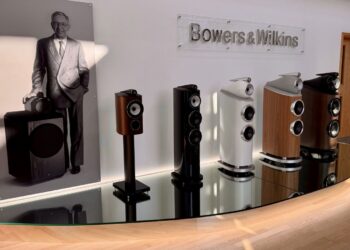
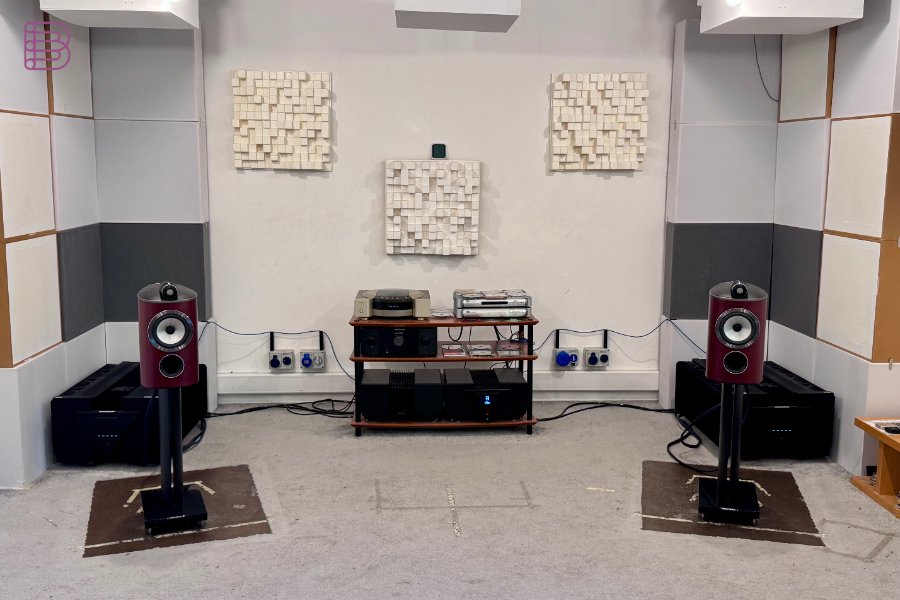
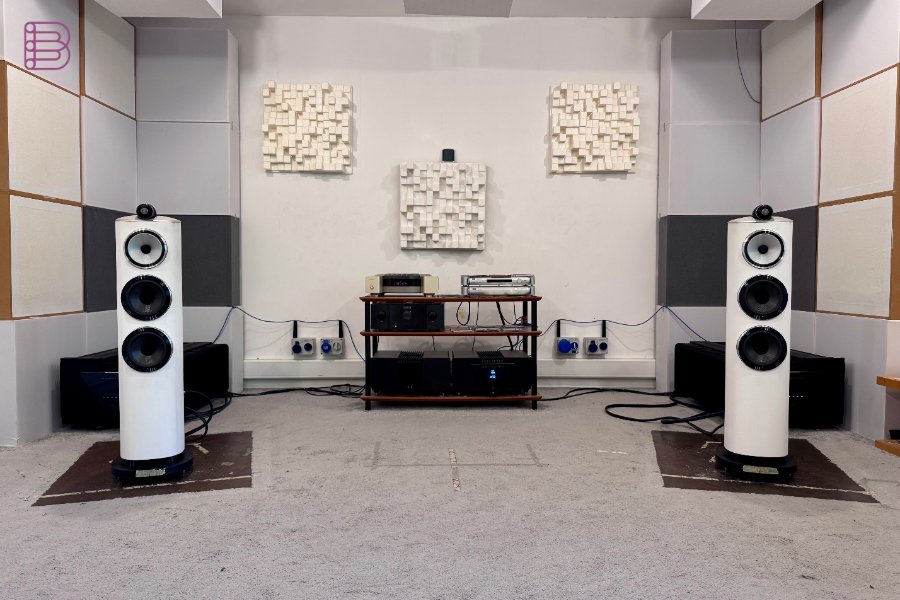
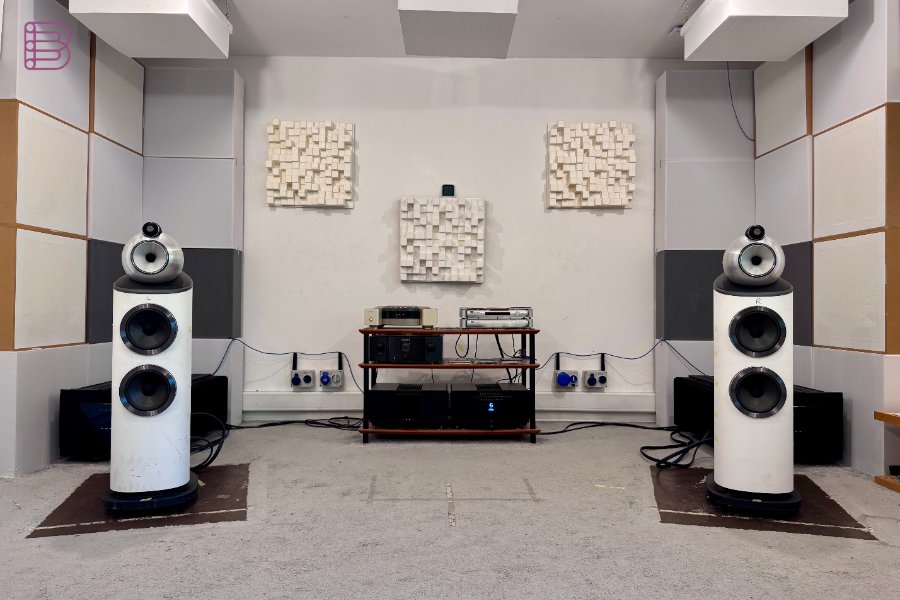
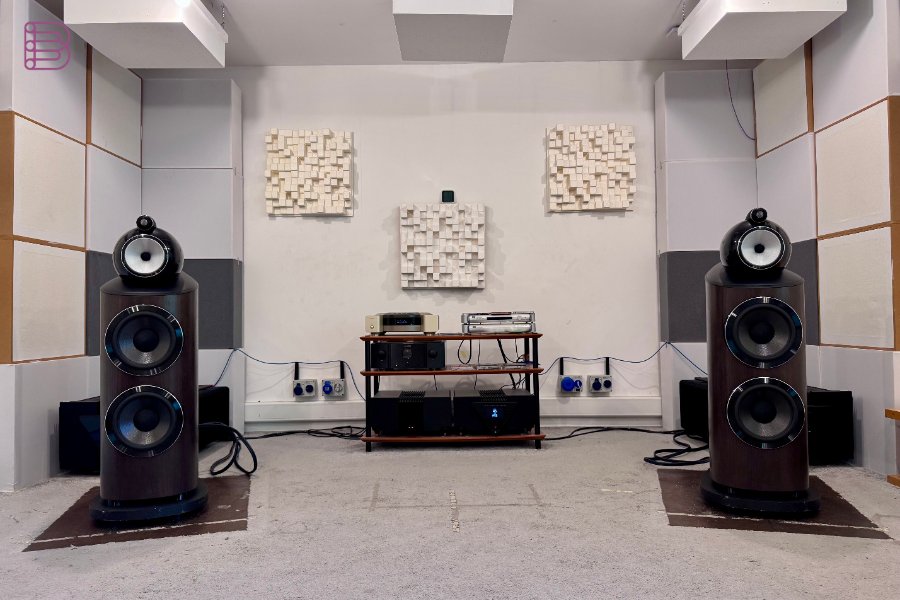
The main listening session took place in the largest of the demo rooms, and it was also the one that ran longest. Rather than jumping straight to the flagship, the team worked upward through the range: 805, then 804, then 803, then 801, leaving only the 802 out of the running. At every step, the same three tracks were played twice, once through the outgoing D4 and once through the new D5, so any difference had nowhere to hide: Harry Belafonte’s “A Fool for You,” Phoebe Bridgers’ “DVD Menu,” and Agnes Obel’s “The Curse,” a deliberate spread from vintage soul to hushed indie folk to spacious chamber-pop.
Were there audible improvements at every stage? Yes, consistently, but not in a way that rewrites the rulebook. This is a case of refinement rather than revolution: small, real steps forward in tonality, resolution and cabinet transparency, exactly what Bowers & Wilkins had promised.
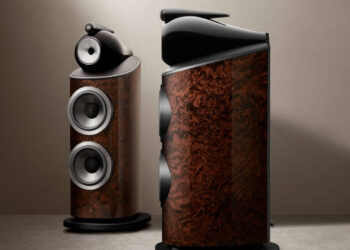
The genuinely interesting moment came at the 803 D5. From that model up, the midrange driver gets its own fully decoupled, purpose-built housing, B&W’s Turbine Head, and the jump in homogeneity, coherence and transparency was the single biggest change of the whole session. Imaging also snapped into focus in a way the smaller models simply could not match, a direct, audible illustration of why B&W keeps building that head assembly the way it does.
Old-School Electronics Driving a New-Generation Speaker
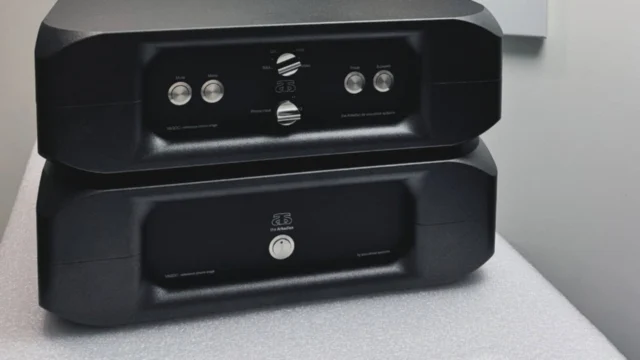
What powered the whole comparison was, frankly, a surprise. Anyone expecting a wall of the newest, most exotic electronics behind a range that tops out at $65,000 a pair would have raised an eyebrow, as we did. The amplification was a pair of Griffin Apex Class A monoblocks, genuine monster amplifiers, fed by a Griffin preamplifier. The source was an older Denon CD transport, not the brand’s latest model, feeding an MSB DAC with an outboard power supply. In an era of 24-bit, 192kHz masters, the team was quite happy running the whole comparison off 16-bit CDs.
The cabling was equally unshowy: relatively mainstream AudioQuest runs, nothing from the high-end reaches of that catalogue, despite driving speakers that very much are. It says something about how Bowers & Wilkins hears its own products that this is the reference chain they reach for.
It also left us curious about a different pairing entirely. Of the four models auditioned, the 803 D5 was the standout, both for what it revealed sonically and for being the largest model that could realistically make it up two flights of stairs into a home listening room. We are especially keen to hear what happens when that speaker meets a pair of Purifi Eval-5 monoblocks, amplifiers so clean and so free of distortion and coloration that a loudspeaker has nowhere left to hide its own character. Listening in a familiar room, on familiar electronics, is always a better final test than a demo suite, so a home follow-up review is very much the plan.
Andy Kerr on What a 800 Series Diamond D5 Buyer Actually Gets
The D4 generation was already a five-star, category-defining range, which raises an obvious question for a new generation with a notable price increase: what does a D5 buyer actually get that a D4 owner is missing? Kerr points to three things. First, tonality: Bowers & Wilkins believes it has continued the same trajectory of improvement it made from the D3 to the D4, without sacrificing resolution, and, if anything, extending it. The goal was a speaker that is more enjoyable to live with and more forgiving of average recordings, not just a more revealing one.
Second, and this is the thread that runs through every generation of the 800 Series since 1979, is removing the audible sense of the cabinet itself. From the Fibre Crimp-filled head assemblies of the mid-1980s, to the first curved cabinet and Marlan head in 1998, to the turbine head and reverse wrap structure introduced in 2015, each generation has chased the same goal: the loudspeaker disappearing from the room. Kerr argues the D5 takes that furthest yet, to the point where he now rates the 801 D5 as good at vanishing acoustically as B&W’s own Nautilus, historically the brand’s benchmark for soundstage disappearance, while adding the dynamics, scale and resolution Nautilus never had.
Third is resolution in the broadest sense: lower distortion throughout the transducers, crossover and cabinet construction, which shows up as extra clarity and what listeners often mistake for extra loudness. “We’ve just removed the unwanted noise that was masking the resolution within the signal,” as Kerr puts it. None of that, he is careful to add, makes the D4 a bad product; it simply means the improvements compound the further up the range, and up the generations, you go.
The 804 D5’s Almost-Turbine Head
The 804 D5 is the clearest engineering story of the whole generation. For the first time, it gets its own dedicated aluminium midrange enclosure, something Bowers & Wilkins describes as derived from the Turbine Head principle without being an actual Turbine Head. We put that framing to Kerr directly: how close does it really get to a headed model like the 803?
His answer was refreshingly specific. The 804 D5 gets two of the Turbine Head’s three benefits, better mechanical stiffness and more consistent, repeatable decoupling of the midrange driver from cabinet-borne resonance, because the assembly is now fully enclosed in metal rather than split between metal and wood. What it cannot replicate is the beneficial acoustic form: a mid-range unit sitting fully isolated on top of the bass enclosure, with minimal material around the driver itself, which is what actually widens and heightens the soundstage in the 803 and above. In short, the 804 D5 bridges the gap to the 803 far better than the D4 generation did, but the head model still wins outright on spatial presentation, and Kerr does not pretend otherwise.
How Far Can the 800 Series Diamond D5 Go?
With the 801 D5 now at $65,000 a pair, and rival brands at High End Vienna pricing well above that, we asked Kerr where Bowers & Wilkins draws the line between reference performance and diminishing returns: is the 800 Series still the benchmark, or increasingly a stepping stone to a pricier ultra-high-end tier above it? His answer leaned on the range’s own history. In the early 1980s, studios asked for an 801 capable of a higher sustained sound pressure level; the resulting 808 was so large it would not fit through most doors, which pushed B&W toward the more modular 800 Matrix instead. He sees a similar modular approach as the only realistic route to anything genuinely bigger, since an 801 has to remain sized for a recording studio and a customer’s front door alike.
More tellingly, Kerr does not think the business case is there yet. B&W, he says, does not want to build a product for 30 or 40 buyers the way Nautilus was; the 800 Series, “relatively” mass-produced by high-end standards, is what pays for the brand’s engineering. His own analogy: B&W’s 801 is its Porsche 911, plenty fast for almost anyone, plenty fast around a track, even if a Pagani or a Lamborghini exists above it.
For now, the company would rather push what the current architecture can do, and apply that knowledge elsewhere in the lineup, than chase a speculative flagship above it. Asked which existing model he is proudest of on pure value, Kerr singled out the 702, calling it “an unbelievable loudspeaker” at a genuinely real-world price.
Harman, Samsung, and What Independence Means Now
No conversation about Bowers & Wilkins in 2026 avoids the ownership question. The brand has passed through EVA Automation, then Sound United under Masimo, and, as of a deal finalised in September 2025 for roughly $350 million, is now part of Harman, itself a Samsung subsidiary, its third owner in a decade. We put the obvious worry to Kerr directly: does joining a mass-market giant risk diluting Bowers & Wilkins’ independence, its R&D budget, and the future of a flagship like the 800 Series?
His answer was more upbeat than defensive. Rather than dilution, he frames the move as a return to a group that already understands Bowers & Wilkins, pointing to a working relationship with Harman on automotive audio projects dating back to 2012. He argues the brand complements rather than duplicates Harman’s existing portfolio, which already includes Revel, Mark Levinson and Arcam alongside JBL, Harman Kardon and AKG, and that nothing suggests B&W will be pulled into unrelated categories.
As public evidence of the new direction, he pointed to B&W’s presence at High End Vienna, and to a slate of additional shows planned through the rest of 2026 and into next year. On costs, his answer was blunt: “there’s no sign of cutting costs, right? Quite the reverse,” with new projects already discussed for the next six months beyond what has just launched.
Is UK Manufacturing Still Guaranteed?
The 800 Series Diamond D5 is still built in the UK, and we asked Kerr, on the record, whether that remains guaranteed under the new ownership and rising costs. His answer was honest rather than promotional: nobody can guarantee anything forever.
But he laid out the practical case for staying put, the factory, the skill set and, in his words, “two or three hundred years worth of accumulated knowledge in just three or four people” on the factory floor, plus a genuine commercial advantage in markets like China, where British or European origin is itself a selling point. He would be “amazed” if B&W ever lost its UK factory entirely, even as some future products or processes shift around it, because, as he put it, being rooted in that heritage is close to the core of what the brand actually is.
A Positive Signal for What Comes Next
One more listening room was on the day-two schedule, and it has to stay off the record for now: new, unreleased Bowers & Wilkins products, expected in early 2027, that we are simply not allowed to describe yet. What we can say is that the intent behind them, and behind the whole two days, read as a genuinely positive signal. This is a company keen to prove it is back on a good course, and returning to making the kind of products it was always known for. Combined with the incremental but real gains of the 800 Series Diamond D5 launch itself, it points to a brand that, under its third owner in ten years, seems to finally be settling into a stable footing again. We will be back with a full review once a 803 D5 pair, hopefully alongside those Purifi Eval-5 amplifiers, makes it into our own listening room.
Bowers & Wilkins 800 Series Diamond D5: Pricing at a Glance
Full technical detail on the range, its four finishes, and its unchanged core technologies, the diamond dome tweeter, Continuum cone FST, Aerofoil bass and Biomimetic Suspension, is available on Bowers & Wilkins’ official 800 Series Diamond D5 product page. US list pricing per pair, at launch, runs as follows. EU pricing is set independently, market by market, and comes out lower in nominal terms: on Bowers & Wilkins’ own Dutch site, VAT included, the 805 D5 is listed at €12,000, the 804 D5 at €18,000, the 803 D5 at €30,000, the 802 D5 at €37,000 and the 801 D5 at €50,000, all per pair.
- 805 D5 (stand-mount): $15,000
- 804 D5 (floorstander): $25,000
- 803 D5 (floorstander, Turbine Head): $35,000
- 802 D5 (floorstander, Turbine Head): $45,000
- 801 D5 (flagship floorstander, Turbine Head): $65,000
- HTM81 (centre channel): $15,000
- HTM82 (centre channel): $12,000
- Launch: unveiled at High End Vienna, 4 June 2026 (Bowers & Wilkins’ 60th anniversary); orders open since 9 September 2026
- Finishes: Stealth Black, Warm White, Light Walnut and Dark Walnut, with Connolly leather detailing