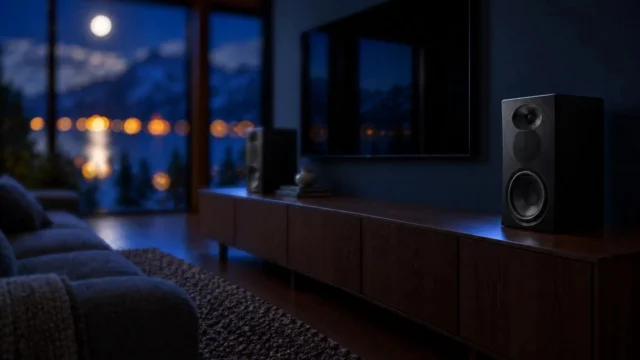


The biggest risk in automated room correction is not that it fails to fix a problem. It is that it fixes problems that were never really there — chasing quirks of one microphone position instead of mapping the entire room, as if a single spot could stand in for room-wide acoustic flaws. That risk of RoomPerfect over-correction, as Roland Hoffmann, Director Product Marketing at Steinway Lyngdorf, explains, is precisely why the system measures the entire listening area instead of a single spot.

The problem with correcting from one position
Measure a room from a single point, and a digital signal processor only has one dataset to work from. Whatever that one measurement shows, correct or not, the system has no way to tell the difference — every dip and peak it detects looks equally real, equally worth correcting. In practice, that means a system measuring from one spot can end up “fixing” something that was only ever a local artefact of exactly where the microphone happened to be sitting, while treating it with the same confidence as an actual, room-wide standing wave.
Mapping the entire room changes what gets corrected
RoomPerfect’s answer is a genuine perspective shift: measuring the room in three dimensions rather than from a single seat, and evaluating acoustic problems from multiple viewpoints across the space rather than one. The practical effect is that RoomPerfect can properly separate what is real from what is not — addressing genuine, consistent room problems while deliberately avoiding the trap of correcting for something that was only ever true at one exact point in the room.
That distinction compounds as more of the room is measured. The more positions RoomPerfect captures, the better it understands not just what the loudspeaker’s own response looks like, but what the room itself is actually doing around it, and which of the two is responsible for a given problem. That separation between speaker behaviour and room behaviour is exactly what keeps the resulting correction targeted rather than indiscriminate.
The result: correction that also sounds better
The payoff of measuring the entire room rather than over-correcting from one spot is not only more accurate — it is also more musical. A correction curve built from a single, possibly misleading measurement point can end up doing more harm than good, actively working against parts of the room it never properly evaluated. A correction built from a genuine map of the room’s acoustic behaviour solves the problems that are actually there, without introducing new ones in the process, which is why RoomPerfect’s more thorough measurement approach translates into a result that measures better and sounds better at the same time. The measurement process itself is covered step by step in our Tech Talk on how RoomPerfect maps a room in 3D.
Frequently asked questions
What is RoomPerfect over-correction, and how does mapping the whole room prevent it?
Over-correction happens when a room correction system treats a problem detected at a single measurement point as if it were a genuine, room-wide issue, and applies a fix for it everywhere. By mapping multiple positions across the room, RoomPerfect can confirm whether a problem is actually consistent throughout the space before correcting for it, avoiding fixes for issues that were never really there.
Does mapping the entire room take longer than a single-point measurement?
Yes, inherently — more measurement positions means more total measurement time. That trade-off is deliberate, and is covered in more detail in our companion Tech Talk on why RoomPerfect measurements take some time.
Can over-correction actually make a system sound worse?
Yes. Correcting for a problem that was only a local artefact of one measurement position, rather than a genuine room-wide issue, can introduce audible side effects elsewhere without solving anything real. Mapping the whole room is specifically designed to avoid that outcome.
Does RoomPerfect distinguish between speaker problems and room problems?
To a meaningful extent, yes. By comparing measurements from multiple positions, RoomPerfect can better identify whether a given issue originates from the loudspeaker itself or from the room’s acoustic behaviour around it, which helps keep the correction focused on what the room is actually doing rather than altering the speaker’s own character unnecessarily.