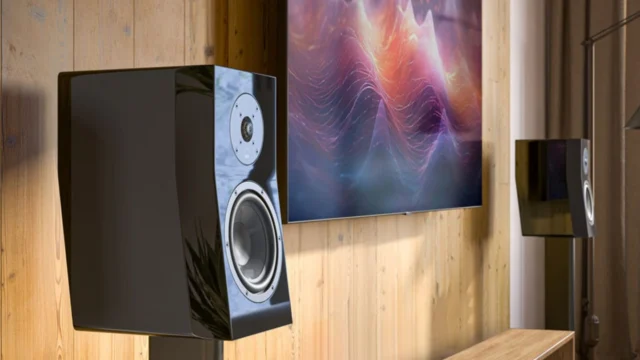


The same mid-range and tweeter section as the flagship Model D
Steinway & Sons’ reference loudspeaker is the two-metre-tall Model D, an open dipole design with no cabinet at all. Not everyone can fit a statement speaker of that size into a living room, so the Steinway Lyngdorf Model C was built around the exact same mid-range and tweeter section — just without the built-in woofers, which are moved into separate boundary woofer cabinets instead.
Open dipole, no cabinet — and four woofer choices to fit the room
Because there is no enclosure, there is also no material to choose — no MDF, glass, steel or concrete box coloring the tone or adding boxy resonance. The drive units sit fully exposed, which also shows off the Steinway design details: high-gloss black or bronze-gold finishes, and front and rear strings that echo the look of a piano.
The Model C works in a 2.2 setup with additional woofers, and Steinway Lyngdorf offers four different woofer models to combine, so the bass end can be matched to the size of the room. The result, according to the brand, combines the transparency and openness of an open dipole with the punch and bass response of a dedicated boundary woofer.
Frequently asked questions
What’s the difference between the Model C and the flagship Model D?
The Model C uses the same mid-range and tweeter section as the Model D, but its woofers are separate boundary woofer cabinets rather than built into a single two-metre open dipole enclosure.
Why does an open dipole design avoid a “boxy” sound?
With no cabinet, there’s no enclosure material — MDF, glass, steel or concrete — to color the tone or add resonance, so the drive units produce their sound unaffected by a box.
Can the Model C’s woofers be matched to different room sizes?
Yes. Steinway Lyngdorf offers four different woofer models for the Model C’s 2.2 setup, which can be combined depending on the size of the room.