

No physical crossovers: direct drive from phono stage to driver
Lyravox has spent ten years building loudspeakers without physical crossovers. Instead, an electronic crossover sits between the phono and line stages and a bank of individual power amplifiers — one per driver. Designer Götz von Laffert calls it “total luxury from the perspective of the driver”: each driver connects directly to its own amplifier, with no losses, no phase shifts and no distortion in between, and noticeably more control over the sound.
From the outside, the flagship still looks like a traditional super-speaker surrounded by power amplifiers. The difference is entirely in how those amplifiers connect to the drivers.
Accuton ceramic drivers in 380kg stone cabinets
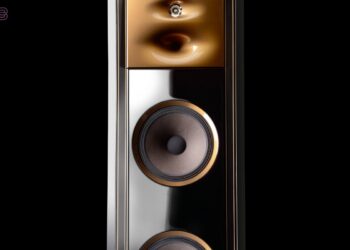
The flagship uses the latest Accuton ceramic drivers — the same German-made units found in other super-speakers, but here Lyravox has chosen the highest-end versions in terms of motor and magnet design. Each driver sits in its own individual cabinet, ten in total, built from a mineralic, man-made stone developed by Lyravox specifically for its acoustic properties. Unlike concrete, which rings and lets resonance pass through, the material damps roughly 30 times more — even Lyravox’s simplest speaker sounds noticeably different once housed in this type of cabinet. The complete flagship weighs 380 kilos, and the mid-range can be upgraded to a diamond version for even greater naturalness, at close to double the price.
A 21-inch subwoofer, and a tuning visit included
Behind the array sits a 21-inch subwoofer with a quad voice coil and double magnet, built into the same monolithic cabinet rather than a separate enclosure — a deliberate choice to keep the footprint compact, even though four separate subwoofer cabinets would technically be possible. Buying the flagship also includes an on-site visit from a Lyravox expert, who tunes the system to the room and to the owner’s taste, compensating for room acoustics rather than working around them with cables or placement alone.
Frequently asked questions
Why doesn’t Lyravox use physical crossovers?
Lyravox uses an electronic crossover paired with one amplifier per driver instead, giving each driver a direct connection to its own amplifier. According to the brand, this removes the losses, phase shifts and distortion associated with a physical crossover network.
What are the flagship’s cabinets made of?
Each of the ten driver cabinets is built from a mineralic, man-made stone that Lyravox developed for its damping properties — around 30 times more effective than concrete, according to the brand.
Can the flagship’s mid-range be upgraded?
Yes. A diamond version of the mid-range driver is available as an upgrade, at close to double the price, which Lyravox says makes the sound even more natural.