

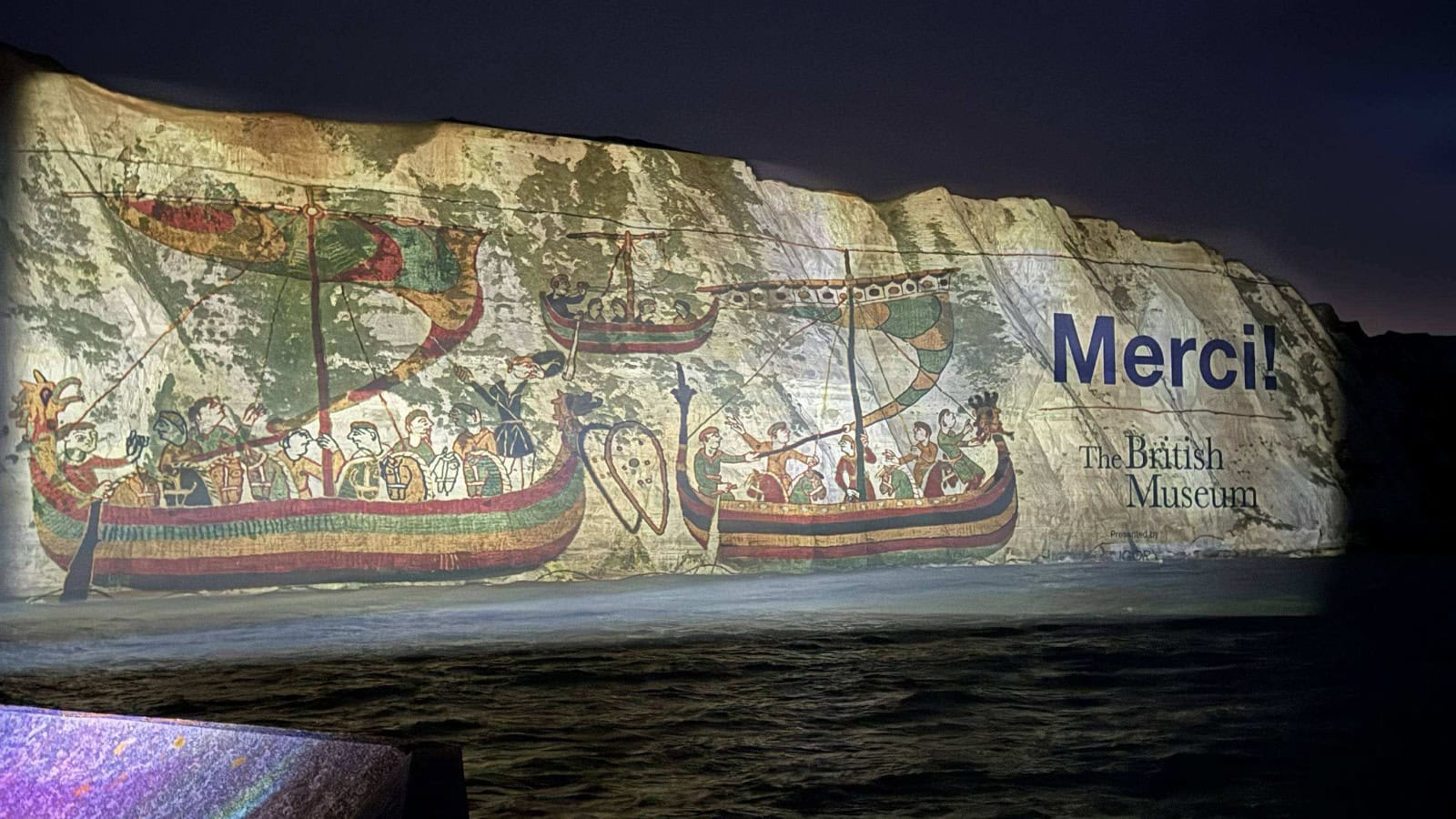
When the British Museum wanted to mark the historic Bayeux Tapestry’s forthcoming loan to England with a public message of thanks to France, it turned to one of the country’s most recognisable landmarks: the White Cliffs of Dover. Bringing that idea to life fell to projection specialist Pixel Sharp, whose founder and director Jon Sharpe chose four Panasonic PT-RQ35K2 laser projectors to turn a mile-long chalk face into a single-night canvas, running entirely on portable battery power with no mains electricity on site.
A Canvas Nearly a Thousand Years in the Making
Nearly 1,000 years after the events it depicts, imagery inspired by the Bayeux Tapestry appeared across the cliffs alongside a simple word: “Merci.” The Museum developed the creative concept; Pixel Sharp translated it into content that could survive a surface that is, in Sharpe’s words, anything but a conventional screen. “The White Cliffs are neither flat nor consistently white,” he explains. “Chalk, vegetation and variations in the surface can affect colour, contrast and legibility.” Darker tones needed careful handling, and the team prepared alternative content layouts so imagery could be repositioned depending on conditions on site.
Four Panasonic PT-RQ35K2 Laser Projectors, Zero Mains Power
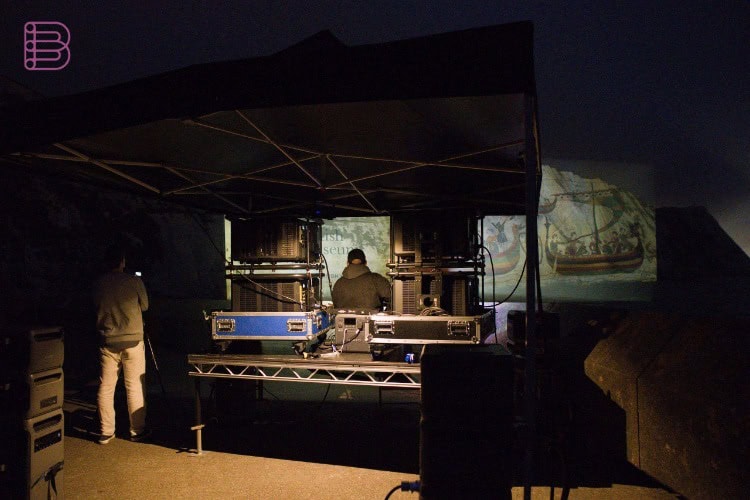
Reaching the projection position meant hauling equipment across difficult terrain with no mains power available, so the system had to deliver enormous output while staying manageable for a small crew. Pixel Sharp deployed four Panasonic PT-RQ35K2 4K laser projectors in two double-stacked pairs, drawing on Sharpe’s long-standing familiarity with the platform. “We always use them. We love them,” he says. “They’re super easy to use, and we’re very accustomed to Panasonic projectors.” For multi-projector mapping he favours the PT-RQ35K2’s 3-Chip DLP engine for colour consistency: “The colours are going to match, the adjustments are going to be better, and the uniformity throughout the image is going to be cleaner.” Portability mattered just as much: “For the power of that projector, three people can pick them up, put them on a desk and move them around.”
Fog, a Storm, and a Narrow Nighttime Window
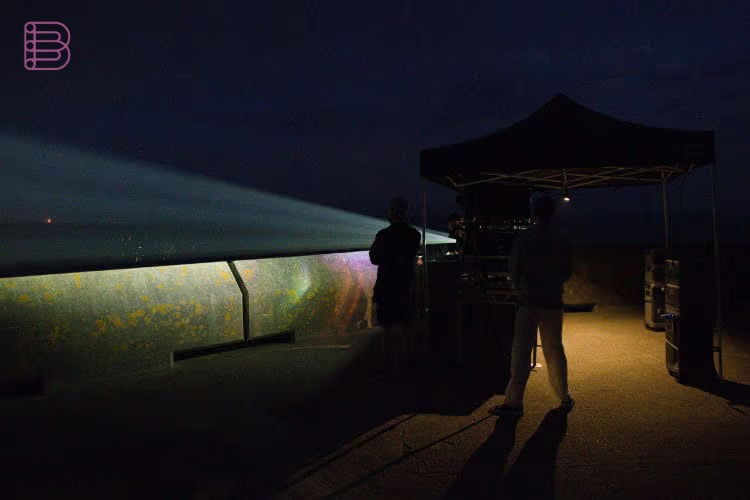
Once on site, the projectors could be positioned within a couple of hours, with roughly another ninety minutes needed for mapping — but the weather had other plans. A thick bank of fog drifted across the cliffs mid-setup, obscuring the surface the team needed to map, and conditions had barely cleared before an electrical storm began approaching the coast. With batteries and electrical equipment exposed on an open clifftop, the crew captured the required imagery and shut the system down early. “You make sure you’ve got cover, you make sure you’re protected, and you have backup plans,” Sharpe says of working against unpredictable outdoor conditions.
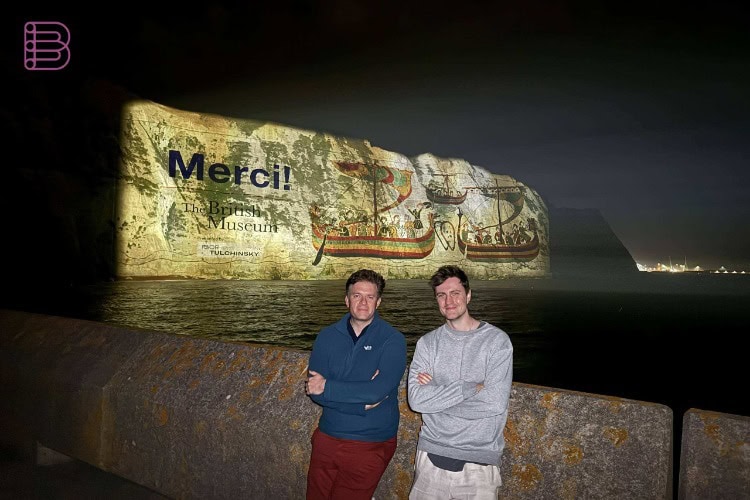
The finished projection travelled well beyond Dover, with images shared by French President Emmanuel Macron among others. For Sharpe, it is proof of what projection can do that a rectangular screen cannot. “The whole value is that you can take your message and give it context by placing it on a location, or by changing the shape of how it’s viewed,” he says. “When you present something in a unique way, people are going to remember it.” More on how Pixel Sharp and the wider Panasonic RQ series scale up for large public installations can be found in our coverage of a record 83-projector light show in Budapest, powered by the PT-RQ35K2’s larger sibling.
Pricing and availability
The Panasonic PT-RQ35K2 is a professional large-venue projector sold through Panasonic’s specialist AV integrator channel rather than consumer retail, so there is no fixed public price for the unit itself. Industry pricing guides put a single PT-RQ35K2 at a street price of roughly $61,850 (around €57,000); a production of this scale is priced separately by the installer based on crew, rigging and rental duration. Further technical details and quotes from Jon Sharpe are available via Panasonic’s official case study.
Key specifications
- Model: Panasonic PT-RQ35K2, 3-Chip DLP laser projector
- Brightness: approximately 30,500 ANSI lumens
- Resolution: 3,840 x 2,160 (4K UHD)
- Contrast ratio: approximately 20,000:1
- Light source: solid-state laser phosphor, lamp-free
- Deployment: 4 units in 2 double-stacked pairs, powered by portable batteries, no mains connection required
- On-site setup: roughly 2 hours positioning plus 90 minutes for projection mapping