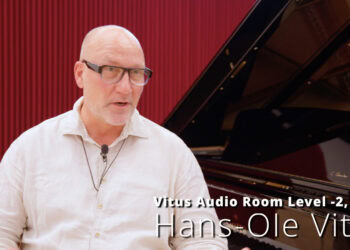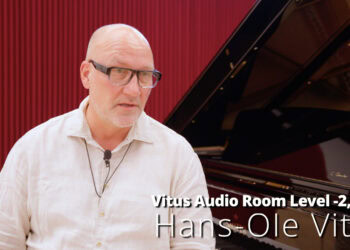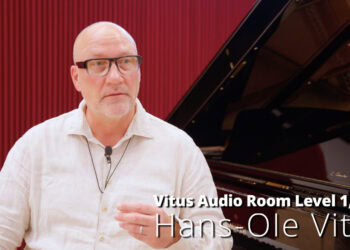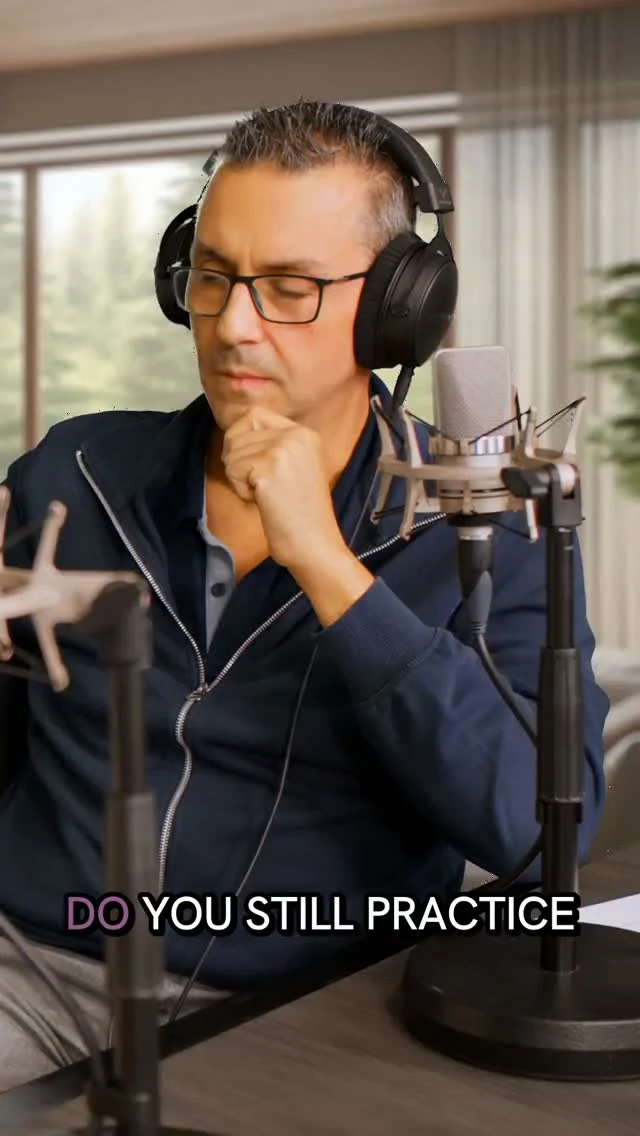


Welcome to a new edition of Tech Talk, recorded in the Best of High End studio. Our guest is Hans-Ole Vitus, founder of Vitus Audio. Over seven episodes we go through his career, his philosophy and his products. In part one we start with the man himself: what Texas Instruments taught him, what drumming and karate have to do with designing amplifiers, the sound he is chasing, and the two Vitus products he is most proud of.
What Texas Instruments taught Hans-Ole Vitus
Hans-Ole Vitus was not born an amplifier designer. Before Vitus Audio, he spent a long period at Texas Instruments, starting out as a technical salesperson, or sales engineer. The lesson he still carries with him is discipline, and above all attention to detail. “Every single company is different, even though they work from the same principles,” he says. Understanding how a customer’s engineering, purchasing and administration interact was difficult at first, but it fascinated him. “That’s one thing that just stuck with me, for good and for worse.”
The second lesson came as a surprise. Part of his job was taking data sheets of new chips to customers and asking for feedback. Only later did he realise that some of those chips did not exist yet: they lived only in the product marketing department, and the customer conversations were shaping what the final chip would become.
His first reaction was to feel a little betrayed. Then he saw the logic. “Why would you bring out a product that nobody wanted to use?” It is a principle he has applied to running his own company for the past 30 years.
And Texas Instruments is still close by: the MSP430 microcontroller he once talked about with customers is used in the Vitus remote control today.
Drums, karate and persistence
Hans-Ole Vitus is a drummer, although he insists on “amateur”. He owns two kits: an electronic set at home, after the acoustic one did not go down well with the rest of the household, and an acoustic set at the company.
He came to the drums through a street marching band, walking around as a young kid with a big snare drum over his shoulder, until someone put him behind a full kit and simply said: play. “I was as surprised as everybody else in the room.”
His joke is that drumming and karate have one thing in common: you get to hit things hard. The serious answer goes deeper. Drumming taught him rhythm, tone and timing, and how to coordinate several things at once.
Karate is more about mindset: precision, timing, and reading your opponent, something he says he uses at work every day. Both taught him persistence. “If somebody tells me this is not possible, that’s just fuel on the fire.”
An old whiplash injury from a car accident ended his karate. These days his “martial art” is golf, which he admits he is not very good at. But like drumming, it forces him to focus on one thing and switch off from work, something he calls a general challenge for anyone who is self-employed.
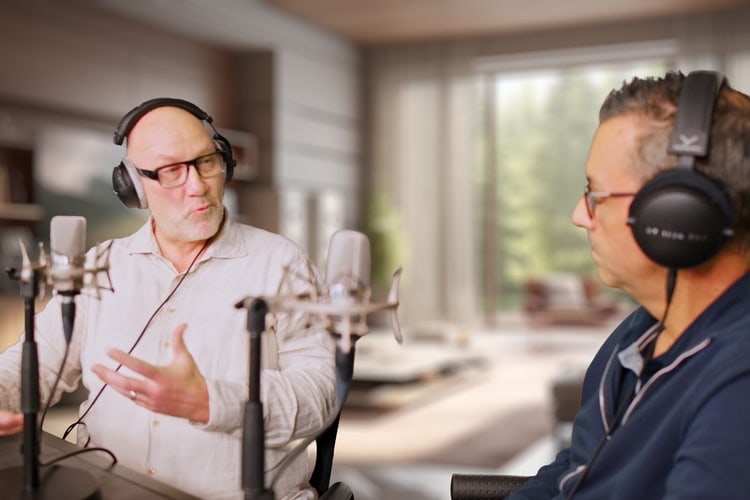
The ultimate system according to Hans-Ole Vitus
What should the ultimate system be able to do? For Hans-Ole Vitus, the first answer is simple: no listening fatigue. “I don’t like a system to dictate how long I can actually sit there and listen.” If he starts turning the volume down or gets distracted after a while, something in the presentation is not right.
That does not mean everything should be soft. Brass can sound harsh, and as a drummer he knows cymbals do too. “But it has to be in a controlled way.”
His second criterion is dynamics and resolution at any volume. Where most people turn the volume up to judge a system, he does the opposite. At shows, he turns the volume up when the room is empty, and down a little when visitors walk in.
“If you listen at low volume and you don’t feel the attack of the stick hitting the skin, then there’s something wrong.” This is not about speaker efficiency, he stresses: an inefficient speaker simply needs a big amplifier that can deliver a lot of current. What counts is the resulting sound pressure, with the full dynamic range and resolution intact, even at low levels.
Unforgettable listening moments
Asked for his most wonderful audio experience, Hans-Ole Vitus needs more than one answer.
The first was at CES 2004, the first time Vitus Audio exhibited. The company was paired with Sound Lab electrostatic loudspeakers, the Ultimate 1: about one metre wide and 2.8 metres tall.
Hans-Ole Vitus had built Apogee-style magnetostatic speakers himself, but this was “next level” in resolution, including in the low frequencies, down to around 24Hz from an electrostatic panel. He remembers Sound Lab’s Roger West, who, as Hans-Ole notes, passed away earlier this year, as proof that deep electrostatic bass is possible.
The second was on a trip through Asia, in a listening room about the size of our studio. A Micro Seiki BL-111 turntable, a Vitus SS-102 or SS-103 stereo power amplifier and a pair of Sonus faber Extrema, so close that he could almost touch both speakers when leaning forward.
“I stopped thinking about resolution and bandwidth. I was just sitting there like: what record is this? I need this record.” Still in that room, he texted a contact in Belgium to find a second-hand pair of Extremas. A month later he picked them up in the Netherlands, and he ended up buying the owner’s turntable as well. “We’re not doing this for a price tag, or for anything other than actually music.”
And then there is the system that started it all, which he heard at around the age of 15: a Micro Seiki DQX-500 turntable with a Benz LP cartridge, a Gryphon Head Amp with its gold front, a Luxman integrated from the Laboratory series with VU meters, and Bowers & Wilkins DM6 loudspeakers, the famous “Penguin”.
Today he owns that same system again, from the exact turntable and tonearm to the same speaker model. He actually has four DM6s. “Too many projects.”
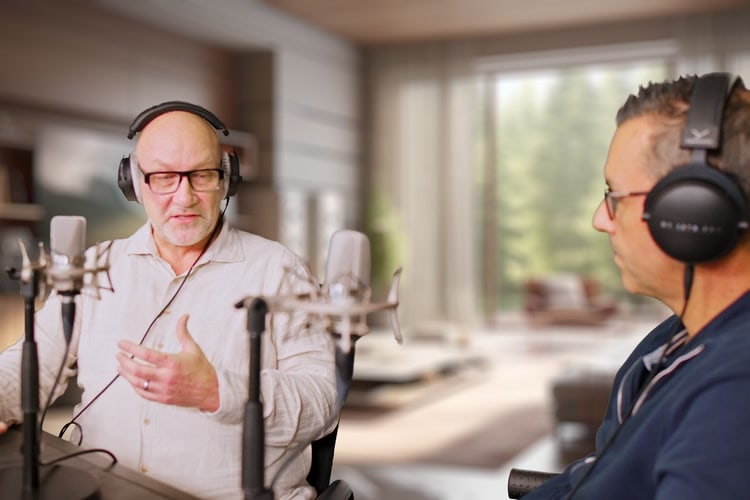
The two Vitus products he is most proud of
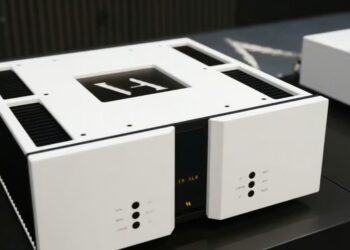
Looking back on 30 years of Vitus Audio, Hans-Ole Vitus picks two products. The first is the SIA-025 integrated amplifier, which The Absolute Sound listed as a legendary product in its amplifier book. It has been in production for more than 15 years.
The only real change was a manufacturability upgrade, moving to more surface-mounted components so that every unit is built identically to spec. “When you can sell a product still unchanged after so many years, that’s special.”
The second is the SIA-030, for a different reason: engineering. It took almost four years from the first idea to the finished product. The SIA-030 weighs 63 kilos, is packed with technology and is one of the most time-consuming products the factory builds today.
Add the optional DAC streamer and phono stage and it becomes a complete one-box system: connect a network cable and your sources, and you are done. When Hans-Ole Vitus jokes that his next product will be “like the SIA-030, just a little more complex”, the production team answers: good luck with that.
It fits the way he likes to design. “If something makes it just a tiny bit better, we’ll just throw more money at it.”
He compares it to building a high-performance car: titanium screws, carbon fibre parts, small and very expensive details that each make a tiny difference. He mentions the Koenigsegg One:1, with its famous one-to-one ratio of weight in kilos to horsepower. “Small things, or big expensive things, that make small differences. But the sum of it all really adds up.”
Coming up next
As you can see, Hans-Ole Vitus is just warming up. In the next episode of Tech Talk, Hans-Ole Vitus shares his listening philosophy.
Want to hear Vitus Audio in a real room first? Read our report from the D&D Audio room at Dutch Audio Event 2026, or visit vitusaudio.com. Subscribe to our YouTube channel or follow us on social media so you don’t miss it.