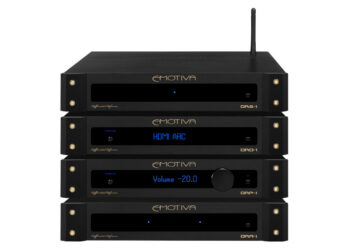


Emotiva is taking listeners behind the scenes of its most space-conscious high-end system yet. In a new official video, “Behind the Build: DR Design Series Streamer, DAC, Preamplifier and Amplifier,” the Tennessee-based manufacturer walks through the engineering decisions behind the Emotiva Differential Reference Stack — a four-box system that packs streamer, DAC, preamplifier and power amplifier into matching cases roughly the size of a sheet of paper.
The Emotiva Differential Reference Stack was designed around a simple question: how much performance can be squeezed into ten inches of shelf space? The answer, according to Emotiva’s engineering team, is a fully balanced signal path carried through all four components — the DRS-1 streamer, DRD-1 DAC, DRP-1 preamplifier and DRA-1 power amplifier — connected via XLR and trigger cabling so the whole stack behaves as a single, tightly integrated system.

Behind the Build: The Emotiva Differential Reference Stack’s Balanced Signal Path
The video’s central theme is Emotiva’s Differential Reference topology, which runs a two-signal, noise-rejecting path through every stage rather than confining balanced circuitry to a single component. Engineers explain how that approach keeps the noise floor low even as each unit is squeezed into an unusually compact chassis, preserving detail and dynamics that are normally associated with far larger separates.
Streaming duties on the Emotiva Differential Reference Stack run through the Volumio app, which comes with a lifetime Premium license included and gives access to Qobuz, TIDAL and internet radio, alongside Bluetooth, USB/NAS and CD playback options. For television use, a single HDMI cable connects straight into the DRD-1 DAC’s HDMI-ARC input, while trigger links let all four boxes power up together at once, so there is no separate remote-juggling required to bring the system to life.

Four Components, One Balanced System
On the amplification side, the DRA-1 is rated at 100 watts x 2 into 8 ohms, 130 watts x 2 into 4 ohms, or 400 watts bridged into a single channel — enough headroom for most stand-mount and floorstanding speakers without leaving the compact footprint behind. The DRD-1 DAC is built around an ESS ES9038Q2M converter chip, with a signal-to-noise ratio up to 120 dB and THD+N as low as 0.0008 percent, figures that place it comfortably among far pricier standalone converters.
Because every unit shares the same case dimensions and rests on rubber feet, the four boxes of the Emotiva Differential Reference Stack lock into a single tower rather than spreading across a rack, which is precisely the space-saving pitch at the heart of Emotiva’s own video walkthrough.

Pricing and availability
The complete Emotiva Differential Reference Stack is priced at €2.795,95 for the full four-component system, sold direct to consumer with no retail markup. Buyers who purchase the full stack also receive a free Cable Kit worth $100, comprising Emotiva XLR, trigger and digital coax cables needed to link the components together. At the time of writing the Emotiva Differential Reference Stack is listed as temporarily unavailable on Emotiva’s site, with a notify-me option for restocking; Emotiva Europe pricing already includes applicable taxes and free shipping.
Key specifications
- Configuration: DRS-1 streamer, DRD-1 DAC, DRP-1 preamplifier, DRA-1 power amplifier
- Amplifier power: 100W x 2 @ 8 ohms, 130W x 2 @ 4 ohms, 400W bridged
- DAC chipset: ESS ES9038Q2M
- SNR: up to 120 dB; THD+N: as low as 0.0008%
- Streaming: Volumio app with lifetime Premium license, Qobuz, TIDAL, internet radio, Bluetooth, USB/NAS
- TV connection: single HDMI-ARC input on the DAC
- Price: €2.795,95 (full stack), free Cable Kit included
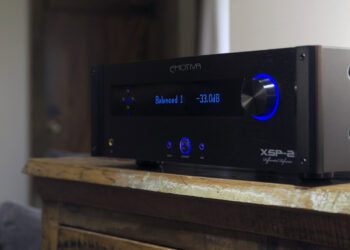
The complete specification sheets for each of the four units — DRS-1, DRD-1, DRP-1 and DRA-1 — are published on Emotiva’s official Differential Reference Stack product page, alongside the full video library. Readers who want to see how the same balanced-circuit philosophy scales up to full-size separates can also revisit our earlier coverage of the Emotiva XSP-2 Differential Reference preamplifier, the standalone unit that first introduced this topology to Emotiva’s range.