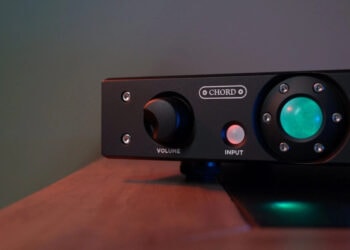


Most component ranges start with a flagship and get filled in around it. Chord Electronics Qutest did the opposite: a standalone DAC that quietly became the anchor for an entire family of components sharing its distinctive milled-aluminium chassis, its illuminated control spheres, and now, its own dedicated rack stand.
The Chord Electronics Qutest DAC, Still the Anchor
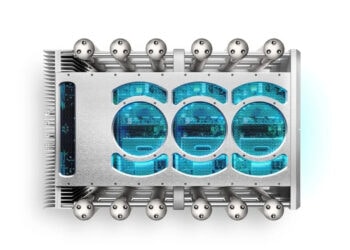
The Qutest itself needs little introduction at this point: Rob Watts’ FPGA-based DAC architecture, a 49,152-tap Pulse Array filter, four selectable frequency-shaping filters and user-selectable 1V/2V/3V output, built into a solid aircraft-grade aluminium billet with a glass viewing window over the illuminated PCB. It has picked up a What Hi-Fi Best DAC award every year from 2018 to 2024, and its price has moved around more than most components in Chord’s range as component costs have shifted – currently around £1,199 in the UK.
Huei and Anni Complete the Family
What’s easy to miss is that Qutest was never meant to sit alone. Huei, Chord’s first phono stage, shares the same chassis dimensions and the same control-sphere interface, but adds microprocessor-controlled gain and impedance memory for MM and MC cartridges – 12-step selectable impedance from 100Ω to 3,700Ω, switchable rumble filtering, and RIAA accuracy to within ±0.1dB. Anni, meanwhile, is Chord’s first desktop integrated amplifier: a 10W-per-channel design built around the company’s ULTIMA circuit topology, driving both loudspeakers and headphones from the same compact box, with simultaneous 3.5mm and 6.35mm headphone outputs.

None of the three Chord Electronics Qutest-format components need each other to function, which is precisely the point. Someone can own only a Qutest, or only an Anni, and be using exactly the product Chord designed. But stack all three side by side and the family resemblance – not just visual, but in the shared design philosophy of solid-billet construction and minimal, deliberate control surfaces – becomes the whole story.

The Rack Stand: a Small but Deliberate Accessory
The detail that ties the range together physically is the Qutest System Stand: a CNC-machined aluminium tier, sold individually, that houses exactly one component – Qutest, Huei or Anni – and can be stacked or arranged side by side to build a complete desktop system without a conventional equipment rack. It is a minor accessory in isolation, but it is also the clearest evidence that Chord always intended these components to be bought as a system rather than as one-off purchases.

Full specifications for the range are listed on Chord Electronics’ own Qutest product page, alongside the Huei and Anni listings.
Pricing and availability
Chord Electronics Qutest is priced at approximately £1,199 in the UK. Huei is priced at approximately £1,150. Anni is priced at approximately £1,299. The Qutest System Stand is sold separately per component, at approximately £245–£265 depending on retailer – buyers building a two- or three-piece system need one stand for each unit. All four products are available now through Chord’s UK and international dealer network.
Key specifications
- Chord Electronics Qutest: FPGA DAC, 49,152-tap Pulse Array, 4 filters, PCM to 768kHz/32-bit, DSD64-DSD512, no headphone output – from £1,199
- Huei: MM/MC phono stage, 12-step impedance selection (100Ω-3,700Ω), switchable rumble filter, RIAA ±0.1dB – from £1,150
- Anni: desktop integrated amplifier, 10W/channel, ULTIMA topology, dual simultaneous headphone outputs – from £1,299
- Qutest System Stand: CNC-machined aluminium, houses one component per stand, stackable or side-by-side – from £245
- Shared design: solid aircraft-grade aluminium chassis, illuminated control spheres, made in England