

High frequencies carry the air, the shimmer of a cymbal, the breath behind a vocal, the sense that a recording was made in a real space. A tweeter that cannot move quickly enough, or that runs out of control before it runs out of output, flattens that detail even when the rest of a system is excellent. One answer that high-end speaker designers keep returning to is the Air Motion Transformer tweeter, a driver that works nothing like the dome or cone most listeners picture when they hear the word “tweeter.”
Where the Air Motion Transformer Tweeter Came From
The Air Motion Transformer was developed in the 1970s by Dr. Oskar Heil, a German physicist whose earlier patents touched on field-effect transistors. Heil licensed his driver to ESS, an American loudspeaker company that sold it through the 1970s and 1980s as the “Heil Air Motion Transformer” or ESS Heil Driver, built into floorstanding speakers that became something of a cult favorite. The design fell out of mainstream production for a couple of decades as conventional dome tweeters improved and manufacturing costs mattered more, before a handful of specialist brands revived it in the 1990s and 2000s, refined it with modern materials, and built it into a recognizable signature of certain high-end loudspeaker lines.
How an Air Motion Transformer Tweeter Actually Works
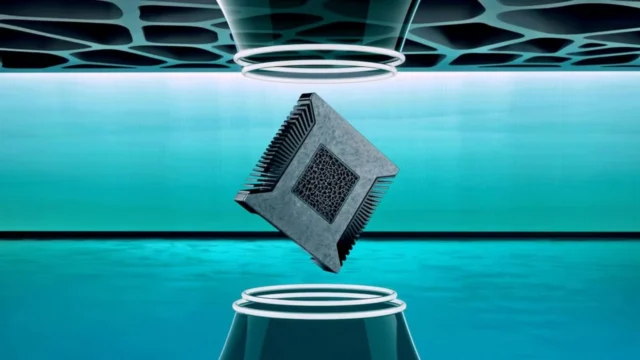
A conventional dome or cone tweeter moves air by moving its whole diaphragm back and forth, piston-style, the same way a drum skin does. An Air Motion Transformer tweeter does something different. Its diaphragm is a thin, pleated film, folded like a concertina or a paper fan, with a conductor printed or bonded onto the folds. That folded film sits inside a strong magnetic field. When music signal passes through the conductor, the pleats squeeze together and pull apart rather than swinging forward and back.
That squeezing motion pushes air out from between the folds at several times the velocity of the diaphragm’s own physical movement, roughly the same principle as squeezing a folded bellows. The diaphragm itself barely has to move far or fast to produce a lot of air velocity, which means its moving mass can be very low relative to the air it pushes. Lower moving mass means less resistance to sudden changes in signal, which in turn means a faster, more linear response to transients than a conventional dome can usually manage, along with a naturally wide and well-controlled dispersion pattern because the folds act almost like a small line source.
Why Designers Still Choose an Air Motion Transformer Tweeter
None of this matters unless it translates into something audible, and speaker designers who build around an Air Motion Transformer tweeter generally point to three things: speed, extension and control. The low moving mass lets the driver start and stop almost instantly, which shows up as crisp transient detail on cymbals, strings and plosive vocal consonants rather than a smeared average of the signal. The pleated geometry also tends to extend smoothly well above 20kHz with less breakup than many small domes, and because the folds behave like a compact line source, off-axis response stays more consistent as a listener moves around a room, which matters a great deal once a pair of speakers has to fill a living space rather than a single sweet spot.
ELAC has arguably done the most to keep the format in the public eye. Working with Heil himself before his passing in 2009, ELAC developed the JET tweeter used across several of its Vela, Solano and Navis loudspeaker ranges, pairing a folded Kapton-film diaphragm with a strong neodymium motor system. ELAC’s own manufacturing photos show the pleated diaphragm being hand-finished before assembly, a reminder that an Air Motion Transformer tweeter is still a comparatively labor-intensive part to build well.

Variants Across Today’s High-End Speakers
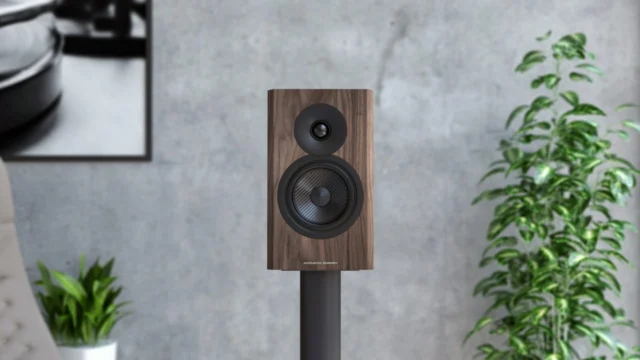
Several current loudspeaker ranges use their own take on the Air Motion Transformer tweeter, each sized and tuned differently for its role. The Wharfedale Elysian series uses a large-format AMT, noticeably bigger than the tweeter in Wharfedale’s more affordable EVO line, specifically to extend bandwidth and increase output headroom in the brand’s flagship models. Esprit Audio’s Stella bookshelf monitor takes a different approach, pairing a compact AMT with a wide-dispersion waveguide to keep the tweeter’s output matched to its midrange driver across a wide listening window. AudioVector, meanwhile, builds its R5 Arreté around an AMT housed in its own outboard cylindrical module, physically separated from the main cabinet to reduce cabinet-borne vibration reaching the diaphragm, a trickle-down approach from the brand’s flagship R&D.

These differences matter because an Air Motion Transformer tweeter is not a single off-the-shelf part; its size, pleat count, magnet strength and crossover integration all change how it behaves, and two speakers built around the same basic principle can sound quite different as a result.

What to Listen For as a Buyer
An Air Motion Transformer tweeter is not automatically “better” than a well-executed dome or ribbon; it is a different set of trade-offs that happens to suit certain recordings and certain rooms particularly well. In the showroom, listen for how cleanly a speaker separates layered high-frequency information, cymbal wash against vocal sibilance against string harmonics, rather than for sheer loudness or brightness. Pay attention, too, to how the top end holds together off-axis, since the AMT’s line-source-like dispersion often keeps a wider listening area sounding consistent. For anyone assembling a high-end system built around detail retrieval and a wide, stable soundstage, a loudspeaker using an Air Motion Transformer tweeter is worth an audition alongside the usual dome and ribbon alternatives.