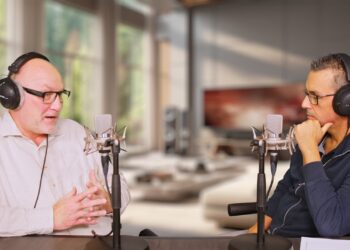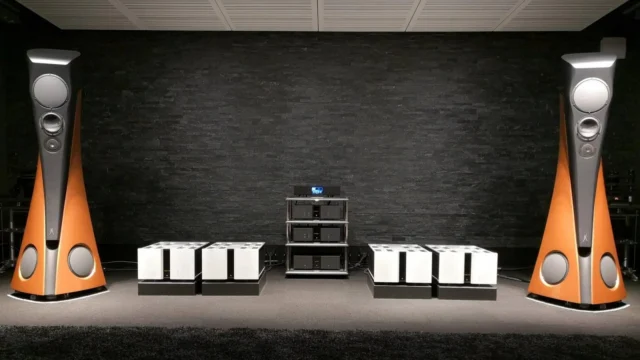


Welcome back to Tech Talk, recorded in the Best of High End studio with Hans-Ole Vitus, founder of Vitus Audio. This sixth episode is the final one of the series, and we use it to look at 2026 and beyond: the new output stage in the SM-025 monoblocks, the story behind the latest Masterpiece upgrades, the first High End show in Vienna, and how streaming and a proper phono stage can live inside a pure Vitus Audio integrated amplifier.
SM-025: a new output stage as the platform for the future
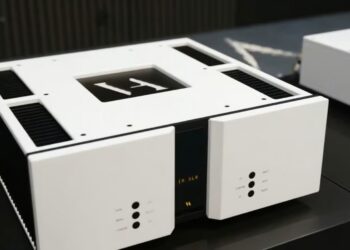
The SM-025 monoblocks are the first Vitus Audio amplifiers with a new output stage. The configuration is similar, Hans-Ole Vitus explains, but the reason for the change came from outside. For years, Vitus used Sanken output transistors in a fairly wide housing. That housing became obsolete, and the successor uses the same die in a much narrower package. “In the old house you could dissipate about 180 watts in each transistor. In the new one, I believe it’s 120 or 130,” he says.
That sounds like a detail, but it created a real challenge. The easy fix would have been to put more output transistors in parallel, and that is exactly what Hans-Ole Vitus never wanted to do for sound reasons. “That’s kind of going against everything that I’ve been promoting,” he says. Vitus tried it anyway, and did not like the result: “It was still the same as it was back in the day.” The team had to find other ways to reach a sound they were happy with, without compromising the traditions of the brand.
The output stage is not the only change compared to the previous SM-011. The transformer is bigger and more powerful, and the input stage received a significant upgrade too. According to Hans-Ole Vitus, the technology inside the SM-025 is the platform from which future designs will start, and it will be scaled into other models over a longer period of time. It is also a direct result of the “rewind and reset” approach he described earlier in this series: questioning his own rules instead of letting them become dogma, so Vitus Audio is not left behind when others move on to new technologies.
Masterpiece Mark II and Mark III: what triggers an upgrade?
A Mark III version is rare at Vitus Audio. The Masterpiece phono stage is one of the few, and the reason was surprisingly practical. Duelund, the capacitor maker Vitus relies on, upgraded its factory and its overall quality, and that changed the footprint of the capacitor. Vitus had to redesign the board, and once that was necessary, the team upgraded everything else as well. The new version also gained more inputs: where the previous phono stage had two, the new one has three or four. “I do believe it’s four, but if it’s only three, please don’t come after me,” Hans-Ole Vitus laughs.
The latest update to the Masterpiece Transport, released in the third quarter of this year, has an even better story. It started with a single customer in Singapore. Years ago, Hans-Ole Vitus decided that the transport would perform the first stage of sample rate conversion itself, with a 192 kHz output, on the assumption that it would mostly be paired with the Masterpiece DAC. This customer used a different DAC that does its own upsampling, and he wanted a native, non-upsampled output so he could experiment.
To make switching between standard 44.1 kHz and 192 kHz possible, Vitus had to upgrade the whole clock circuitry and the clocks themselves significantly. The result was so good that the custom request became a new version of the product, available to every customer. For Hans-Ole Vitus, it is a perfect example of the point he made in an earlier episode about listening to customers. “He’s super happy. I’m super happy,” he says.
High End Vienna: four days of back-to-back meetings
This year, the biggest show of them all, High End, moved from Munich to Vienna. Vitus Audio did not have its own room, but supported four rooms in total, and was a full co-exhibitor in three of them. Visitors could hear two Masterpiece systems and two Signature series systems, including the SM-025 monoblocks. In the Masterpiece rooms, the MPL line stage was paired once with the Masterpiece stereo amplifier and once with the Masterpiece mono amplifiers. There were no other product launches: “When we do product launches, we want to be 100% in control, and we can’t be 100% in control as a co-exhibitor.”
Hans-Ole Vitus calls the new venue a clear upgrade over the MOC in Munich, which had been the home of the show for more than 20 years and was getting “a little bit tired”. Getting used to a new, large venue took time, though. Friends call him “the human GPS”, he says, yet he still got lost and arrived late for a meeting. Commercially, Vienna was a big success. In Munich, Thursday and Friday were busy, while the weekend was quieter. In Vienna, it was four days of back-to-back meetings. His only criticism is shared by many: there are too few good-quality rooms for the number of exhibitors, and several brands showed in side events nearby. He hopes High End Society can expand the show next year, and that Vitus Audio will have a room of its own again.
Streaming and a zero feedback philosophy
The final question of the series brought us back to a familiar theme. How does the streaming and digital integration of the RI-101 Mk II sit alongside the pure, zero feedback analogue philosophy of Vitus Audio? For Hans-Ole Vitus, digital and analogue are separate tasks, approached with the same philosophy: “The result is what matters.” He does not stream at home himself and prefers a music server, but if the product is good enough, he says, it makes no difference to him whether it is a standalone unit or integrated.
The main driver is the customer. People who move to an integrated amplifier often want a very high-quality, one-box solution, and Hans-Ole Vitus hears one word again and again: integration. That is why Vitus added streaming as an option, never forced on anyone. Because the team knew from the start of the first RI-100 that streaming would become an option, they took every precaution they could at the time. In the newer model, they went further with optimised power supplies and local regulation on the streaming board, to keep digital noise under control.
SIA-030: a real phono stage inside an integrated amplifier
The biggest challenge, Hans-Ole Vitus admits, was the SIA-030 with its phono stage, and the market noticed because of the delays. His own demand was that the DAC and streamer board and the phono stage board should coexist in the same product, next to a 20 kg UI transformer. On top of that, he had promised that the phono stage would handle MC cartridges down to around 500 microvolts output, with the signal-to-noise ratio, sound quality and features he wanted. “That was a tough nut to crack, but we managed,” he says. The SIA-030 is now in full production and shipping.
Typically for Vitus Audio, it is not a token phono input either. It offers two inputs, with all the memory and features of the brand’s external phono stages. “It has to be a real phono stage, and not just something that is there so you can plug it in and listen to your records.”
The end of the series
That closes our Tech Talk series with Hans-Ole Vitus, after hours of conversation in our cosy studio. A big thank you to Hans-Ole for his time and his openness. Missed the earlier episodes? Start with Hans-Ole Vitus: From Drummer to Designer, then Measurements Serve the Music, The Pursuit of the Absolute, Rethinking the Rules and From Idea to Amplifier. Discover the Reference, Signature and Masterpiece series on the Vitus Audio website, and listen to this episode as a podcast on Spotify.