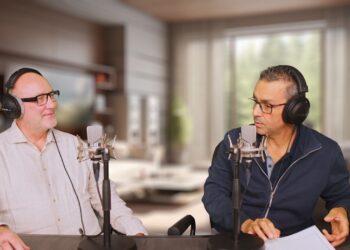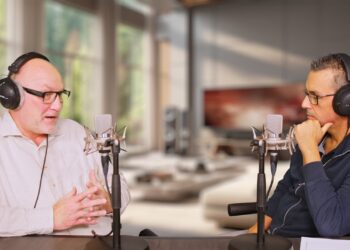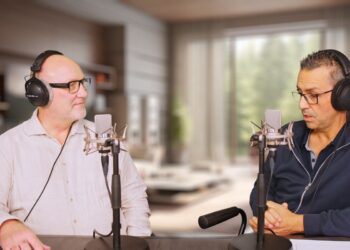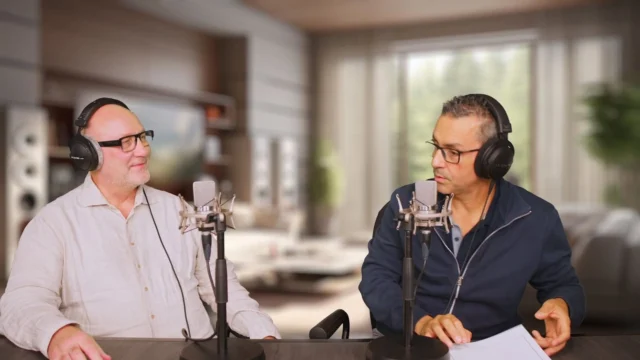


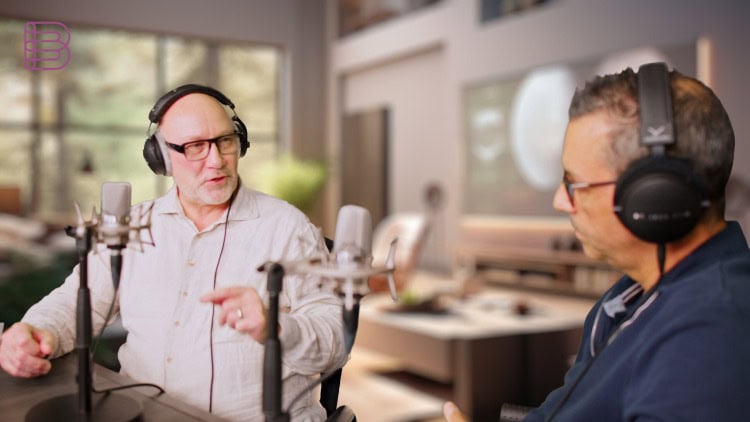
Welcome back to Tech Talk, recorded in the Best of High End studio with Hans-Ole Vitus, founder of Vitus Audio. After getting to know the man and his listening philosophy, this third of seven episodes turns to brand positioning and the market: how Hans-Ole Vitus looks at class D, what separates the Reference, Signature and Masterpiece series, and why the best compliment a customer can give him is forgetting about his products altogether.
Hans-Ole Vitus on class D: threat, complement or different segment?
The first question is a loaded one. Is the rise of class D in high-end a threat, a complement or simply a different segment? “Number three,” Hans-Ole answers, laughing. People who know him remember his early view on class D: “Well, it sounds horrible.” In those days the technology was mainly used to drive woofers, as Bang & Olufsen did with ICEpower, where DSP room correction asks for a lot of power in the low frequencies.
Today he sees it differently. Class D is just another technology, and it has its positives. In active speakers, especially the “wireless” ones that still need a power cord, it is a perfect fit. Vitus Audio builds class A and high-bias class AB amplifiers because that was the right choice for him when he started more than 20 years ago, not because other approaches are bad. “If it was bad, it wouldn’t exist anymore, would it?”
Will Vitus ever build a class D amplifier? Probably not. But if it delivered the results he is after, why wouldn’t he? As he explained in the previous episode, the technology serves the music, not the other way around. “What matters is what I hear when I sit down and listen to a system.” He has heard class D systems that made him say: “Say what? That’s class D?”
He also knows the technology from the inside. At Texas Instruments he saw the company acquire the Danish firm behind the TacT Millennium amplifier, whose technology went into later TI chipsets. One of the engineers from that period is now a founder of Purifi, whose modules he calls a big step up. “But it’s not a technology that I master, and it’s not something that I’m pursuing.”

“We start where others stop”
Most manufacturers call their top series the reference line. At Vitus Audio, Reference is the entry level, and that is a deliberate choice. At CES 2004 the company even hung a banner that read: “We start where others stop.” It came down after about two hours. “People really took that the wrong way, and it was 100% on us,” Hans-Ole admits. The message was never meant as “we are better than everyone else”. It was about the thought process behind the designs.
Today he has a better term for it: the pursuit of the absolute. “You will never reach the absolute, because as soon as you get close, it moves.” Technology keeps advancing, Vitus keeps experimenting, and the goal shifts again. “So it’s really about the journey.”
Reference, Signature and Masterpiece
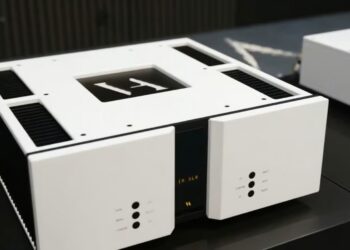
The product names follow the series: RI-101 stands for Reference integrated amplifier, SIA for Signature integrated amplifier, MPL for Masterpiece line stage. Vitus actually started with Signature, with the SM-100 monoblocks as its first product. At the time, Hans-Ole thought it was the best they could possibly build. Then new markets asked for something even higher.
The first step towards Masterpiece was the power supply. The SL-103 Signature line stage is one chassis; the Masterpiece line stage has two, with the first part of the power supply in a separate box, which immediately pays off in lower noise. The second step was refining everything, including the parts. All three series are fully balanced designs, and where Signature uses 1% resistors, Masterpiece moves to 0.1% or even 0.01% parts. Better precision in a balanced circuit means less distortion, and the price difference between those tolerances is “not children’s play”.

Going down to Reference meant meeting a lower price point. The biggest saving is the chassis: simpler sheet metal instead of the machined casework of the higher series. That matters in Denmark, where labour is expensive and every extra hour of assembly adds cost. Reference also uses EI transformers instead of the huge UI transformers in Signature and Masterpiece; the one in the SM-103 alone weighs 20 kilos. And Reference is not class A, which means much smaller heat sinks.
The core technology, however, stays the same across the range: only bipolar transistors and no global feedback, so the sound signature remains recognisable. What do you get as you move up? “More of everything,” Hans-Ole jokes. In practice that mainly means resolution: a lower noise floor, more detail and more dynamics.
The Vitus sound: tubes and solid state
How does Vitus Audio stand apart in high-end? Hans-Ole doesn’t follow what his colleagues are doing, only the trends in the market, so he answers from a sound point of view. He plays drums and “goofs around” on guitar and bass, and both his bass amp and his guitar amp at the company run on tubes. When tubes distort, they produce even-order harmonics, which the ear finds pleasing. Solid state produces odd-order harmonics, which it does not.
“I don’t know how to make tubes sound any good. I tried, I failed. So I switched to the other side.” What he has always tried to do is merge the two: the tube-like sound from the lower midrange upwards, with the attack and impact of solid state below. Over the years, customers have described exactly that sound to him, without knowing what he was aiming for. “Super, super cool feedback.”
Products that disappear
The design follows the same thinking. Vitus products look industrial and clean, and come in several colours, so customers can choose a finish that makes the product disappear in the room. “The products are not to be seen. What they do is meant to be heard.” Any marketing department might hate him for saying it, he admits, but the products themselves are not what matters to him. The result is: the goosebumps when you sit down and listen.
The best feedback he ever got proves the point. A customer apologised, then complimented him on the products, and added that since he got them, he had completely forgotten about the products and the stereo. He was just listening to music. “For me, that’s the best compliment I can get. Then the product is doing its job right.”
Coming up next
That closes episode three of our Tech Talk series with Hans-Ole Vitus. Missed the earlier episodes? Watch Hans-Ole Vitus: From Drummer to Designer and Hans-Ole Vitus: Measurements Serve the Music. More about the Reference, Signature and Masterpiece series can be found on vitusaudio.com. Prefer to listen? Every Tech Talk is also available as a podcast on Spotify.