

Class D and digital amplifiers picked up a reputation for sounding harsh, lean and analytical — and for years, that reputation was earned. In this Tech Talk, Roland Hoffmann, Director of Product Marketing at Steinway Lyngdorf, walks through the digital amplifier revolution from its unglamorous origins in energy efficiency to the handful of genuine benchmark designs that changed what a switching amplifier could sound like.

Why the digital amplifier revolution wasn’t originally about sound quality
Class D and switching amplifiers exist because they’re dramatically more energy efficient than Class A or AB designs, not because early engineers set out to beat the best conventional amplifiers on sound quality. Analogue amplification simply couldn’t fit inside a mobile device, a computer, or a portable player — it generated too much heat. That efficiency need later crept into AV receivers, too, since running five, seven or nine channels of Class AB amplification would have made a receiver into a space heater. None of that early Class D and digital amplifier design was optimised to outperform the best traditional amplifiers; it was optimised to be practical.
The Millennium: a digital amplifier built for a different reason
The first genuine exception, in Hoffmann’s account, was the Lyngdorf Millennium, the first true digital amplifier, developed in the late 1990s. Unlike nearly everything that came before or after it for a decade, the Millennium wasn’t built primarily to save energy — Peter Lyngdorf and his team set out to build a benchmark amplifier, full stop, by keeping the signal in the digital domain as long as possible and pairing a Class D-related switching topology with a genuinely audiophile-grade output filter. That distinction — designed for sound first, efficiency second — is exactly what most Class D amplifiers of the era got backwards.

Only a handful of true game-changers
For more than a decade after the Millennium, Hoffmann counts only three or four amplifiers that genuinely changed listeners’ minds: the Millennium itself, the NAD M2, Hypex’s Class D modules, and — more recently — Purifi. Each was engineered explicitly to be the best amplifier available, not simply the most efficient one, which is precisely why they earned credibility that most Class D designs of their era never did. It’s a distinction that connects directly to the broader story of how Class D amplification actually began and how the technology evolved into today’s self-oscillating, feedback-corrected designs.
Why musicality and low distortion aren’t opposites
It’s tempting to assume that an amplifier engineered purely to drive THD toward zero must sound clinical, while a “musical” sound requires some flattering coloration from magic components. Hoffmann rejects that framing entirely: removing distortion and side effects is exactly what returns musicality, rather than removing it. He points to how reviewers now use the word “musicality” when describing the Lyngdorf MXA-8400, a description that would have been unthinkable for a Class D amplifier a decade earlier — a direct result of getting the output stage and signal path fundamentally right, not of adding character back in.
The volume wheel is more than an aesthetic choice
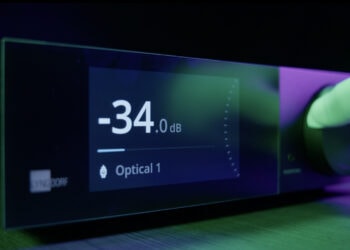
The Millennium’s oversized volume knob, since carried through to current TDAI amplifiers, isn’t just a tactile design flourish. In a conventional amplifier, turning the volume down attenuates an already-weak incoming signal before amplifying it back up — adding noise along the way. In the Millennium and its descendants, the volume control instead sets the output voltage of the power amplifier stage directly, without ever attenuating the incoming signal in either the analogue or digital domain. That’s a genuinely different signal path, and the big wheel exists partly to signal that this amplifier works differently from a conventional design.
What “switching” actually means, and why it’s inaudible
The letter D in Class D is simply the next letter after A, B and C — it has nothing to do with “digital,” despite the confusion the name has caused. What actually happens is switching at extremely high frequency, often around 400 kHz and up to 800 kHz in some designs — far above the audible range, comparable to how an LED bulb switches too fast to see yet appears to shine continuously. Just as early LED lighting had flickering, poor colour rendering before the technology matured, early Class D amplifiers were more efficient without necessarily being better — and it took roughly two decades of refinement in the output stage and switching implementation to consistently close that gap.

Frequently asked questions
Why did the digital amplifier revolution start with efficiency rather than sound quality?
Because Class D and switching amplifiers were originally developed to fit into devices where heat-generating Class A or AB amplification was physically impossible, such as mobile devices, computers and multi-channel AV receivers — not primarily to outperform existing amplifiers on sound.
What made the Lyngdorf Millennium different from other early digital amplifiers?
It was engineered specifically to be a benchmark amplifier rather than simply an efficient one, keeping the signal in the digital domain as long as possible and pairing a Class D-related topology with an audiophile-grade output filter.
Do low-distortion Class D amplifiers sound less musical than traditional designs?
No — according to Hoffmann, the opposite is true. Reducing distortion and side effects is exactly what allows musicality to come through, which is why modern low-distortion Class D amplifiers are now described by reviewers as musical rather than clinical.
What does the large volume wheel on a Lyngdorf amplifier actually do?
Unlike a conventional volume control, it sets the power amplifier’s output voltage directly rather than attenuating the incoming signal before amplification, which avoids adding noise through unnecessary signal attenuation.
Why is Class D switching inaudible even though the amplifier is constantly turning on and off?
Because the switching happens at an extremely high frequency, often 400 kHz or higher, far above the range of human hearing — comparable to how an LED bulb switches too fast for the human eye to perceive as flickering.