

The name is slightly misleading, and Roland Hoffmann, Director of Product Marketing at Steinway Lyngdorf, says so himself: RoomPerfect room calibration doesn’t actually correct the room. No DSP, whatever the brand, can stop a window or a bare wall from reflecting sound. What it can do — and how it does it differently from most of the competition — is the subject of this deep-dive Tech Talk into measurement methodology, algorithms, and why a straight, linear frequency response turned out to be the wrong goal all along. It’s a companion piece to two related Tech Talks: how room correction software elevates your listening experience more broadly, and where physical acoustic room treatment fits in alongside it.

Why RoomPerfect room calibration doesn’t try to “fix” the room
Room calibration, Hoffmann explains, is really speaker calibration — it’s about how the speakers interact with the room, not about physically changing the room itself. No system corrects the room; what it does is pre-correct the signal before the sound comes out of the speaker, based on an acoustic fingerprint captured by a measurement microphone. Feed that fingerprint back into an amplifier or speaker’s onboard DSP, and it becomes possible to send less sound energy into the room at exactly the frequencies where a problem — exaggerated bass, an uneven response, excessive brightness from reflections — would otherwise occur. It’s a feedback loop, not a room renovation.
Why the old “measure and flatten” approach fell short
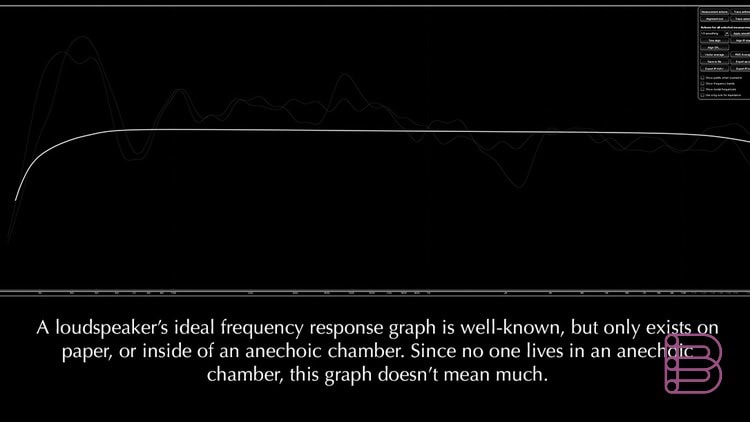
Early room correction relied on a short sweep, the same signal used to measure a speaker in an anechoic chamber, then simply linearized whatever “Rocky Mountain” response came back. It’s still, in Hoffmann’s estimate, the underlying approach in roughly 80% of room corrections on the market. The problem: that approach did remove the boomy bass, but listeners often described the result as sterile, flat, or lacking musicality. A short sweep over a brief time window isn’t the same as the sustained sound energy of actual music or movie soundtracks filling a room over time — and, more fundamentally, a perfectly straight line isn’t necessarily what good sound in a room should measure like at all. An anechoic chamber measures perfectly linear and sounds, by Hoffmann’s own account, “terrible” to sit in for more than a minute or two.

More measurements, more data, better results
This is where RoomPerfect room calibration diverges most sharply from a single-spot sweep. Most systems measure at one location — the listening seat — and calibrate from that single snapshot alone. RoomPerfect uses that first measurement only as a reference point, then takes further measurements from different positions, angles and heights across the room. As measurements accumulate, the interface reports a rising “room knowledge” percentage, typically completing around 90%, and Hoffmann is clear that this isn’t a cosmetic progress bar: every additional measurement genuinely improves the end result, moving the calibration away from an oversimplified straight-line correction and toward one built on actual power response data.
Why a wider measurement window matters more than it sounds
RoomPerfect’s measurement tones are deliberately long, sweeping through low and then high frequencies over an extended period — much closer to how a room actually fills with sound during real listening than a brief sweep ever could be. A useful side benefit: a longer measurement window makes stray noise during calibration largely irrelevant. A dropped pen, a passing car, someone talking — with a short sweep, any of that can corrupt the result and force a re-measurement; with RoomPerfect’s wider window, it’s effectively filtered out or ignored, and if there’s continuous background noise, the system simply extends the measurement window until it has enough clean data.
What time alignment and phase correction do — and don’t — touch
Speaker distance and time alignment are handled in a separate setup step before RoomPerfect calibration begins. RoomPerfect itself doesn’t touch a speaker’s internal phase response between tweeter, midrange and woofer, since that alignment is the speaker designer’s job, done correctly at the driver level. Some competing systems claim to correct room-related phase issues directly in the speaker signal — Hoffmann is sceptical of that approach, since altering phase behaviour off-axis inevitably changes what the speaker does on-axis as well, which isn’t a trade-off worth making.
What listeners actually report afterward
The pattern Hoffmann describes echoes across every Lyngdorf Tech Talk on this subject: listeners rarely lead with “the boomy bass is gone.” Instead, they describe better imaging and staging between speakers, more depth, and hearing further into the actual recording. RoomPerfect doesn’t add space between instruments or extend a recorded hall’s dimensions — it can’t. What it does is remove the room’s negative interference well enough that detail already present in the recording becomes newly audible, which is precisely the audiophile experience of moving closer to the original source.
Frequently asked questions
Does RoomPerfect room calibration actually change the physical acoustics of a room?
No. It pre-corrects the audio signal digitally before playback, based on an acoustic measurement of the room, rather than altering any physical property of the space itself. A reflecting window or bare wall remains exactly as reflective as before.
Why does RoomPerfect take so many measurements instead of just one?
Because measuring only at the listening position gives the algorithm a single, incomplete snapshot. Additional measurements from different positions and heights build a much more complete picture of how the speakers and room interact, which produces a noticeably better calibration result.
Why did early room correction systems sound sterile or lifeless to some listeners?
Because they linearized the frequency response toward a perfectly flat target based on a brief measurement sweep, which isn’t how humans actually perceive good sound in a real room — an anechoic chamber measures perfectly linear but sounds unpleasant to sit in.
Does background noise during a RoomPerfect measurement ruin the calibration?
Rarely. RoomPerfect uses a long measurement window that can filter out or ignore brief noises like a dropped object or passing traffic, and will extend the measurement time if needed to gather clean data.
Does RoomPerfect correct the phase alignment between a speaker’s own drivers?
No. Driver-to-driver phase alignment is handled by the speaker’s designer and isn’t touched by RoomPerfect, which focuses on room-related acoustic issues rather than a speaker’s internal crossover design.