

Dutch Audio Event is a wonderful kind of maze. Corridor after corridor, door after door, and behind every one of them another system asking for your attention. Somewhere in that labyrinth at NH Koningshof in Veldhoven, we walked into a room that felt less like a demo and more like a quiet statement: Aequo Audio, playing on home ground with the Aequo Audio Ensium. Paul Rassin, who co-runs the Dutch loudspeaker company, did most of the talking. We were happy to listen.

A home game for a Dutch maker
Aequo Audio comes from Eindhoven and has been building loudspeakers for more than a decade. The Aequo Audio Ensium is something new, though: the first product of a new range, launched about six months before the show. And the story of the Aequo Audio Ensium does not start with a driver or a crossover. It starts with a material.
Cast, not built
Most loudspeaker cabinets are assembled: panels cut, glued, braced and finished. The Aequo Audio Ensium is cast. Aequo developed its own nanomaterial, which it calls Diluvite, and pours the entire cabinet from it in one piece. That changes everything about what a cabinet can be.
According to Paul, the material is twice as stiff as aluminium and offers ten times better damping. More importantly, that damping stays consistently high across a huge range, measured from 1 to 100,000Hz: “five times above what we can hear.” Instead of storing vibrations and releasing them as colouration, the material turns them into heat.
Because it is castable, the shapes can be as complex as the engineers like. The internal structure of the Ensium is organically formed, with no compromises imposed by flat panels and straight joints. Knock on the cabinet and, as Paul puts it, “you hear that it’s nothing.” Dead quiet, exactly as a cabinet should be.
Heavy, but not bulky
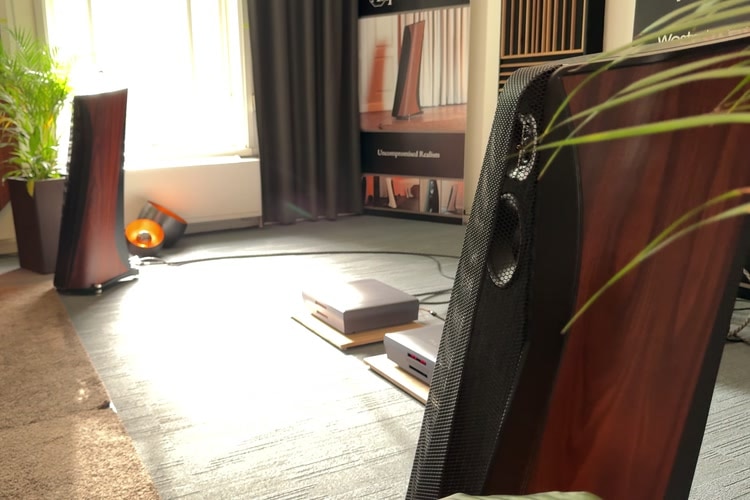
There is a catch, and Paul is honest about it: one Aequo Audio Ensium weighs around 130 kilos. In this case, though, heavy is good. The mass gives the speaker a far better connection to the floor. And the weight is not the result of thick walls: the cabinet walls are only five to six millimetres thick, so the internal volume is very large compared to the outside dimensions. The result is a speaker that looks surprisingly compact for what it is.
Stiff, highly damped and heavy: “those three things you want for a cabinet,” says Paul. Living on the second floor without a lift? It is doable, he smiles. A bit harder to get into place, but no problem.
Aequo Audio Ensium: built to disappear
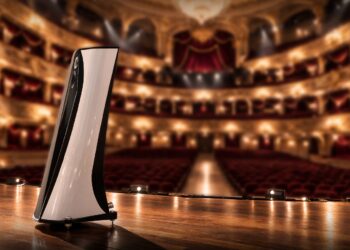
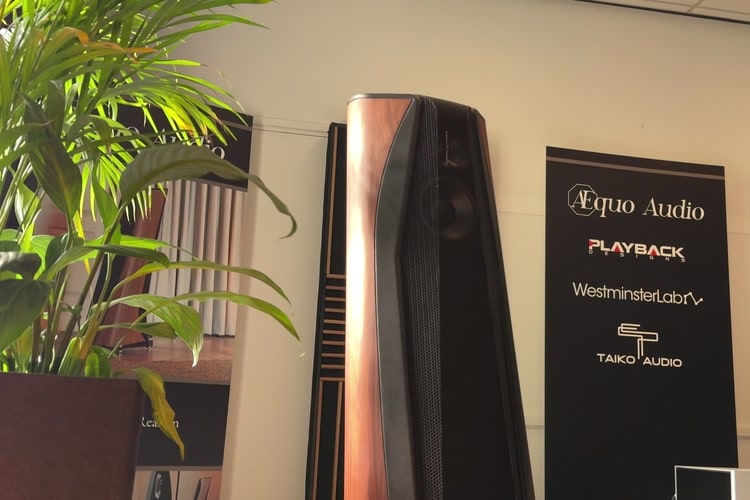
Walk into the room and the first thing you notice is the shape. The Aequo Audio Ensium is sculpted, almost organic, and the finishes on show were exquisite. But the form follows a clear goal. “We want to forget that we’re listening to a system and immerse ourselves in the music,” says Paul. The sound should come from inside the room, not from a box.
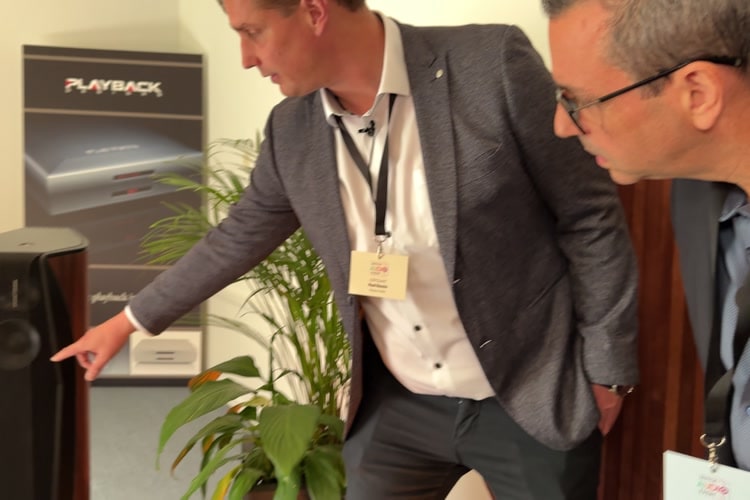
To get there, the drivers are physically staggered. The bass driver sits slightly further forward than the midrange, which in turn sits slightly in front of the tweeter. That makes the drivers perfectly phase-aligned, not just around the crossover frequencies but across the whole bandwidth, so the Aequo Audio Ensium behaves like a point source. There are no reflective surfaces on the speaker itself: a special felt on the cabinet prevents reflections, and the sides curve away so that sound disperses freely into the room. The speakers simply vanish.
Assisted bass: power where it’s needed
So do you need a monster amplifier? Not at all. The Ensium in Veldhoven was the version with Aequo’s assisted bass system, and it is a clever piece of thinking. On the back of each speaker you find two dials: one for room size and one for placement. With them you adjust the low frequencies to your room, with no DSP involved.
What happens behind those dials is the interesting part. Aequo changes the impedance curve and adds current where it is needed, based on the settings, without touching the input voltage. The signal stays perfectly intact, while the amplifier has to work much less hard. That opens the door to amplifiers with far less power, even a 20-watt tube amp. “You don’t have to look for a matching amplifier on power output, but on characteristics,” says Paul. In other words: you choose an amplifier for its sound, for your own taste, not for its wattage.
The system in the room
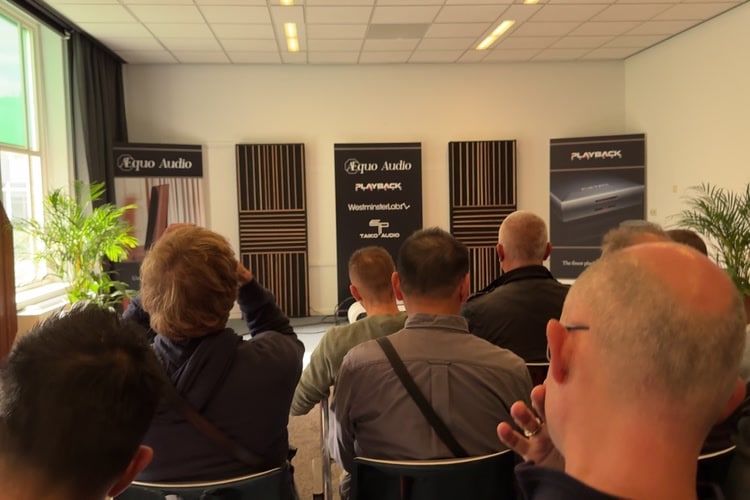
In Veldhoven, the Aequo Audio Ensium played with sources and electronics from Playback Designs, WestminsterLab and Taiko Audio: a serious front end for a speaker that hides nothing. The room was packed during our visit, and that says something at a show where visitors have dozens of other doors to choose from.
Price and bespoke finishes
The Aequo Audio Ensium costs €49,900 per pair in its standard version. Wood finishes come at a small extra cost, and that is where the fun starts. Aequo offers a wide range of bespoke options: different wood types, but also any car paint or lacquer you can think of. Got a Zebrano chair and want your speakers to match? “No problem.”
Our take
The Ensium is one of those products where the idea comes first and the hi-fi follows. Casting a cabinet from a self-developed nanomaterial is a bold move for a relatively small Dutch company, and the logic behind it holds up: a stiff, dead, heavy enclosure, phase-aligned drivers, and a shape designed to make the speaker disappear. Add an assisted bass system that frees you to choose an amplifier on character rather than raw power, and the Ensium becomes surprisingly flexible for a speaker of this weight and ambition.
At almost €50,000 per pair it is not a casual purchase. But in a maze full of loudspeakers, this was a room that made you stop, sit down and forget you were listening to a system. That, in the end, is exactly what Aequo set out to do.
Discover more from Dutch Audio Event 2026: read our reports on Vitus Audio in the D&D Audio room and System Audio Silverback. More information: aequoaudio.com