

Why compressed music is a contradiction comes down to two very different meanings of the term, and Peter Lyngdorf says conflating them is where most confusion starts. One is relatively harmless. The other, he argues, quietly ruins recordings.
Two kinds of compression
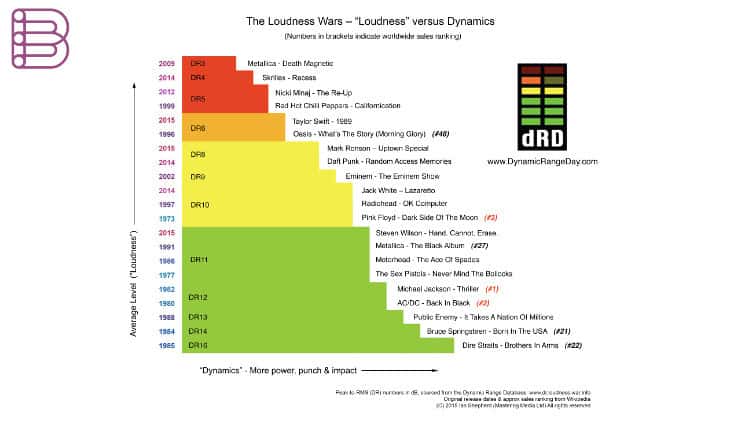
Data compression — what happens with an mp3 — simply reduces the amount of data used to describe a signal. At 128 kbit/s it can sound acceptable, if not aggressive; at 192 kbit/s, Lyngdorf says it’s genuinely fine for a car, just not for a serious home system. Dynamic range compression is a different matter entirely: it reduces the gap between a recording’s loudest and quietest moments, pushing the average level up. That’s been the basis of the decades-long “loudness war” between record labels competing to sound louder than each other on the radio.

How the loudness war breaks rhythm
The mechanism, Lyngdorf explains, isn’t simply lifting everything up — it’s stretching sound in the time domain. Take a kick drum’s low-frequency thump at 40 Hz: making that 13 dB louder means literally 20 times louder, which isn’t possible from a single hit already near maximum level. So instead of one clean strike, the engineering trick becomes stacking 20 cycles back to back — turning a sharp “bang” into a smeared “blow” of sustained energy. Rhythm and punch disappear as a direct result. A compressed human voice can still sound reasonable, Lyngdorf notes, but drums and percussion lose their kick, their definition, their sense of space — and the quiet moments between notes, which he considers just as much a part of music as the notes themselves, vanish under a wall of constant loudness.

A 150-year-old lesson from the piano
Lyngdorf points to musical history for the underlying principle: when the Steinway grand piano broke through around 150 years ago, it displaced the harpsichord almost overnight, because a harpsichord’s plucked strings produce the same volume no matter how hard the keys are struck — it simply has no dynamic range. Listenable for five or ten minutes, unbearable after half an hour. The story goes that the Paris music school, hit by a particularly cold winter not long after the Steinway’s arrival, burned its harpsichords for warmth rather than keep listening to them. Dynamic range, in other words, is where the emotion in music actually lives — the same reason Lyngdorf calls music the most emotional art form he knows.

A shift toward loudness normalization
Lyngdorf sees change coming: streaming services including Spotify and Tidal, along with many European radio stations and now US broadcasters, are adopting loudness normalization, which removes the competitive advantage of compressing a track to sound louder than the next one. He expects the wider music industry — which he calls one of the most conservative he knows, for all its reliance on technology — to take perhaps another decade to fully accept that compression no longer buys anything except worse sound. There’s already plenty of well-recorded jazz, classical and pop to prove the point; Lyngdorf cites his own work with Mark Knopfler, an artist he says is genuinely committed to preserving dynamic range in his recordings.
Visit the Steinway Lyngdorf website.
Frequently asked questions
What’s the difference between data compression and dynamic range compression?
Data compression (like mp3) reduces the amount of data describing a signal. Dynamic range compression reduces the gap between loud and quiet passages, pushing the average loudness up — this is the kind Lyngdorf says damages music.
Why does dynamic range compression hurt rhythm?
Making low frequencies louder without more headroom means stretching them in time — turning a sharp kick drum hit into a smeared, sustained sound, which destroys punch and timing.
What does the harpsichord have to do with dynamic range?
It’s Peter Lyngdorf’s historical example: the harpsichord produces the same volume regardless of touch, and its lack of dynamic range is why it was displaced almost overnight once the Steinway grand piano arrived.
Is the industry moving away from compressed, loud mastering?
Yes — loudness normalization on streaming platforms like Spotify and Tidal, and on many radio stations, is removing the incentive to compress tracks for extra loudness.