

It’s an easy assumption to make: every speaker calibration system uses a microphone, every one of them measures sound in the room, so surely they’re all doing roughly the same thing. According to Roland Hoffmann, Director Product Marketing at Steinway Lyngdorf, RoomPerfect starts from a fundamentally different place than most AVR calibration systems — and that difference shows up in the result.
Where most AVR calibration systems come from
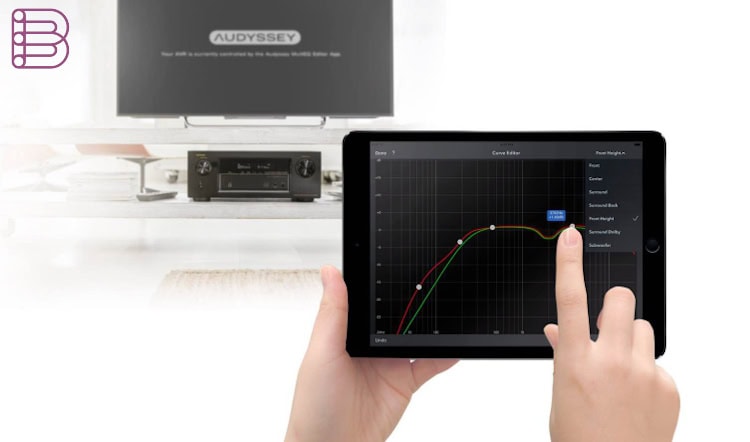
Most AV receiver calibration routines, in Hoffmann’s account, are rooted in an approach that dates back to the 1990s: a typical layout of large front speakers, a medium-sized centre channel and smaller surrounds, each positioned at different distances from the listening seat — one three metres away, another two metres, another just one. The job of that kind of calibration is essentially alignment: matching volume level, frequency response and distance compensation across speakers of different sizes sitting at different distances, so the system behaves as one coherent whole rather than a set of mismatched boxes.
Why RoomPerfect starts from room acoustics instead
Steinway Lyngdorf and Lyngdorf Audio’s background is different: the company started with digital amplifiers and room acoustics, not with AVR-style speaker alignment. That background means the engineering behind RoomPerfect is built around understanding how sound actually behaves in a room — how it bounces off walls, ceiling and floor, and how human hearing perceives that behaviour — rather than simply aligning speaker outputs to each other.
In practice, that means RoomPerfect’s microphone and DSP aren’t just correcting speaker-to-speaker mismatches. They’re capturing and addressing the room’s actual acoustic energy — the standing waves, reflections and resonances that shape what you actually hear, on top of whatever the speakers themselves are doing. Rather than only fixing what’s easy to measure — level, distance, basic frequency response — RoomPerfect is addressing the room acoustic problems underneath those symptoms, which is why Hoffmann frames the result as a genuinely different level of correction rather than a more thorough version of the same thing. For how that room-wide approach plays out in practice, see our Tech Talk on how RoomPerfect maps a room in 3D.
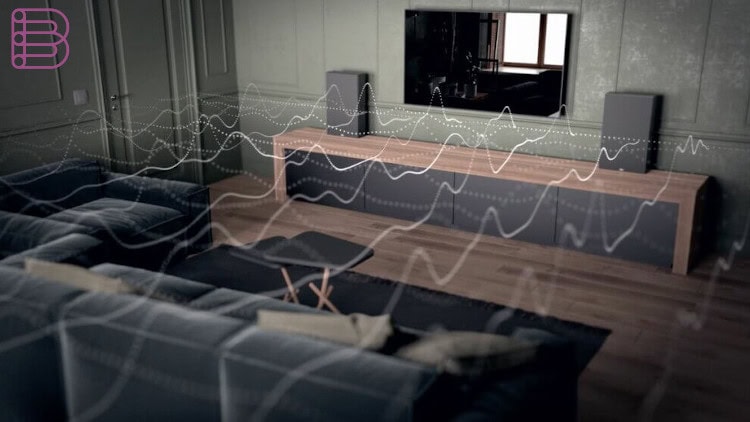
It is worth being precise about what gets replaced and what does not. Ordinary speaker calibration — matching level, frequency response and timing across speakers of different sizes and distances — still matters, and RoomPerfect performs that part of the job too. What changes is everything built on top of it: instead of treating speaker calibration as the finish line, RoomPerfect treats it as a starting assumption, then goes on to measure and correct for what the room itself is doing to the sound. That is the practical difference Hoffmann keeps coming back to — not a rejection of speaker calibration, but an extra, room-focused layer most AVR routines never get to.
Frequently asked questions
Isn’t all automated speaker calibration basically the same?
Not according to Hoffmann. Most AVR calibration systems focus on aligning speaker level, frequency response and distance — a legacy approach from mismatched speaker layouts of the 1990s. RoomPerfect instead starts from room acoustics: understanding and correcting how sound actually behaves in the specific room.
What does “speaker calibration” typically correct?
Primarily differences between speakers of different sizes and distances from the listening position — matching their volume level, frequency response and timing so they behave consistently as a set.
What does RoomPerfect add beyond that?
An understanding of the room’s own acoustic behaviour — reflections, standing waves and resonances from the walls, floor and ceiling — captured through microphone measurement and addressed with DSP, on top of any speaker-to-speaker alignment.
Why does Lyngdorf’s background matter here?
Steinway Lyngdorf and Lyngdorf Audio’s engineering originated in digital amplification and room acoustics specifically, rather than general AVR calibration — a starting point Hoffmann credits for RoomPerfect’s different approach.