

In this walkthrough of auto-calibrating Genelec high-end systems, Marcel Schechter introduces the hi-fi side of Genelec’s line-up — all built around the company’s smart active monitoring technology, aimed at optimising the listening experience at home.
High Fidelity explained
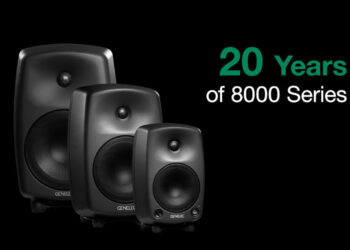
Schechter starts from the term itself: high fidelity means reproducing audio as faithfully as possible to the original, without adding anything of the system’s own character. It’s an approach Genelec has built its reputation on for more than 40 years in professional audio, valued by sound engineers, mixing and mastering engineers, producers and artists who need their work to translate reliably — from the studio to a wide range of playback systems and rooms, including a listener’s home. The same Smart Active loudspeakers and woofer systems used to create those professional productions are, in Schechter’s view, exactly what makes it possible to recreate that listening experience at home.

The Ones and smart active monitoring technology
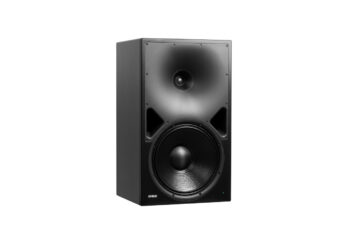
The Ones series is Genelec’s point-source design: a coaxial driver with the tweeter centred in the midrange driver, with no gap between them to introduce coloration, and two oval bass drivers positioned behind the cabinet to reduce modulation of the higher frequencies. The die-cast aluminium enclosures are built to be stable and resonance-free. The series spans four sizes — the compact 8331 (45 Hz / 104 dB), the 8341 (38 Hz / 110 dB), the 8351B (32 Hz / 113 dB) and the largest, the 8361 (30 Hz / 118 dB) — with larger models suited to larger rooms or greater listening distances.

What distinguishes The Ones for home use, according to Schechter, is a wide, coloration-free listening zone: the sound character stays consistent even when moving around the room, and room reflections stay uncoloured thanks to controlled off-axis performance — a direct answer to the over-pronounced bass frequencies that can otherwise mask detail and clarity in a room.

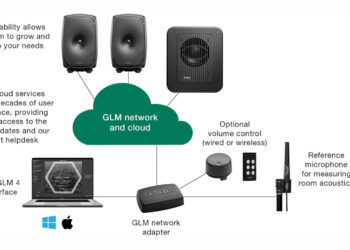
That room-matching happens through the same smart active monitoring technology covered elsewhere, using the Genelec Loudspeaker Manager kit — a USB network adapter, measuring microphone and software connected via standard CAT cabling in a simple daisy-chain. Each speaker and subwoofer is measured at the listening position, and the internal DSP compensates for the room and placement automatically — a process Schechter calls AutoCal. The result is a neutral starting point that can still be adjusted afterwards: more warmth or bass without losing precision, natural and open vocals, a grand piano’s real character, tighter drums and bass, all while keeping a stable stereo image with precise phantom sources and depth. Because of the point-source design, The Ones can also be used horizontally — a practical option for a centre channel.

Genelec W371 adaptive woofer system
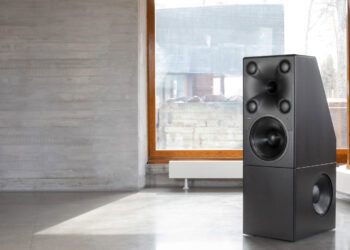
For the three largest models in The Ones range — the 8341, 8351B and 8361 — the W371 adaptive woofer system extends the low end down to 23 Hz. It combines a 14-inch closed-design woofer on the front with a 12-inch bass-reflex woofer on the lower back, and by using two woofers at different physical positions, it can improve the bass range further than a single traditional subwoofer would in a room with challenging acoustics. Different operating modes — selectable through GLM — let the system prioritise directivity or decide automatically which driver handles which frequency range, achieving a bass linearity normally associated with flush-mounted speakers while keeping the flexibility of a free-standing system. Offloading the lowest bass range from the main speakers also frees up headroom and resolution for the rest of the signal.

Genelec 6040R
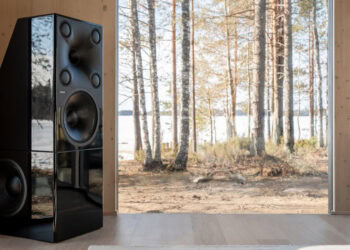
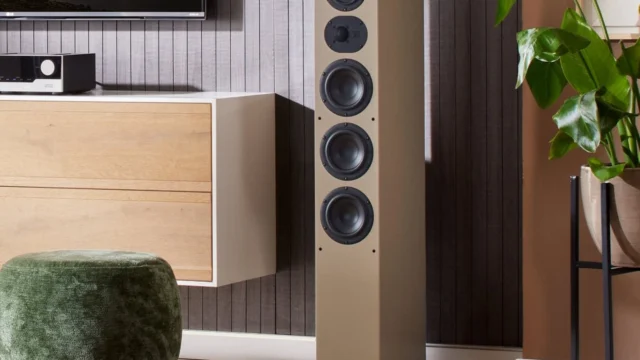
The 6040R is a floor-standing two-way speaker built around the Minimum Diffraction Enclosure design originally created by Finnish industrial designer Harri Koskinen for the 6040A, 20 years ago — rounded edges that avoid diffraction, paired with Genelec’s waveguide for controlled, coloration-free directivity and stable stereo imaging. Two decades on, the 6040R adds Genelec’s current key technologies: analogue and digital inputs, DSP-based room and placement adaptation, and Class-D amplifiers capable of 109 dB SPL at 1 metre while keeping power consumption low, with a configurable stand-by mode. The enclosure uses recycled aluminium, and the Iisalmi, Finland factory runs entirely on renewable fuels.
On its own, the 6040R is a closed design that plays down to 43 Hz; adding a Genelec F Two subwoofer extends that to 27 Hz, with an optical input from a TV or streamer connecting directly to the sub, which handles everything below 85 Hz and high-pass filters the signal sent to the speakers. SAM-family subwoofers are also compatible, bringing the same room-adaptive benefits to the bass range, and two subwoofers can be added for true stereo bass extension. The 6040R is available in grey, black, white, black with white grilles, and white with black grilles.

More information about The Ones.
Visit the Genelec website.
Frequently asked questions
What is AutoCal and how does it work?
AutoCal is the measurement-and-correction process behind Genelec’s smart active monitoring technology: the GLM kit measures every speaker and subwoofer at the listening position, and the internal DSP compensates for the room and placement automatically.
How many models are in The Ones series, and what’s the difference?
Four — the 8331, 8341, 8351B and 8361 — with larger models reaching lower bass extension and higher maximum SPL, from 45 Hz / 104 dB up to 30 Hz / 118 dB.
What does the W371 woofer system add to The Ones?
It extends bass down to 23 Hz using two woofers at different physical positions, and is compatible with the 8341, 8351B and 8361.
What colour options are available for the Genelec 6040R?
Grey, black, white, black with white grilles, and white with black grilles.