

Yes, in many real rooms it’s possible to localise the subwoofer, even though the textbook answer is that humans can’t localise very low frequencies — somewhere around 60 to 80 Hz, the ability to tell where a sound is coming from falls away, at least on paper, in a laboratory. In an actual room, according to Roland Hoffmann, Director Product Marketing at Steinway Lyngdorf, that theory holds up far less well than it sounds like it should.
Why a lab measurement doesn’t match a living room
A single subwoofer placed somewhere in the room doesn’t just radiate a pure, isolated low-frequency tone the way a laboratory test might imply. It interacts with the room around it — there is no sharp, brick-wall filter cutting the signal off cleanly at the crossover frequency, so the subwoofer produces some higher-frequency overtones alongside the intended bass. Those overtones are exactly the kind of information a listener’s hearing can localise, even at a volume where the fundamental bass itself would be undetectable as directional.
Hoffmann describes a simple way to hear this for yourself: set the crossover at 80 Hz, switch off every front, centre and surround speaker so that only the LFE channel through the subwoofer is playing, and listen with your eyes closed. In his account, most listeners can point to where the subwoofer is sitting — not because they’re localising 80 Hz bass itself, but because of what that bass is doing once it meets the walls, floor and ceiling of a real room.
What this means for how you localise the subwoofer
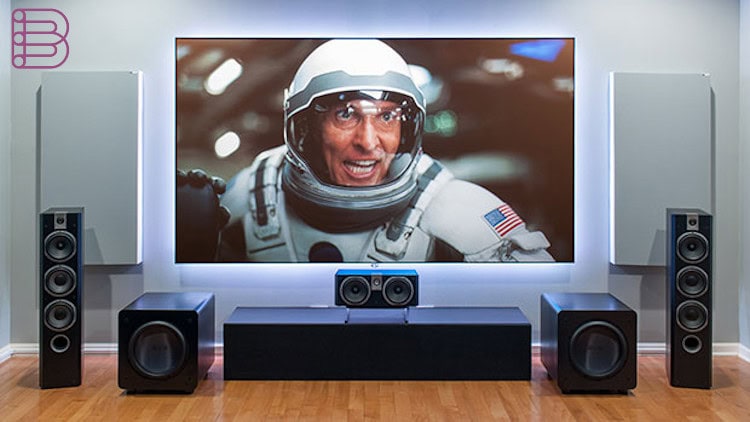
This is part of why Lyngdorf Audio and Steinway Lyngdorf systems often favour two subwoofers over one. Splitting the same low-frequency content across two positions, rather than concentrating it — and its room-generated overtones — at a single spot, helps it integrate more convincingly with the front speakers instead of announcing itself as a separate box in the corner. A genuine stereo or 0.2 configuration, where left- and right-originating bass stays separated rather than folded into one mono feed, extends the same idea further — covered in our Tech Talk on why using two or more subwoofers is not all marketing.
In practice, that’s why so many listeners struggle to localise the subwoofer even when they try. Room reflections scatter the direct sound before it reaches the listening position, and two subwoofers make it harder still to localise the subwoofer precisely, because two overlapping wavefronts blur any single point source. Roland Hoffmann notes that this is a feature, not a flaw, of the approach to bass management: a system engineered so listeners can’t easily localise the subwoofer means placement can be chosen for room performance rather than for hiding a speaker.
Frequently asked questions
If humans can’t localise low frequencies, why can I hear where my subwoofer is?
Because a real subwoofer in a real room doesn’t produce a perfectly isolated low frequency. It interacts with nearby surfaces and generates audible overtones above the crossover point, and those higher-frequency artefacts are what your hearing is actually localising.
At what frequency does localisation ability drop off, in theory?
Roughly 60 to 80 Hz in controlled laboratory conditions — though as this Tech Talk covers, that figure doesn’t translate directly to how a subwoofer behaves once it’s placed in an actual room.
Does having two subwoofers help with localisation?
It’s one of the reasons Lyngdorf Audio and Steinway Lyngdorf often recommend two subwoofers — spreading the bass load across two positions rather than one location’s worth of room interaction and overtones.
Can I test whether my own subwoofer is localisable?
Yes — set the crossover to around 80 Hz, mute every other speaker so only the LFE channel plays through the subwoofer, and listen with your eyes closed. Most listeners can point to it.