Konstantinos Pilios founded Pilium roughly 11 years ago and, in that relatively short time, has propelled his massive amplifiers into the sphere of highly respected manufacturers—although his obsession with size and detail is naturally reflected in their luxurious price tags. Today, this Athens-based company represents a benchmark of Greek high-end—and not only Greek. The portfolio is divided into two lines: Divine and Master Divine. The latter, the higher tier, includes the Olympus preamplifier and the second-from-the-top Kratos monoblocks.



It is impossible not to notice that Pilios is something of a Greek-Macedonian patriot, naming his products after ancient legends. Beyond Olympus and Kratos, the lineup includes Atlas, Cronus, Zeus, Ares, Alexander, Hercules, Poseidon, Achilles, Iasonas, Leonidas—even Elektra. The full mythology, essentially.
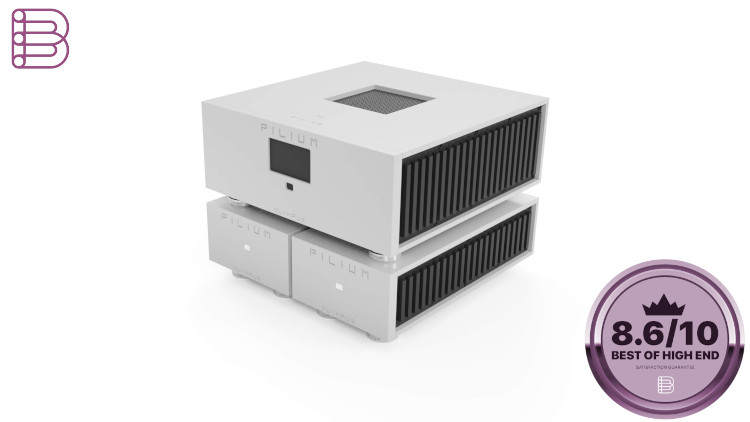
Pilium Olympus
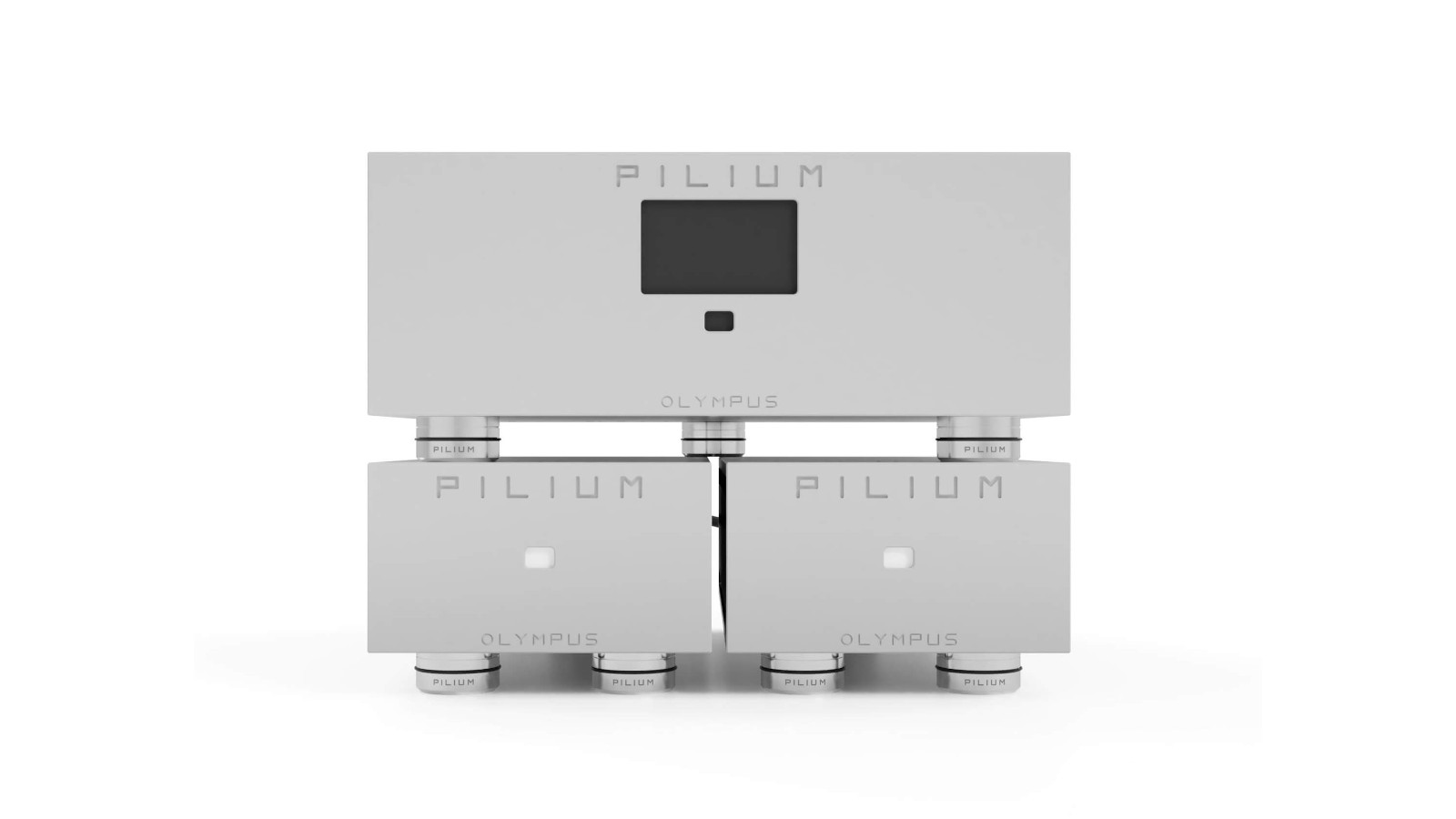
The Olympus is the only preamplifier in the upper Master Divine series. Its visual identity is uncompromisingly modern and consistent with all other Pilium models. Sharply cut, thick aluminum profiles, deeply milled engravings, sides shaped into bold yet orderly heatsinks, ventilation cutouts on the top panel—all assembled with absolute cleanliness and clarity, without visible screws. For the considerable investment required, you unquestionably receive precision manufacturing quality.
The preamplifier is divided into three independent, massive chassis: two dedicated to power supply duties and one handling the signal. There are virtually no physical controls—only a modest display showing essential operating information. Standard commands can be issued via remote control or directly through the touchscreen section of the display.
The rear panel reveals three balanced inputs and two unbalanced ones, along with two regulated XLR outputs. Connectivity is puristically analog and appropriately comprehensive. Everything is neatly divided into left and right channel sections, with four power interfaces in between, using color-coded powerCON connectors to prevent incorrect connection.
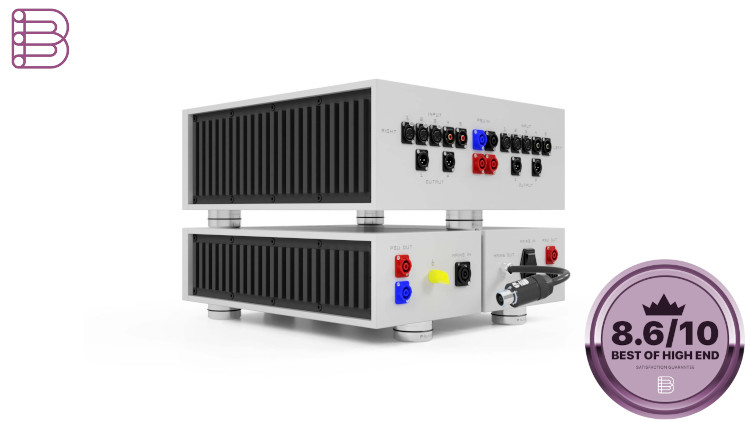
Even the power supply units follow logical symmetry. Interestingly, the mains input socket is located on only one of them; energy is transferred to the second via a short, permanently integrated cable. The “secondary” unit also features a wing nut serving as a grounding point.
Pilios describes the preamplifier as the junction point between source and power amplifier, its role being impedance matching at the input and volume control at the output. The topology is referred to as quad mono, with true balance and ultimate channel separation. Volume control is genuinely minimalist—at any time, only a single resistor is present in the signal path.
The power supplies utilize custom transformers with an unspecified “special” core, further shielded and mounted on anti-vibration beds to isolate them from the chassis. That is essentially all the technical detail provided, aside from general statements about top-grade components and cost-no-object materials—which at this level is to be expected.
Voltage gain is 8 dB. Input impedance is 60 kΩ (XLR) and 30 kΩ (RCA), output impedance just 10 ohms. Frequency response spans 0.1 Hz to 500,000 Hz (-3 dB), with THD+N below 0.0172% at 1 kHz and a signal-to-noise ratio of 119 dB or more.
The main unit measures 48 cm wide, 49 cm deep, and 21.2 cm high, weighing a formidable 52 kg. Each power supply chassis measures 23.5 x 49 x 16.2 cm (W x D x H) and weighs 19.5 kg.
Pilium Kratos
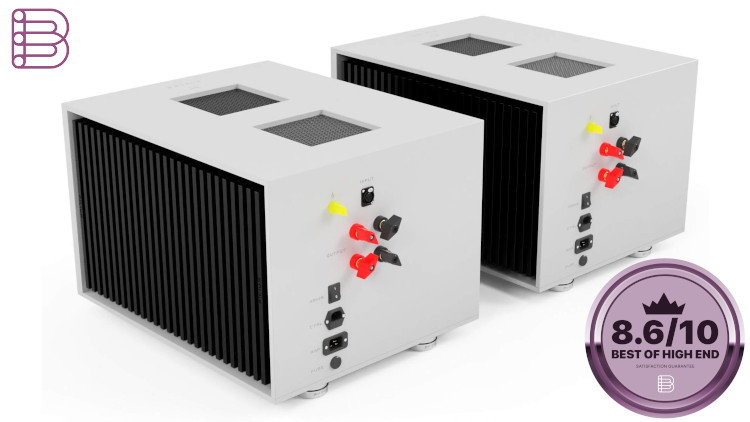
The name Kratos belongs to the second-highest monoblocks in Pilium’s lineup. If the Olympus is large and imposing, the Kratos are truly gargantuan. Clearly designed by the same hand, they share the same sharp, clean aesthetic. Status light, engraved lettering—and little else. Only the massive side heatsinks, reminiscent of a domestic radiator, interrupt the otherwise smooth surfaces. Ventilation grilles are naturally present on the top panel.
On the rear, even the substantial connectors appear almost discreet given the vast real estate. Power is delivered via two cables: the main analog circuits draw current through a 16A connector, while the control circuitry (microprocessor monitoring temperature, DC offset, limiting, etc.) uses a standard 10A interface, completely separated. Both are governed by a large rocker switch.
Signal reaches the speakers through two sets of heavy-duty binding posts capable of securing even the most substantial cables. A single XLR input handles signal entry. A grounding terminal completes the layout.
Pilium remains discreet about internal topology—Rolls-Royce-like in that regard. They mention two encapsulated 1.5 kVA transformers, again mechanically isolated from the chassis. The power supply is further reinforced by a custom-made 480,000 µF supercapacitor. Output is provided by 18 pairs of power transistors.
The result is 400 W into 8 ohms, 800 W into 4 ohms, and 1,600 W into 2 ohms—while reportedly remaining stable even down to 0.5 ohm loads. Frequency response extends from 0.1 Hz to 125,000 Hz (-3 dB). Signal-to-noise ratio reaches an excellent 133.2 dB. THD+N at 50 W / 1 kHz is just 0.00260%, and output impedance remains below 0.1 ohm.
Dimensions are 48 cm wide, 60.5 cm deep, and 41.2 cm high. Weight? An astonishing 154 kg each.
Listening
Listening took place in the importer’s showroom, in distinguished company. The constant reference was YG Acoustics Sonja 3.3 loudspeakers. The primary source was the WADAX Atlantis Reference, supplemented by a Kuzma turntable with DS Audio optical cartridge and matching equalizer. Cabling was Stage III Concepts, with Paul Pang switches and Telos Power Station Master Tai Chi Edition filtering and grounding units. For comparison, we had the familiar Ypsilon combination—PST 100 MK2, Aelius II, and Hyperion.

Ypsilon electronics carry tube charm and richer color. Beautiful high-end in its own right, charming enough that one rarely feels the urge to search further. Yet next to the Pilium set, it felt cautious—almost modest. This is no criticism of Ypsilon; rather, it reflects respect for Olympus and Kratos.
Various combinations were attempted—Olympus with Ypsilon power amps, Ypsilon preamp with Kratos monoblocks. In every case, any configuration involving Pilium proved cleaner, more concrete, clearer, and more robust than the pure Ypsilon pairing—and indeed more so than any combination previously heard at Dream Audio.
The rapid attack of pulsating bass in James Blake’s “Limit to Your Love” (2011 | ATLAS | 00602527857671) is a favorite piece of material that companies use at exhibitions to show off the authority and control their systems have over bass. Well… There’s nothing to fault with the Olympus / Kratos duo (or rather trio). This is the benchmark for reliability and stability, simply a powerhouse with instant power delivery that is not affected by any volume, any impedance variation, or any amount of energy that needs to be supplied. It’s just there. The pulses are precise, as is customary with Pilium, but compared to previous listening experiences we’ve had with lower models, there is a looseness here, not just dry information. The mass of rich low octaves comes across as completely effortless, perfectly defined, with enormous power, yet still maintaining a clean, neutral, unemotional balance that does not overshadow other information. If Pilium has any character, it is a combination of purity and reserve, fitting this set into the realm of the ultimate in hi-fi precision. It is pointless to evaluate the tension, physicality, authority… Yes, everything is there, everything is good, or rather, everything is exactly as the signal source serves it up.

Leonard Cohen’s “Hallelujah” – with a little exaggeration – wasn’t that popular until a few years after its creation, when various other artists began to cover it, including Jeff Buckley (“Grace” | 1994 | SONY | 886447700778), who chose an intimate form with a few raw touches. Olympus and Kratos ensure superb transparency, a feeling of extraordinary naturalness and, especially in combination with the ultimate WADAX Atlantis Reference, that “something,” that spirit, which ensures that you almost don’t realize you’re not in the recording studio with the performer. It is not aggression, arrogance of power, or any other pushy expression; on the contrary, it is the suppression of all influencing factors and parameters to such an extent that only the recording remains, shaped by the style of the player. It is so clean and controlled that even a sharp strike on the strings, which usually sounds quite harsh, is here abrupt, crisp, but vividly authentic, and therefore not unpleasant, because there is no distortion.
“You Look Good To Me” performed by the Oscar Peterson Trio (“We Get Requests” | 2005 | recorded in 1964 | Verve | 00602498840429) is a wonderful recording of chamber classical jazz, embodying the charm of “the old days.” The delicate sounds of the drummer’s fleeting touches on the cymbals have a long reverberation – clearer, not more piercing, but just right, resonant, clean, faithfully metallic, yet remaining legible and distinct until they naturally fade away, despite the presence of other elements in the recording. This is what defines top-of-the-line high-end, the effortless and “normal” presence of everything in the recording – at the right moment, at the right volume, it’s just there. The tonality remains very “down to earth,” unpolished, freely airy. The amplifiers may have powerful performance and huge bodies, but what is essential is the lively, clean, and precise signal control, immediacy, and realistic focus.

If the massive construction, weight, and power of the electronics are noticeable somewhere, it is in the dynamics. The closed YG is not afraid of variable impedance with very low positions, yet they are no problem for Kratos (with the support of Olympus). In “The Four Horseman” by Aphrodite’s Child (“666” | recorded in 1971 | Universal | 00042283843028), a youthful Greek project led by Vangelis, the dynamics are perfectly confident. You perceive absolute stability, where you feel the variability of the flowing energy at the acoustic pressure of a whisper, but also at concert level, where the listening room is almost bursting at the seams, but the speakers themselves remain tame and clean and the signal completely under control. It is a massive force with a firmly set bit, the amplifiers keep any surge fantastically non-violent – it just happens, just as the energy of a loud live concert with fabulous sound surrounds you, you have the same feeling here. Kratos (plus Olympus) are a truly inexhaustible reservoir that even the most complex moment can lean on and not fall short.
However, it is not just about power; Pilium also benefits from stability and neutrality, as well as a sense of overall clarity. At his peak, Michael Jackson was a pop genius and bursting with ideas, much like Prince – this can be heard clearly in “Remember the Time” (“Dangerous” | 2009 | recorded in 1991 | SONY | 884977307832), a driving track where you don’t even realize how many sounds make it up until you start to focus on it. With the Master Divine series from Pilium, it’s a breeze, because even though the presentation is beautifully clear and fantastically solid, it also feels luxuriously relaxed, like a yoga master after half a century of meditation high in the mountains. Although the electronics maintain the neutral balance and absence of coloration that we have experienced before, the resolution is even better on the one hand, the discipline is absolute, so everything holds together in a phenomenally defined way, but nothing is emphasized. Everything is as it should be – fullness, weight, power, speed, control, clarity, light and long reverberations, easily separated individual sounds and notes…
„Short Ride in a Fast Machine“ (John Adams | Michael Tilson Thomas / San Francisco Symphony Orchestra | „Harmonielehre“ | 2012 | SFS Media | SFS0053) is a somewhat atypical orchestral work from the mid-1980s, falling into the category of modern classics. In this recording, it seems as if the reproduction is actually lying on the stage in front of you, slightly above, with the instruments arranged in a completely clear manner, but above all with absolute freedom. Air, breath, freedom, space… All of this stems from that undistorted stability, allowing all attributes other than its own to stand out – you perceive the recording, you perceive the character of the source, the style of the speakers, and Pilium serves as a solid control point with truly uncompromising certainty.
But you can also listen to mainstream rock such as “Rosanna” by Toto (“Toto IV” | 1982 | SONY | 074643772822) with complete peace of mind, because when using Olympus / Kratos, everything is in its place, at the right time, with adequate power and unwavering confidence. Here we are at the level of perfect listening, it flows beautifully, it is completely relaxed, and whatever you want is there. The music is completely mastered, lively, and captivating. There is nothing to discuss…
Playlist Used
https://tidal.com/playlist/547729f6-a43e-4359-841d-c93fe612888e
Pilium Olympus Preamp + Kratos Mono Power Amp
€68.000 + €144.000The Olympus preamplifier and Kratos monoblocks prove that massive overengineering and meticulous execution—without exotic gimmicks—are more than sufficient. First-class components do exactly what they should, without interfering, allowing music to flow freely and authentically. If one word defines this system, it is stability. From that stems unlimited dynamics, crystal-clear resolution, tonal neutrality, and absolute confidence in every moment, regardless of system or recording complexity. Yes, this is extraordinarily—almost absurdly—expensive. But as in every field, the very best commands a premium. Olympus and Kratos undoubtedly belong among the very best.
Pros
- first-rate, virtually indestructible build quality
- Pilium neutrality, yet more relaxed than previous models
- absolute stability regardless of volume or musical complexity
- impact, explosiveness, and authority beyond even large YG speakers
- speed, focus, and rock-solid concreteness
Cons
- price accessible only to the select or the deeply committed enthusiast