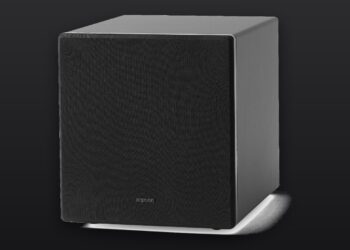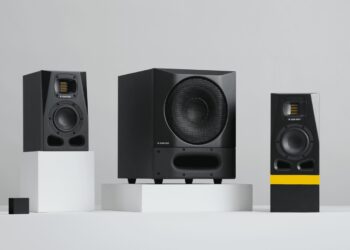


A small subwoofer looks like it should be able to handle “the bass” — after all, that’s its one job. In practice, whether it actually can depends entirely on where the crossover point is set, as Roland Hoffmann, Director Product Marketing at Steinway Lyngdorf, explains: a subwoofer is rarely just reproducing the dedicated LFE channel, and that mismatch is where small subwoofers run into trouble.
The LFE channel is not the only bass a subwoofer plays
Film and game soundtracks can carry bass down to 20 Hz on every channel, not just the LFE track — the LFE channel is an additional, separate signal, not a container for all of a system’s low frequencies. Once a crossover point is set, say around 80 Hz, the subwoofer ends up reproducing the dedicated LFE content plus all the bass redirected from the front, centre and surround speakers below that crossover. That combined load is considerably more demanding than the LFE channel on its own, and it is where a small subwoofer’s headroom runs out fastest.
A subwoofer’s own frequency response compounds the problem. Many subwoofers have what Hoffmann describes as a “church-like” response — a peak around 80 Hz that tapers off both above and below it — so they are not equally capable across the full range they are now being asked to cover, on top of already carrying more than just the LFE signal.

Why undersizing the other speakers makes it worse
The other side of the equation is the front and surround speakers. Undersizing them pushes even more bass down to the subwoofer, widening the gap between what the main speakers comfortably reproduce and where the subwoofer has to pick up the load. According to Hoffmann, this is part of why Lyngdorf Audio and Steinway Lyngdorf build their own subwoofers as high-bandwidth woofers rather than narrow-range boxes — designed to stay comfortably within their operating range even when crossed over as high as 100 or 200 Hz, rather than being pushed to their limit right at the point where they are handed the most demanding, combined signal.
Frequently asked questions
Why can’t a small subwoofer just handle the LFE channel and be done with it?
Because in most systems it isn’t only reproducing the LFE channel. Bass redirected from the front, centre and surround speakers below the crossover point is added on top, which is a considerably larger load than the LFE signal alone.
What is a “church-like” frequency response in a subwoofer?
A response that peaks around 80 Hz and rolls off both above and below it, rather than staying flat across the full range it may be asked to cover once other channels’ bass is redirected to it.
Does the size of the front and surround speakers affect subwoofer performance?
Yes. Undersized front or surround speakers redirect more of their own bass to the subwoofer, adding to its load — one of the reasons it matters to make the other speakers as wide-band as the system budget allows.
Is adding a second subwoofer a way to fix this?
It’s one option, and a common next step once a single small subwoofer is overloaded — covered in our Tech Talk on upgrading bass performance from one subwoofer.